Delivery Driver Safety: The Complete 2026 Guide
By Joe SnyderThe complete guide to delivery driver safety—defensive driving, fatigue and distraction, vehicle upkeep, safety tech, and a safety-first culture.

The complete guide to delivery driver safety—defensive driving, fatigue and distraction, vehicle upkeep, safety tech, and a safety-first culture.
For a delivery business, your drivers are both your most valuable asset and your most exposed one. Every shift puts them on roads where a single lapse — a glance at a phone, a missed rest break, a worn tire — can end in a collision that hurts someone and disrupts your whole operation. The encouraging news is that most crashes are preventable. U.S. traffic deaths fell to an estimated 36,640 in 2025, a 6.7% drop from 2024, and the leading contributors — speeding, impairment, distraction, and not buckling up — are exactly the behaviours a good safety program can change.
This guide pulls together the practices that matter most for delivery teams: building a training program, defeating distraction, driving defensively, managing fatigue, keeping vehicles road-ready, using technology wisely, staying safe overnight, and creating a culture where safety comes first. Treat it as a foundation you can fold into your wider last-mile delivery best practices.

Driver safety is not just a compliance checkbox — it is a business strategy. Safe drivers mean fewer injuries, lower insurance and repair costs, less downtime, and more reliable deliveries, all of which protect your reputation and your bottom line. When the people behind the wheel feel supported and well-trained, they make better decisions and represent your brand more professionally.
The risks are real but largely controllable. Federal data consistently points to the same handful of behaviors behind serious crashes, and each one responds to training, policy, and the right tools. The sections below tackle them one at a time, so you can build a program that covers the whole picture rather than reacting to incidents after they happen.

Comprehensive training is the foundation of everything else. A solid program should cover defensive driving techniques, hazard recognition, safe vehicle handling, adverse-weather strategies, and proper lifting and carrying to prevent injuries during drop-offs. New hires need it, but so do veterans — refresher courses keep good habits sharp and introduce new protocols.
One useful framework is the SPIDER model, which breaks safe driving into a sequence of mental tasks: Scan for potential hazards, Predict where they might come from, Identify the real risks, Decide how to respond, Execute that response, and Reflect once it is safe to do so. When a driver looks away from the road, every step in that chain breaks down — which is precisely why distraction is so dangerous.
For structured, recognized instruction, the National Safety Council offers defensive driving courses that can lower crash risk and, in many cases, reduce insurance premiums. Pairing formal coursework with regular in-house coaching gives drivers both the theory and the day-to-day reinforcement they need. It also helps to define what makes a good delivery driver so expectations are clear from day one.
Distraction is one of the deadliest habits on the road. In 2024, 3,208 people were killed in crashes involving distracted drivers, and sending or reading a single text takes a driver's eyes off the road for about five seconds — at 55 mph, that is like covering the length of a football field blindfolded.
Share a few concrete habits with your team to keep their attention where it belongs:
Route software helps here too. When drivers have clear, optimized navigation, they no longer need to call or text dispatch for directions, which removes one of the most common reasons to reach for a phone.
Defensive driving means assuming other road users may make mistakes and staying ready to react. It rests on three basics: keep space around your vehicle, maintain visibility by checking mirrors and staying out of blind spots, and use clear communication through turn signals.
A few habits turn those principles into instinct:

Three behaviours account for an outsized share of fatal crashes, and all three are entirely avoidable.
Impairment. About 30% of U.S. traffic deaths involve an alcohol-impaired driver; in 2024, 11,904 people died in drunk-driving crashes — roughly one life every 44 minutes. Remind drivers that even over-the-counter medications can slow reaction time, and make a zero-tolerance impairment policy non-negotiable.
Speeding. Speed reduces reaction time and makes every crash more severe. It was a factor in 29% of all traffic fatalities in 2024, claiming 11,288 lives. Arriving a few minutes late always beats not arriving at all, so balance routes and schedules so no driver feels pressure to rush.
Seatbelts. The simplest habit of all is also one of the most effective: lap and shoulder belts reduce the risk of fatal injury to front-seat car occupants by 45% (and by about 60% for light-truck occupants). Make buckling up mandatory on every trip, no matter how short.
Tired driving is dangerously easy to underestimate. A study by the AAA Foundation for Traffic Safety estimates that drowsy drivers were involved in 17.6% of all fatal crashes between 2017 and 2021 — far more than official police-reported counts capture. Fatigue dulls judgment and reaction time in much the same way alcohol does.
Managing it is a shared responsibility between drivers and managers:

Even the most careful driver is at risk in a poorly maintained vehicle. A preventative maintenance routine catches small problems before they become roadside emergencies. Build a checklist that covers:
Keep detailed records of every inspection and repair. Documentation makes it easy to spot recurring issues, prove compliance during audits, and hold the whole team accountable. Just as important, give drivers a simple, no-blame way to report a problem the moment they notice it.
The right tools turn safety from a hope into a measurable system. Telematics, cameras, and GPS give you visibility into how vehicles are actually being driven and let you coach before a near-miss becomes a crash. In studies by the Virginia Tech Transportation Institute, event-based video paired with driver coaching was associated with roughly 20% fewer fatal crashes and 35% fewer injury crashes.
A few technologies are worth prioritizing:

Night and early-morning deliveries carry extra risk: reduced visibility, more fatigue, and greater security concerns. The fundamentals still apply, with a few additions. Plan routes in advance to avoid poorly lit or higher-crime areas, and lean on a reliable driving route app so drivers are never improvising directions in the dark. Keep cash on hand to a minimum, favour cashless transactions, and make sure every vehicle is locked during drop-offs.
Above all, prioritize rest before an overnight shift and build in breaks, since fatigue peaks in the small hours. Pre-trip vehicle checks matter even more at night, when a breakdown can strand a driver in an isolated spot. Equip drivers with emergency contacts and a clear protocol so help is one call away.
Policies only stick when the culture supports them. Safety has to be modeled from the top and reinforced often enough that it becomes second nature rather than a poster on the wall.
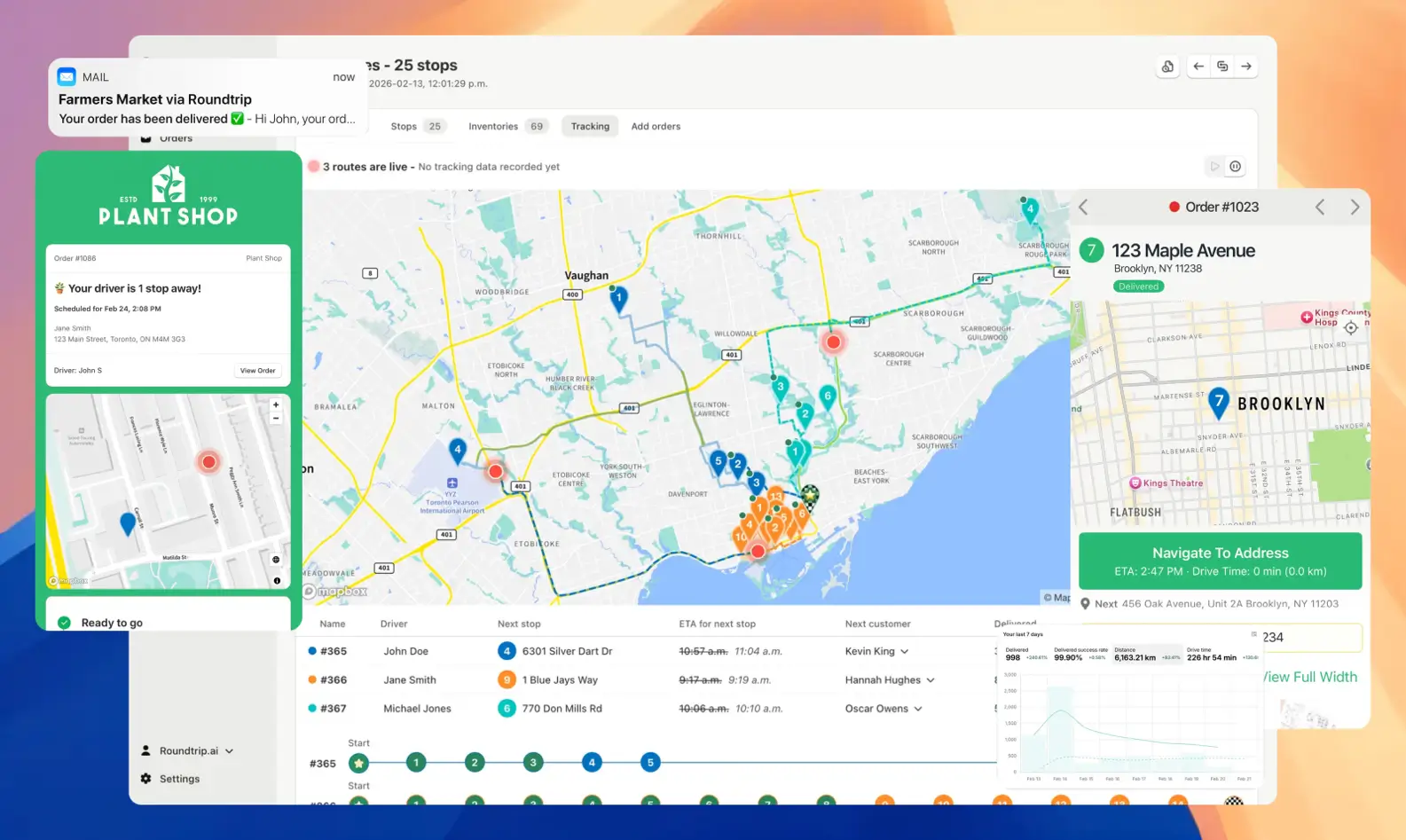
Many of the practices above are easier to sustain with the right delivery software. EasyRoutes, a local delivery route planner that integrates directly with Shopify, helps delivery teams build safety into everyday operations:
Keeping delivery drivers safe is a layered effort — training, defensive habits, fatigue management, maintenance, technology, and a genuine culture of care all work together. None of it is complicated, but it does take consistency. Put these practices in place and you protect your drivers, lower your costs, and build a more dependable operation. To see how smarter routing can support every one of these goals, explore the EasyRoutes website and start building safer deliveries today.
Yes. Add scheduled driver breaks to new or existing route, and EasyRoutes will insert a break stop while updating downstream ETAs and total route time.
See: Driver Breaks
Yes. Enable Real‑Time Tracking in Settings → Driver settings (Premium/Enterprise subscription plans) to view live driver location and progress in the Tracking tab of any route.
See: Real‑Time Tracking
Yes. Delivery Analytics reports completion rates, average delivery times, and success rates; filter by driver or date and export to CSV.
See: Analytics
EasyRoutes is the AI-native delivery operations platform trusted by 5,000+ businesses across 75+ countries. Plan routes in seconds, dispatch drivers automatically, and delight your customers — from Shopify or any order source. Experience delivery operations that run themselves. Rated 4.9 stars and certified Built for Shopify.
⭐⭐⭐⭐⭐ 4.9 stars • Trusted by 5,000+ Businesses