A comprehensive guide to the best food delivery apps in 2026, the trends reshaping the industry, strategies to improve delivery operations, and why self-managed delivery with EasyRoutes might be the smartest move for your food business.
Food delivery has become a permanent fixture of the restaurant and food business landscape. The global online food delivery market surpassed $110 billion in revenue in 2024 and continues to grow at a CAGR of roughly 7.6%, on track to reach $2 trillion by 2030. In the U.S. alone, the market generated $353 billion in 2024, with over 65% of Americans expected to use food delivery platforms.
For restaurant owners and food businesses, the question is no longer whether to offer delivery — it's how. This guide covers the major food delivery platforms and what they offer, the trends reshaping the industry in 2026, proven strategies for improving your delivery operations, and why an increasing number of businesses are choosing to manage delivery themselves rather than relying exclusively on third-party apps.
Table of Contents
The Top Food Delivery Apps in 2026
What to Look for When Choosing a Platform
Key Trends Shaping Food Delivery in 2026
Strategies to Improve Your Food Delivery Operations
Why Self-Managed Delivery Might Be the Smarter Play
Conclusion
The Top Food Delivery Apps in 2026
The U.S. food delivery market is dominated by a handful of major platforms, each with distinct strengths and tradeoffs. Here's how the landscape looks in 2026:
DoorDash
DoorDash is the undisputed market leader, commanding approximately 56–67% of U.S. food delivery market share depending on the data source. It serves over 310,000 restaurants across 4,000+ cities and has expanded well beyond restaurant food into grocery, alcohol, and convenience delivery. DoorDash achieved $10.7 billion in revenue in 2024 and reported its first annual profit. Its DashPass subscription ($9.99/month) offers reduced delivery fees and is a major driver of customer retention. DoorDash also owns Caviar, which focuses on premium dining delivery.
Best for: Broad market reach and high order volume. Watch out for: Commission rates of 15–30% can significantly impact restaurant margins.
Uber Eats
Uber Eats holds approximately 23–25% of U.S. market share and is the most popular food delivery app globally, with 88 million users internationally. It leverages Uber's existing driver network and technology infrastructure for refined logistics and real-time tracking. Its Uber One subscription (46 million subscribers) bundles delivery discounts with ride benefits, creating strong cross-platform loyalty.
Best for: Businesses wanting international reach and data-driven operations. Watch out for: Service and delivery fees cut into both restaurant and driver earnings.
Grubhub
Grubhub (which also operates Seamless) holds roughly 16% of U.S. market share and partners with over 200,000 restaurants across 4,000+ cities. Now owned by Wonder Group, Grubhub has a notable partnership with Amazon, offering exclusive deals to Prime members — a significant distribution advantage. Its pricing structure is relatively straightforward compared to competitors.
Best for: Restaurants in major metro areas, especially the Northeast. Watch out for: Market share has been declining steadily, and driver satisfaction reviews are mixed.
Instacart
Instacart has evolved from a pure grocery delivery platform into a broader food and essentials service. It connects customers with local grocery stores and retailers, offering both delivery and pickup options. Instacart is particularly strong for businesses selling perishable goods, pantry staples, and household items alongside prepared food.
Best for: Grocery-adjacent food businesses and prepared meal sellers. Watch out for: Delivery fees are higher than some competitors, and the tip structure is unfavourable for drivers.
Gopuff
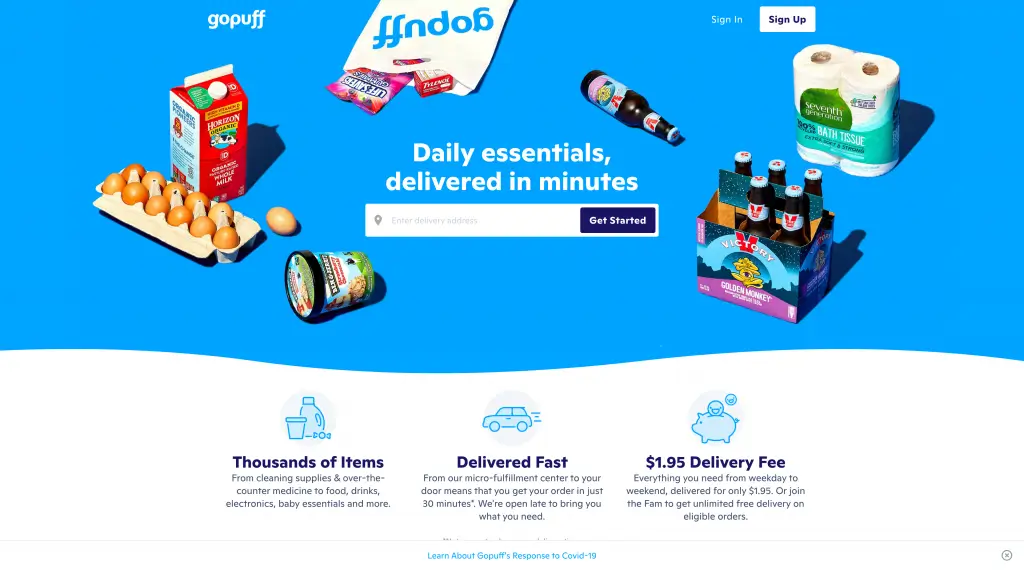
Gopuff takes a different approach — it operates its own micro-fulfillment centers rather than partnering with restaurants, delivering snacks, drinks, groceries, and convenience items in under 30 minutes for a flat $1.95 delivery fee. It's available in over 500 U.S. locations and is rapidly expanding.
Best for: Convenience and impulse purchases. Watch out for: No restaurant meal delivery; inventory is limited to what Gopuff stocks in its own warehouses.
Skip The Dishes
Skip The Dishes is the leading food delivery platform in Canada, partnering with major chains (McDonald's, Subway, KFC) and independent restaurants alike. It provides its own courier network, handling pickup and delivery without requiring restaurants to maintain their own drivers.
Best for: Canadian restaurants wanting broad consumer reach. Watch out for: Service fees reduce restaurant profit margins, and reliability can vary by region.
What to Look for When Choosing a Platform
Before committing to a platform, evaluate these factors against your specific business needs:
Commission structure: Third-party platforms typically charge 15–30% per order. On a $30 meal, that's $4.50–$9.00 going to the platform before any other costs. For businesses operating on already-thin food service margins, this can be the difference between profitability and loss on delivery orders.
Customer ownership: When a customer orders through DoorDash or Uber Eats, the platform owns that customer relationship. You often don't get their email address, can't market to them directly, and have limited control over the delivery experience. If the driver is late or the food arrives cold, the customer blames your restaurant — not the app.
Delivery quality and tracking: Look for platforms that provide real-time order tracking and delivery notifications. Customers overwhelmingly prefer businesses that offer tracking capabilities, and visibility reduces "where's my order?" support inquiries.
Menu and pricing control: Some platforms restrict your ability to set your own prices or require menu markups to cover commission costs. Understand the degree of control you'll retain over pricing, promotions, and menu presentation.
Market presence in your area: The best platform for your business is the one with the strongest presence in your local market. DoorDash may dominate nationally, but in specific cities or neighbourhoods, Uber Eats or a regional player might have more active users.
Key Trends Shaping Food Delivery in 2026
The food delivery industry is evolving rapidly. Understanding these trends helps you position your business ahead of the curve:
Ghost kitchens and delivery-only operations
Delivery-only kitchens — facilities with no dine-in component, built exclusively for fulfilling delivery orders — continue to expand. They dramatically reduce overhead (no front-of-house staff, no dining room real estate) and allow businesses to focus entirely on food quality and delivery efficiency. Brands like Donovan's Dish to Door have built successful operations around this model, streamlining everything from kitchen workflow to last-mile delivery.
Hyperlocal and same-day delivery
Consumers increasingly expect near-immediate delivery, and hyperlocal models — serving a tight geographic area from a nearby kitchen or hub — are becoming the fastest-growing segment. Businesses like Uproot Food Collective have adopted hyperlocal delivery to ensure maximum freshness and speed, connecting directly with nearby customers rather than trying to serve an entire metro area.
Sustainable packaging and eco-friendly delivery
Single-use plastics are being replaced by biodegradable, recyclable, and reusable materials across the industry. Research indicates that nearly two-thirds of consumers are more likely to choose businesses that demonstrate sustainable practices. Companies like Crisper Meal Kits have built sustainability into their brand identity with zero-waste packaging — and it's become a genuine competitive advantage, not just a marketing angle.
AI-powered logistics and route optimization
Artificial intelligence is transforming delivery operations — from predicting demand and optimizing driver schedules to dynamically adjusting routes based on real-time traffic. AI route optimization can reduce fuel costs by up to 20% and significantly improve delivery speed, both of which directly impact the freshness and quality of food when it arrives at the customer's door.
Subscription and loyalty models
Subscription-based meal services and loyalty programs are becoming standard retention tools. Regular delivery customers who subscribe generate predictable revenue and are significantly less likely to churn than one-time orderers. Businesses like fit-flavors use weekly meal subscriptions to create consistent demand and streamline their delivery operations around predictable order volumes.
Health, wellness, and dietary personalization
Consumers increasingly seek food delivery options aligned with specific health goals — keto, high-protein, low-sodium, plant-based, allergen-free. Businesses that offer clearly labeled, diet-specific menus attract a growing segment of health-conscious customers. The Real Good Life has built its entire model around nutritious, customizable meal kits that cater to diverse dietary preferences.
Takeout cocktails and alcohol delivery
Relaxed alcohol delivery regulations that began during the pandemic have largely remained in place. Cocktail kits, wine pairings, and alcohol add-ons are now a meaningful revenue stream for many food businesses — with alcohol typically carrying 20–30% of a restaurant's total sales margin.
Strategies to Improve Your Food Delivery Operations
Whether you use third-party platforms, manage delivery yourself, or do both, these strategies will improve your operations:
Optimize your delivery routes. Poorly planned routes lead to late deliveries, cold food, and wasted fuel. Route optimization software analyzes traffic, delivery windows, and stop sequences to produce the most efficient routes possible. Businesses using optimized routing typically see 15–20% reductions in delivery time and meaningful improvements in food quality on arrival.
Implement real-time tracking and notifications. Customers want to know exactly where their food is. Real-time tracking with automated notifications reduces "where's my order?" inquiries dramatically — EasyRoutes customer Bloomen reduced WISMO calls by nearly 80% after implementing tracking and notifications.
Ensure quality control during transit. Invest in proper packaging that maintains temperature and prevents spills. Train drivers on handling protocols for different food types. The best route in the world means nothing if the food arrives damaged or cold.
Personalize the delivery experience. A handwritten thank-you note, branded packaging, or a small surprise (a complimentary cookie, a discount code for next time) transforms a routine delivery into a memorable brand interaction. Businesses that personalize their delivery touchpoints see measurably higher repeat order rates.
Set transparent delivery expectations. Use historical delivery data to provide accurate delivery windows. If delays occur, communicate proactively. Research consistently shows that customers are far more tolerant of delays when they're informed in advance than when they're left wondering.
Collect and act on feedback. A brief post-delivery survey or a follow-up email asking about the delivery experience gives you the data to continuously improve. Happy customers leave positive reviews that attract new business; unhappy customers who feel heard often become your most loyal advocates.
Why Self-Managed Delivery Might Be the Smarter Play
Third-party delivery platforms offer convenience and access to a large customer base, but they come with significant tradeoffs that more food businesses are recognizing in 2026:
Commission costs erode your margins. At 15–30% per order, third-party commissions can eliminate profitability on delivery orders entirely. For a business doing $10,000/month in delivery sales through a platform at 25% commission, that's $2,500/month — $30,000 per year — going to someone else for delivering your food.
You lose the customer relationship. When a customer orders through DoorDash, they're DoorDash's customer — not yours. You can't email them, can't offer them loyalty rewards, can't invite them to try a new menu item. The platform owns the data, the relationship, and the reordering behavior.
You can't control the delivery experience. A rude driver, a late delivery, or a bag tossed on the porch damages your brand — but you have no control over the person representing you. With self-managed delivery, every driver is your driver, trained to your standards, delivering your brand experience.
Self-managed delivery is more accessible than ever. Tools like EasyRoutes have made professional-grade delivery management available to any Shopify-based food business. Orders are pulled in automatically from your store, routes are optimized with AI, drivers receive their assignments via the driver app, customers get real-time tracking and delivery notifications, and every delivery is documented with proof of delivery. You get everything the big platforms offer — without giving up 25% of your revenue or your customer relationships.
Businesses like Sweet E's Bake Shop and Wonky Box have seen the difference firsthand. By managing their own delivery with EasyRoutes, they maintain full control over quality, timing, and the customer experience — while keeping margins that would otherwise disappear into platform fees.
The most successful food businesses in 2026 aren't choosing exclusively between third-party platforms and self-managed delivery — they're using platforms strategically for discovery and new customer acquisition while building their own delivery channel for retention, repeat orders, and profitability. Think of DoorDash as your billboard and EasyRoutes as your profit centre.
Conclusion
The food delivery landscape in 2026 is more competitive, more innovative, and more demanding than ever. Third-party platforms like DoorDash and Uber Eats provide massive reach but at a steep cost to your margins and customer relationships. Industry trends — from ghost kitchens and hyperlocal delivery to AI logistics and sustainability — are creating new opportunities for businesses willing to adapt.
For food businesses ready to take control of their delivery operations, the tools are now available to compete at any scale. Own your delivery, own your customers, and keep your margins.
Ready to take delivery into your own hands? EasyRoutes gives your food business AI-optimized routes, real-time customer tracking, proof of delivery, and a professional driver app — all within a single, integrated platform. Start your free trial today and see what delivery looks like when you're in control.
About EasyRoutes
EasyRoutes is the AI-native delivery operations platform trusted by 5,000+ businesses across 75+ countries. Plan routes in seconds, dispatch drivers automatically, and delight your customers — from Shopify or any order source. Experience delivery operations that run themselves. Rated 4.8 stars and certified Built for Shopify.