10 Proven Ways to Grow Your Delivery Revenue
By Joe SnyderTen proven ways for delivery businesses to grow revenue in 2026: smarter pricing, customer service, retention, email marketing and route optimization.

Ten proven ways for delivery businesses to grow revenue in 2026: smarter pricing, customer service, retention, email marketing and route optimization.
Every delivery business owner shares the same goal: grow the operation and increase revenue. No matter how many customers you serve or how dense your distribution network is, your bottom line is what separates a thriving company from a struggling one. Customers don’t think about your margins — they want efficiency, transparency, and reliability at a fair price, and that expectation now extends well beyond how your staff treat them or how much they trust your product.
Any management textbook will tell you that the fastest, most effective way for a small business to lift sales revenue is to improve service quality and pricing. Earning more by delivering the right service at the right price is far more efficient than endlessly chasing new customers. As last-mile delivery has grown more competitive, the most successful operators have shifted their sales strategies away from pure expansion and toward activities that protect margin and compound profit. That’s why smart owners obsess over the top line and the bottom line at the same time.
Here are ten proven ways to grow your delivery revenue this year.

When owners look to grow revenue, they usually fixate on selling more or spending less — and overlook the single most powerful lever they have. In McKinsey’s widely cited analysis of the Global 1200, a 1% improvement in price drove an 11% improvement in operating profit — more than triple the impact of a 1% gain in sales volume and well ahead of cutting variable or fixed costs. The reason it works is that a price increase flows almost entirely to the bottom line with no added cost attached.
That doesn’t mean raising every rate overnight. Start by segmenting your services: a same-day or time-window delivery is worth more than a standard drop, and pricing should reflect that. Test a modest increase on a single tier, watch volume and churn for a billing cycle, and adjust. Customers will accept a higher price when they understand exactly what they’re paying for and what level of service comes with it, so pair any change with a clear articulation of the value — speed, reliability, tracking, and proof of delivery — that justifies it.
Cross-selling and up-selling services that complement what you already offer is one of the quickest ways to lift revenue per customer — try bundling a discounted block of pickups or recurring deliveries to win commitment. Revenue you keep is just as valuable as revenue you earn, so attack the cost side with equal focus. Applying lean principles to remove process waste protects margin on every order, whether that’s eliminating duplicate data entry, batching nearby stops, or filling vehicles closer to capacity before they roll.
One of the biggest variable costs in delivery is fuel, and it compounds with every unnecessary mile. Tightening your operation with smarter scheduling, denser routes, and proven strategies for cutting fuel costs frees up cash you can reinvest in growth. Small per-order efficiencies are easy to dismiss, but across hundreds of deliveries a month they add up to a meaningful swing in profitability.

Poor service damages your reputation and, ultimately, your revenue. A single bad experience can trigger a scathing review that quietly erodes retention and lead generation for months. Research from Qualtrics and ServiceNow found that 80% of consumers have switched brands because of poor customer experience, with U.S. companies risking $1.9 trillion in spending every year as a result.
Because winning a new customer costs far more than keeping an existing one, every interaction should be engineered to leave customers more loyal than before. In delivery, service quality is mostly operational: did the order arrive in the promised window, did the customer know where it was, and was the handoff clean and documented? Treat each delivery as a service moment — punctual, communicative, and dependable — and study what separates an ordinary handoff from a great delivery experience. Get those fundamentals right and customer service stops being a cost center and becomes a reason people choose you over a cheaper competitor.
Your company’s online reputation is now inseparable from its revenue. Most customers vet a delivery business through reviews and ratings before they ever place an order, so claiming your listings, monitoring what’s said about you, and responding to feedback all pay off. Resolve complaints publicly and promptly — a thoughtful reply to a negative review often reassures future buyers more than a wall of five-star ratings does.
Reputation isn’t only about damage control, either; it’s an extension of how you present your delivery business brand. A consistent, trustworthy brand voice across reviews, social channels, and your website turns first-time buyers into repeat ones and gives word of mouth something memorable to latch onto. The businesses that win locally are usually the ones customers can describe in a single confident sentence.

There are dozens of social platforms, but not all of them suit your business. Identify the one or two networks where your customers actually spend time and commit to them rather than spreading yourself thin across all of them. For a local delivery operation, that often means showing the work: behind-the-scenes routes, driver spotlights, service-area announcements, and quick responses to questions in the comments.
Social media is increasingly where customers discover local services, read peer recommendations, and judge how responsive a business is. An exceptional experience there compounds — people who get a fast, helpful reply are measurably more likely to buy again, stay loyal, and recommend you over a competitor. Treat every public interaction as a small advertisement for how you do business, because that’s exactly how prospective customers read it.
Customers reward companies that clearly understand their needs and meet them at a fair price. Modern delivery management software lets your team analyze order history and delivery patterns so you can anticipate demand, recommend the right add-ons, and personalize service. Which customers order on a predictable cadence? Which neighbourhoods cluster well enough to support a tighter delivery window? The answers are sitting in your own data.
Used well, that data becomes the basis for up-selling — offering a faster window, a recurring slot, or a premium handling option — in a way that feels helpful rather than pushy. When you reach out with an offer that genuinely fits a customer’s pattern, it lands as good service rather than a sales pitch, and customers feel valued enough to stick around and spend more.

A modern, responsive website remains essential for attracting and converting new customers. Check that your site loads quickly and looks right across a range of mobile devices, since the majority of prospective customers will find you on a phone — often while comparing you against a competitor in the next tab. Slow pages and clumsy mobile layouts quietly cost you orders you never see.
The job of your website is to inform visitors clearly enough that they can decide to use your service with confidence: what you deliver, where, how fast, and at what price. A fast, mobile-first, genuinely useful site with obvious calls to action is one of the most cost-effective marketing assets you own, and unlike paid ads it keeps working long after you build it.
Customers rarely refer you unless you ask. The most reliable way to earn referrals is to deliver high-quality service at a fair price, then simply let your existing customers know you’re looking to grow. The economics make this a priority: acquiring a new customer can cost five to twenty-five times more than retaining an existing one, and lifting retention by just 5% can boost profits by 25% to 95%.
A satisfied customer who refers a friend hands you a warm lead at almost no acquisition cost — so ask for the referral at the moment satisfaction is highest, like just after a flawless delivery, and consider a small incentive for both sides. Remember to thank customers who send business your way; a little recognition turns a one-time referrer into an ongoing advocate. If you want a deeper playbook, our guide to customer retention for delivery businesses goes further.
Email remains one of the highest-return channels available to a delivery business. Industry data puts average email marketing returns at roughly $36 to $42 for every $1 spent, climbing to about $45 for retail and e-commerce senders. Few other channels come close, and unlike social reach, your email list is an asset you own outright.
For owners who use it thoughtfully and ethically, email is remarkably versatile — it nurtures engagement, recovers abandoned orders, announces new service areas, and supports almost any marketing or strategic goal you set. The leverage comes from segmentation: a reminder to lapsed customers, a thank-you to your most loyal ones, and a delivery-day update each serve a different purpose. Pair a clean subscriber list with a few well-timed, relevant campaigns and the channel quickly pays for itself many times over.
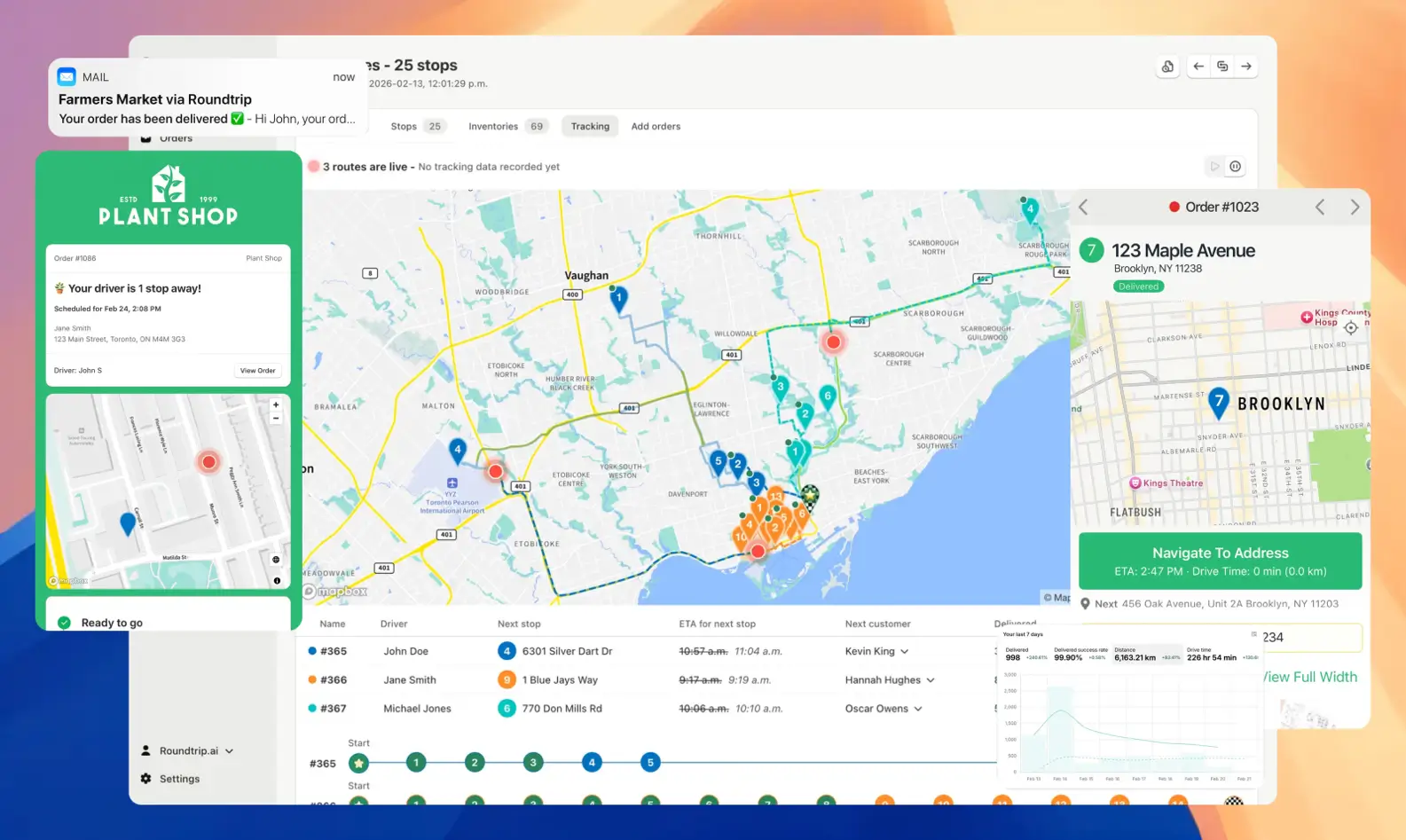
Between guaranteeing on-time deliveries and handling the back-end paperwork, there’s barely enough time to supervise drivers and juggle schedule changes — which is exactly why delivery companies lean on route optimization software. The stakes are high: last-mile delivery now accounts for roughly 53% of total shipping costs, up from 41% in 2018, making it the single largest logistics expense for most brands.
Optimized routing attacks that cost directly — AI-powered systems can cut fuel costs by 15% to 25% through shorter routes, less idling, and traffic-aware sequencing. EasyRoutes is a powerful route optimizer that builds precise, efficient multi-stop routes in seconds, balancing stops across drivers and respecting vehicle capacity so no run is overloaded. Just as importantly, it improves the customer experience with automated ETAs, SMS and email notifications, live tracking links, and proof of delivery — the exact signals that reduce support calls and build the trust that earns repeat orders. And because reliability drives repeat business, the same tooling reinforces why on-time delivery matters to your margins.
The profitability of your delivery business comes down to cutting costs while growing sales. Your best bets are building efficient systems and focusing your sales energy on the customers you already have, then layering in up-selling and cross-selling to segment and expand that base. None of these ten moves is dramatic on its own, but stacked together and applied consistently they widen both your revenue streams and your profit margins over time.
Try EasyRoutes free for 14 days — install it from the Shopify App Store or create an account on our standalone web app today.
Yes. EasyRoutes Premium and Enterprise plans support branded SMS notifications with usage‑based pricing per message segment. Configure templates and funding in Settings.
ETAs use route distance, stop service times, and historical traffic, and they update during the day as drivers progress. Accuracy improves when addresses and time windows are clean.
Yes. Enable Real‑Time Tracking in Settings → Driver settings (Premium/Enterprise subscription plans) to view live driver location and progress in the Tracking tab of any route.
See: Real‑Time Tracking
Yes. Enable Delivery Ratings so customers can leave star ratings and optional comments on the tracking page after delivery. Export results or review per driver from their profile pages.
See: Delivery Ratings
EasyRoutes supports delivery photos, e‑signature, driver notes, and automatic timestamps (with GPS location when available) to provide a complete delivery record.
See: Proof of Delivery
Yes — if enabled. Planners can allow drivers to manually reorder stops and or re‑optimize remaining stops mid‑route.
Absolutely. Plan with item and weight limits to reflect the capacities of your fleet. Configure and assign Vehicle Profiles for an additional indicator for routes that have specific restrictions by vehicle.
EasyRoutes is the AI-native delivery operations platform trusted by 5,000+ businesses across 75+ countries. Plan routes in seconds, dispatch drivers automatically, and delight your customers — from Shopify or any order source. Experience delivery operations that run themselves. Rated 4.9 stars and certified Built for Shopify.
⭐⭐⭐⭐⭐ 4.9 stars • Trusted by 5,000+ Businesses