How to Optimize Delivery Routes and Cut Costs
By Joe SnyderA practical guide to delivery route optimization: where bad routes leak money, how to cut last-mile costs step by step, and how to choose the right tools.

A practical guide to delivery route optimization: where bad routes leak money, how to cut last-mile costs step by step, and how to choose the right tools.
Most delivery businesses obsess over the price of a vehicle, the cost of a driver, or the rate a carrier charges — and quietly ignore the single biggest variable they actually control: the route. The last leg of a delivery has become the most expensive part of the whole journey. Industry research now puts last-mile delivery at between 41% and 53% of total shipping costs, up from roughly 41% in 2018. When that much of your spend rides on the final mile, an inefficient route isn’t a minor annoyance — it’s a margin leak that compounds every single day.
This guide is the practical, money-focused companion to our overview of what route optimization is and how AI powers it. Rather than rehash the theory, we’ll focus on the operations side: where badly planned routes bleed cash, where your delivery budget really goes, and a step-by-step way to tighten both — without an enterprise budget.

The damage done by poor routing rarely shows up as a single line item, which is exactly why it goes unmanaged for so long. It hides inside fuel bills, overtime, missed delivery windows, and frustrated customers who never order again. Put a number on it, though, and the picture sharpens fast. For a 50-vehicle last-mile operation, the avoidable inefficiency from the absence of route optimization — breakdowns, failed re-deliveries, excess fuel, and service-level penalties — can total $1.1 million to $1.4 million a year. That is money lost not to a competitor or a bad market, but to disorganized stops.
Failed deliveries are the clearest example. A single missed delivery costs a retailer roughly $17.20 and adds up to around $197,730 a year for a typical operation once you account for the re-attempt, the customer-service handling, and the disruption to the rest of the day. Every one of those failures usually traces back to something a good route would have prevented: an unrealistic stop sequence, no delivery window, or a driver who ran out of daylight. Tightening first-attempt success is one of the highest-return moves in the business, which is why it’s worth treating as its own discipline — see our guide to reducing missed deliveries and reverse-logistics costs.
The long-term cost is even steeper. Companies that fail to optimize the delivery process can see profits decline by as much as 26% over three years as inefficiencies compound and customer expectations keep rising. The takeaway is simple: routing isn’t a back-office chore. It’s a profitability lever.
You can’t cut what you can’t see. Before optimizing anything, it helps to understand the anatomy of a delivery dollar. In a typical last-mile operation, labor alone accounts for roughly half of expenses, with fuel adding another 10–25% and carrier surcharges quietly inflating invoices by 30–40%. Those proportions matter because they tell you where optimization actually bites: every route that removes a redundant mile cuts fuel directly and shortens the paid hours a driver spends behind the wheel. For a deeper teardown of these line items, our breakdown of transportation and delivery costs is a useful companion, as is the dedicated guide to last-mile delivery costs and how to calculate your cost per mile.
Geography swings these numbers more than most operators realize. Urban deliveries average around $10 per package while rural ones can reach $50, simply because of distance and low stop density. That single fact is the whole argument for optimization in one sentence: the more stops you fit per mile driven, the lower your cost per delivery falls.
Fuel deserves special attention in 2026. After two relatively calm years, diesel prices whipsawed upward this spring as supply disruptions around the Strait of Hormuz squeezed global markets, pushing the U.S. on-highway average above $5 per gallon — well over a dollar higher than the prior year. When fuel is volatile, the cheapest gallon is the one you never burn, which makes mileage reduction the most reliable hedge a delivery business has. (For tactics beyond routing, see how to cut gas costs across your delivery business.)

Optimization isn’t a single button — it’s a repeatable workflow. Here is a practical sequence that works whether you run two vans or twenty.
One of the most stubborn myths in last-mile logistics is that serious optimization belongs only to companies with serious budgets. That stopped being true years ago. Cloud-based platforms, pay-as-you-grow pricing, and quick setup have pulled advanced routing within reach of two-person operations, and smaller fleets often see the highest percentage return because inefficiency hits a tight margin harder than a deep-pocketed one.
The math is rarely subtle. With businesses spending around $10 per order on last-mile delivery, shaving even a fraction off each stop scales into real money across a month. Start with free or low-cost route planners to prove the concept, then graduate to a dedicated tool once you feel the ceiling — the signs are unmistakable: routes that take an hour to build, drivers calling in for re-sequencing, and overtime you can’t explain. The goal isn’t the fanciest software; it’s the cheapest mile.

For online retailers, the route doesn’t begin at the warehouse door — it begins the moment an order lands. The operations that win on cost are the ones where orders flow automatically from the store into the routing engine, with no manual export-and-import in between. That integration does two things at once: it removes a data-entry step where errors (and failed deliveries) are born, and it lets you batch orders by geography and delivery window the instant they arrive.
Smart batching is where e-commerce routing earns its keep. Grouping orders by proximity minimizes backtracking and maximizes deliveries per route, which is the same density principle that drives cost down everywhere else. Pair that with accurate, automated customer notifications and you attack the failed-delivery problem from both ends — better sequencing gets the driver there on time, and a heads-up text makes sure someone is home to receive it.
Plenty of tools can draw a line between stops. The ones worth paying for are those that move the cost needle and earn back their subscription many times over. When you evaluate options, weigh them against the cost levers we’ve covered rather than a feature checklist for its own sake:
If you want a structured way to compare vendors, our walkthrough on how to choose the right route planner turns these criteria into the specific questions to ask before you buy.
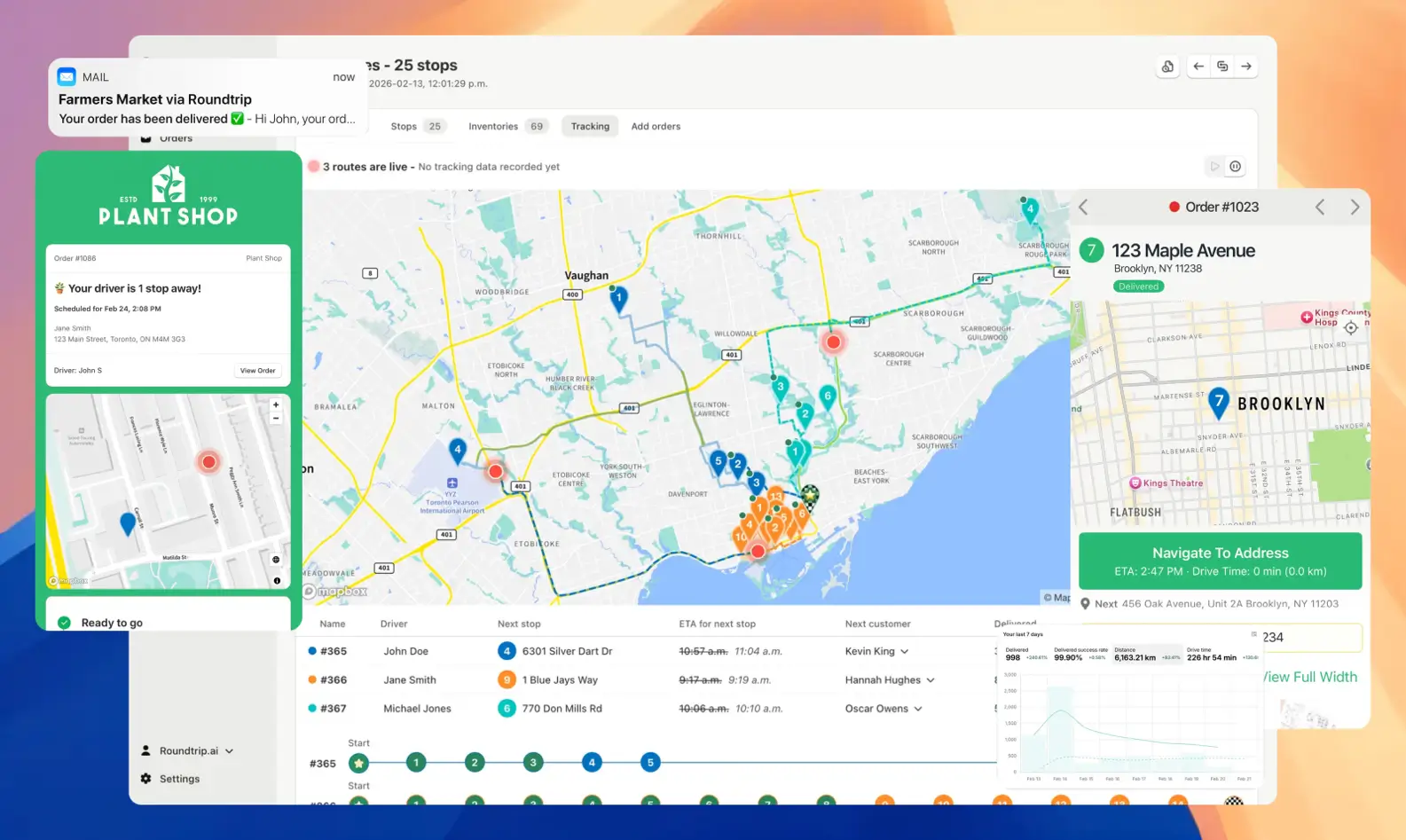
For Shopify merchants and growing delivery operations, EasyRoutes brings every one of those cost levers into a single platform. Orders flow in automatically from your store — no spreadsheets — and routes are optimized in a few clicks around real constraints like vehicle capacity and delivery windows. Drivers get turn-by-turn navigation, proof of delivery, and the ability to re-optimize on the fly from their phones, while customers receive automatic notifications and live tracking that keep first-attempt success high.
Because EasyRoutes scales with you — from a handful of orders to thousands — you don’t pay enterprise prices to run a lean operation, and the analytics show you exactly where your cost per delivery is heading. It’s the practical embodiment of everything above: fewer miles, fewer failed drops, and fewer hours lost to planning.
Route optimization has quietly become one of the most direct ways a delivery business can protect its margin. With the last mile absorbing the majority of shipping costs, fuel prices swinging hard, and a single failed delivery costing nearly twenty dollars, the routes you run are no longer an operational detail — they’re a financial decision you make dozens of times a day.
The good news is that this is one of the few cost problems with an accessible, high-return fix. Clean your data, stop planning by hand, optimize for density, and let software absorb the complexity. Ready to stop paying for wasted miles? EasyRoutes gives you smarter routes, real-time tracking, and automatic customer updates in one integrated platform — start your free trial and see the savings for yourself.
EasyRoutes optimizes deliveries using your selected orders, start & end locations, stop time intervals, time windows, and route limits. You can balance routes, respect capacities, and re‑optimize as plans change.
See: Route Options · EasyRoutes 101
Yes. EasyRoutes supports Vehicle Profiles you can configure and assign to routes. EasyRoutes also supports capacity planning via item or weight limits per route. Use these with other options (like time windows, or custom start/end locations) to keep plans realistic and drivers on schedule.
See: Vehicle Profiles · Max items/weight per route · Commercial/GPX Export
Yes. Enable Balance routes to distribute stops as evenly as possible across multiple routes/drivers while respecting other route constraints (like time windows, or item/weight limits).
See: Balance routes · How many routes?
Yes. Re‑optimize at any time — after adding or removing stops, changing stop priorities, editing route options, or balancing loads. Drivers can also re-optimize routes delivered out of order, or re‑order stops if enabled from your EasyRoutes Settings.
Yes. You can set delivery time windows per stop or import them from supported third‑party date/time apps. EasyRoutes optimizes routes to meet these windows and calculates ETAs accordingly.
Yes. Routes display estimated distance and drive time after optimization, and update automatically when you add/remove stops and re‑optimize.
See: Route Mileage
Yes. Schedule routes for specific dates/times, and ETAs will be calculated for each stop on a route. These ETAs can be shared via customer tracking links and email/SMS delivery notifications.
Yes. EasyRoutes lets you set limits for maximum route duration, maximum stops per route, and maximum items per route. Configure these constraints in Route Options before planning, or when editing a route.
See: Route Options
Yes. Use the customizable Rescheduled notification (email/SMS) to explain delays, provide a new ETA/date, and include the tracking link.
Yes. Assigned drivers receive a push notification when a route is dispatched to them, linking straight into the route in the EasyRoutes Delivery Driver mobile app.
EasyRoutes is the AI-native delivery operations platform trusted by 5,000+ businesses across 75+ countries. Plan routes in seconds, dispatch drivers automatically, and delight your customers — from Shopify or any order source. Experience delivery operations that run themselves. Rated 4.9 stars and certified Built for Shopify.
⭐⭐⭐⭐⭐ 4.9 stars • Trusted by 5,000+ Businesses