Proof of Delivery: The Complete Guide for 2026
By Joe SnyderThe complete guide to proof of delivery (POD) and electronic proof of delivery (ePOD) for delivery businesses in 2026: what it is, types, benefits, best practices, and how to implement it.

The complete guide to proof of delivery (POD) and electronic proof of delivery (ePOD) for delivery businesses in 2026: what it is, types, benefits, best practices, and how to implement it.
Every delivery business eventually faces the same question: how do you prove a package actually arrived? Whether it's a customer claiming they never received an order, a driver disputing a complaint, or an insurance claim that needs documentation, proof of delivery (POD) is the evidence that settles the matter.
In 2026, with e-commerce volumes continuing to grow and customer expectations higher than ever, implementing a reliable proof of delivery system isn't optional — it's a baseline requirement for any business that delivers physical goods. This guide covers everything you need to know: what POD is, the different types available, why electronic proof of delivery (ePOD) has become the standard, how to implement it effectively, and what to look for in the right software.


Proof of delivery is a document or electronic record that confirms a shipment has been delivered to the intended recipient. It serves as verifiable evidence that the delivery occurred as expected — providing accountability for the driver, protection for the business, and assurance for the customer.
POD typically includes details such as the date and time of delivery, the recipient's name or signature, and any relevant notes about the condition of the goods or where they were left. In its simplest form, it might be a signed paper slip. In modern delivery operations, it's more likely a digital record that includes a photo, GPS coordinates, a timestamp, and an electronic signature — all captured in seconds on a mobile device.
Proof of delivery is used across virtually every industry that involves physical delivery, from grocery delivery and meal kits to flower delivery, pet supplies, and medical supplies. Anywhere a package changes hands, POD provides the record that it happened correctly.
o

There are several methods for capturing proof of delivery, each suited to different business needs and customer expectations:
Signature confirmation is one of the oldest and most recognized forms of POD. The recipient signs — either on paper or a digital device — to confirm they've received the package. This method is especially common for high-value or sensitive goods where confirming the specific recipient matters.
Photographic evidence has become increasingly popular, particularly for contactless and doorstep deliveries. The driver takes a photo of the package at the delivery location, providing visual confirmation that it was left in a secure spot. This is now the default approach for many e-commerce and food delivery operations.
GPS and timestamp verification uses the driver's device to automatically record the location coordinates and exact time of delivery. This provides precise, tamper-proof data that confirms the driver was at the correct address at the recorded time — particularly valuable for businesses where timing matters, like perishable goods or time-window deliveries.
Barcode or QR code scanning adds another verification layer by confirming that the specific package (not just the driver) arrived at the correct destination. This is useful for businesses handling high volumes where package mix-ups are a risk.
Delivery notes allow drivers to add context — "left with neighbor," "placed in garage as requested," or "customer not home, left at side door." These notes provide valuable detail that photos and timestamps alone may not capture.
In practice, modern ePOD systems combine multiple methods simultaneously. A single delivery confirmation might include a photo, a GPS stamp, a timestamp, a digital signature, and a driver note — all captured in one quick workflow on the driver's mobile device.

Proof of delivery serves several critical functions for delivery businesses:
Dispute resolution: When a customer claims they didn't receive a package, POD provides the evidence to resolve the issue quickly. Without it, the business is often forced to absorb the cost of a replacement or refund with no recourse. A clear photo, GPS stamp, and timestamp can resolve most disputes in seconds rather than days.
Driver accountability: POD creates a verifiable record for every delivery, encouraging drivers to handle packages responsibly and follow correct procedures. When drivers know their deliveries are documented, accuracy and care improve naturally.
Customer trust and satisfaction: Customers increasingly expect visibility into their deliveries. Research shows that the vast majority of online shoppers consider delivery tracking and confirmation a key component of a satisfactory experience. When customers receive a photo of their package at their door alongside a delivery notification, their confidence in the business grows — and so does their likelihood of ordering again.
Legal protection: In cases involving insurance claims, regulatory compliance, or formal disputes, POD serves as a legal record that the delivery was completed as agreed. This documentation can be critical for businesses handling high-value, regulated, or sensitive goods.
Operational intelligence: POD data feeds into broader delivery analytics. By tracking completion rates, delivery times, photo compliance, and customer feedback, businesses can identify patterns, spot underperforming routes or drivers, and continuously improve their operations.

Electronic proof of delivery (ePOD) is the digital evolution of traditional paper-based POD. Instead of collecting a signature on a paper slip — which is easy to lose, hard to organize, and impossible to search through at scale — ePOD systems capture delivery confirmations digitally through mobile apps and cloud-based platforms.
Here's how it typically works: when a driver completes a delivery, they use an app on their phone or tablet to capture the required proof — a photo, a digital signature, a GPS stamp, or a combination. That data is instantly uploaded to a centralized system, where it's accessible to dispatchers, managers, and customer service teams in real time. Many systems also automatically trigger a delivery confirmation notification to the customer, complete with the photo and timestamp.
The shift from paper to electronic POD has been one of the most impactful operational changes in last-mile delivery over the past several years. Paper POD required drivers to manage physical documents, businesses to file and store them, and anyone resolving a dispute to manually locate the right slip. ePOD eliminates all of that friction, replacing it with an instant, searchable, and shareable digital record.

The advantages of electronic proof of delivery extend across operations, customer experience, and the bottom line:
Reduced delivery disputes and chargebacks: With photographic, GPS, and timestamp evidence for every delivery, the grounds for disputes shrink dramatically. Businesses that implement ePOD consistently report significant reductions in "not received" claims and the costly refunds or replacements that follow.
Improved delivery accuracy: Digital records reduce the errors and ambiguities inherent in manual processes. When every delivery is documented with precise data, mistakes are easier to catch and correct — and less likely to occur in the first place.
Enhanced customer experience: Automated delivery notifications with photos and timestamps give customers immediate confirmation that their order has arrived. This transparency reduces "where's my order?" support inquiries and builds trust. For contactless delivery scenarios — which have become the default for many customers — a delivery photo is often the only confirmation a customer needs.
Operational efficiency: ePOD eliminates paper-based workflows entirely. No more printing delivery slips, collecting them from drivers at the end of shifts, filing them, or searching through boxes of paper to resolve a complaint from three weeks ago. Everything is digital, searchable, and instant.
Better driver performance: When deliveries are documented digitally, driver performance becomes measurable. Completion rates, photo compliance, delivery times, and customer feedback can all be tracked at the individual driver level — enabling data-driven coaching and recognition.
Environmental sustainability: Going paperless with ePOD eliminates the need for printed delivery slips, signature pads, and physical filing systems. It's a small but meaningful contribution to reducing your operation's environmental footprint.

Implementing ePOD is straightforward, but doing it well requires attention to a few key details:
Choose software that fits your workflow. The best ePOD system is one that integrates seamlessly with your existing delivery management and e-commerce platform. For Shopify-based businesses, tools like EasyRoutes offer built-in ePOD capabilities — including photo capture, digital signatures, and delivery notes — directly within the driver app, with no additional setup required.
Train your drivers thoroughly. ePOD is only as good as the data your drivers capture. Make sure every driver understands how to take a clear delivery photo (showing the package and enough context to identify the location), collect a signature when required, and add notes for unusual situations. A five-minute training session prevents weeks of poor data quality.
Set clear standards for photo quality. A blurry, dark, or poorly framed photo defeats the purpose of photographic POD. Establish simple guidelines: the package should be clearly visible, the delivery location identifiable, and the photo taken before the driver leaves the stop.
Communicate the process to customers. Let customers know that they'll receive a delivery confirmation with a photo and timestamp. This sets expectations, reduces anxiety about unattended deliveries, and positions your business as professional and transparent. Many customers come to rely on — and even expect — this level of visibility.
Prioritize data security. ePOD involves collecting personal data — signatures, addresses, photos of homes. Choose a platform with robust data encryption and clear privacy policies. This is especially important for businesses handling deliveries in regions with strict data protection regulations.
Use POD data proactively. Don't just collect ePOD for dispute resolution — analyze it. Track photo compliance rates, identify drivers who consistently miss POD capture, monitor delivery success rates by area, and use the data to improve your overall delivery quality over time.

When evaluating ePOD solutions, these are the features that separate good tools from great ones:
Multiple capture methods: The software should support photos, digital signatures, GPS stamps, timestamps, barcode scanning, and delivery notes — ideally all within a single, streamlined workflow so drivers can complete POD capture in seconds.
Real-time upload and access: POD data should sync instantly to a centralized dashboard, not batch-upload at the end of the day. Real-time access means dispatchers can verify deliveries as they happen and customer service can respond to inquiries immediately.
Integration with your delivery platform: ePOD should be part of your broader delivery management workflow, not a separate tool. Look for solutions that integrate with your route planning, order tracking, and customer notification systems so POD fits naturally into your existing processes.
Automated customer notifications: The best ePOD systems automatically send delivery confirmation to customers — including the photo and timestamp — without requiring any manual action from the driver or dispatcher.
Driver-friendly mobile experience: Drivers capture ePOD dozens of times per shift. The app needs to be fast, intuitive, and reliable — even with inconsistent cellular connectivity. If the process takes more than 15–20 seconds per stop, compliance will suffer.
Scalability: Whatever solution you choose should handle your current volume comfortably and scale as your operation grows. A system that works for 20 deliveries a day should also work for 500 without degradation or additional complexity.
Reporting and analytics: Beyond capture, look for tools that let you analyze POD data — delivery success rates, average time at stop, photo compliance percentages, and dispute resolution metrics. This data drives continuous improvement.

If you're adding ePOD to your delivery operations for the first time — or upgrading from a paper-based system — here's a practical implementation path:
1. Choose your POD methods. Decide which types of proof are appropriate for your business. Most delivery businesses benefit from a combination of photo + GPS + timestamp as the default, with digital signature added for high-value or sensitive deliveries.
2. Select your software. For Shopify merchants, EasyRoutes provides built-in ePOD as part of its delivery management suite — no separate tool or integration needed. Drivers capture photos, signatures, and notes directly in the EasyRoutes driver app, and the data syncs instantly to your dashboard.
3. Train your team. Walk every driver through the POD capture workflow. Show them what a good delivery photo looks like versus a bad one. Explain why POD matters — not just for the business, but for protecting them personally when a customer disputes a delivery.
4. Set up customer communications. Configure automated delivery notifications so customers receive confirmation as soon as their order is marked complete. Include the delivery photo and timestamp. This single step can dramatically reduce support inquiries and build customer loyalty.
5. Monitor and improve. After launch, track your POD compliance rate. Are all drivers consistently capturing proof for every delivery? Are photos meeting your quality standards? Are delivery disputes declining? Use the data to refine your process and recognize drivers who are doing it well.
Businesses like Donovan's Dish to Door have seen firsthand how ePOD strengthens delivery operations. Delivering fresh, chef-prepared meals requires careful handling and precise timing — and proof of delivery gives both the business and its customers confidence that every order arrives intact and on schedule.
Proof of delivery has evolved from a paper signature on a delivery slip to a rich digital record that includes photos, GPS data, timestamps, and electronic signatures — all captured in seconds on a driver's phone. For delivery businesses in 2026, ePOD isn't just a nice-to-have feature. It's a fundamental part of providing professional, trustworthy, and dispute-proof delivery service.
The best part: implementing ePOD doesn't require a massive technology investment or a dedicated IT team. Modern delivery management tools build it right into the driver workflow, making it effortless to capture and automatic to share with customers.
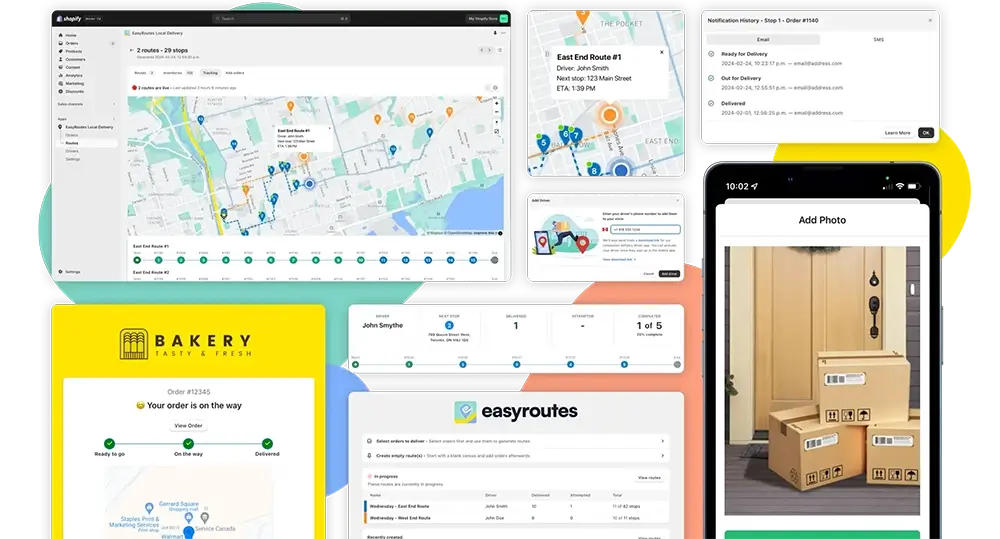
Ready to add proof of delivery to your operations? EasyRoutes includes built-in ePOD — photos, signatures, delivery notes, and automated customer notifications — all integrated with route optimization and real-time tracking. Start your 14-day free trial today.
EasyRoutes is a delivery management and route optimization platform for merchants, local delivery teams, and logistics operators. It helps you plan routes, dispatch to drivers, track progress in real time, and notify customers. Works with Shopify and integrates with other e-commerce platforms via EasyRoutes for Web.
EasyRoutes supports delivery photos, e‑signature, driver notes, and automatic timestamps (with GPS location when available) to provide a complete delivery record.
See: Proof of Delivery
Absolutely. Drivers can add photos, collect an e‑signature, and record notes at each stop; these appear in the route and customer tracking (if enabled).
See: Proof of Delivery
Yes. Require photos, e‑signature, and or a driver note individually before a stop can be marked Delivered or Attempted in the driver app.
See: Mandatory PoD
You can attach up to four delivery photos per stop, plus an e‑signature and driver notes, to document each delivery thoroughly.
See: Proof of Delivery
Yes. Admins can upload photos and notes directly to a stop from the browser if something couldn’t be captured from a mobile device.
See: Manual Upload
Yes. You can show proof of delivery (photos, e‑signature confirmation, and driver notes) on customer tracking pages for delivered or attempted stops. Enable this from EasyRoutes' Order Tracking settings.
Yes. If enabled in Order Tracking settings, photos, e‑signature confirmation, and driver notes appear on the tracking page alongside live status updates.
Tracking pages show that a signature was collected and when; for security purposes, the actual signature image isn’t displayed publicly but is retained internally for reference.
See: Proof of Delivery
Yes. Export routes/stops to CSV to get timestamps and URLs to proof items for archiving or analysis. Pair with Analytics for summary trends.
Yes. With the Premium plan and above, fully customize email/SMS: add your logo and colors, edit copy/variables, and choose which events send. Works for Shopify orders and imported/manual stops.
Delivery Analytics shows totals and trends for stops and routes, including completed vs. missed deliveries, average delivery time, per‑driver performance, and route metrics over a chosen period.
See: Delivery Analytics
EasyRoutes is the AI-native delivery operations platform trusted by 5,000+ businesses across 75+ countries. Plan routes in seconds, dispatch drivers automatically, and delight your customers — from Shopify or any order source. Experience delivery operations that run themselves. Rated 4.9 stars and certified Built for Shopify.
⭐⭐⭐⭐⭐ 4.9 stars • Trusted by 5,000+ Businesses