Few delivery niches combine strong demand, recurring revenue, and genuine community impact the way medical and pharmacy delivery does. As telehealth visits, e-prescriptions, and home-based care become the norm, more patients expect their medications and medical supplies to arrive safely at their door. That shift has turned a once-niche courier service into one of the fastest-growing corners of last-mile logistics. The global e-pharmacy market alone is projected to climb from roughly USD 104.73 billion in 2025 to USD 125.52 billion in 2026, on its way to USD 310.38 billion by 2031, with prescription drugs making up the large majority of those orders.
The broader medical delivery opportunity is just as compelling. The global medical supply delivery service market was valued at about USD 70.49 billion in 2025 and is forecast to reach USD 123.25 billion by 2032, with pharmaceutical supplies the leading segment and scheduled, recurring deliveries among the fastest-growing. Whether you plan to deliver prescriptions, durable medical equipment, or lab specimens, the path to a profitable business runs through careful compliance, the right cold-chain and packaging setup, a well-trained team, and technology that keeps every delivery on time. This guide walks through each step.
Understanding the Medical & Pharmacy Delivery Market

Before buying a single insulated bag, get clear on who you will serve. Medical and pharmacy delivery spans several distinct customer bases, each with its own rhythm. Hospitals and clinics place large, repeat orders and value reliability above all. Retail and independent pharmacies need same-day or next-day prescription runs to compete with the big chains. Individual patients — especially older adults and people managing chronic conditions — want predictable, recurring deliveries they can count on.
Demand is being pulled forward by three forces: an aging population that increasingly prefers care at home, the mainstreaming of telemedicine and e-prescribing, and patient expectations set by everyday e-commerce. Courier-based delivery already dominates this market, and scheduled deliveries are one of the fastest-growing service types as patients move to standing monthly refills.
That recurring nature is what makes the economics attractive. Unlike one-off parcel work, a single chronic-care patient on a monthly refill can represent years of predictable, route-friendly volume, and a pharmacy contract can anchor an entire delivery zone. The flip side is that the work is also higher-stakes: individual deliveries are smaller and more scattered than a hospital bulk run, with more frequent stops and tighter windows. Deciding early whether you will chase high-density B2B contracts, serve individual patients, or blend both will shape your vehicle mix, staffing, and pricing. Mapping your place in that landscape — and treating each segment as a slightly different product — is what separates a sustainable operation from a string of one-off runs. If you are new to the mechanics of getting parcels the final stretch to the customer, our last-mile delivery guide is a useful primer.
Navigating Laws, Licensing & Compliance

Because you are handling sensitive products and protected health information, compliance is not a box to tick once — it is the backbone of the business. Requirements vary significantly by country, state, and province, so confirm the rules for every region you serve before you launch. Helpful starting points include the FDA’s drug guidance and compliance resources in the United States, Health Canada’s rules on transporting controlled substances in Canada, and the NHS home-delivery service specification in the United Kingdom.
Prescriptions and proof of delivery
Prescription deliveries almost always require a signature, which means deliveries to P.O. boxes are typically refused and the delivery address usually must match the address on the medication. You generally cannot hand a patient’s medication to a friend or family member at a different address. Capturing a verifiable signature, photo, and timestamp at the door protects both the patient and your business — read our overview of proof-of-delivery benefits and implementation for how to build this into your workflow.
Handling protected health information
Delivering medicine means working with sensitive patient data, which in the United States falls under HIPAA and elsewhere under equivalent privacy law. Limit who can see prescription details, store records securely, and keep an auditable trail of every handoff. Strong documentation is not just a legal safeguard; it is also a selling point when you pitch hospitals and pharmacies that must answer to their own regulators.
Setting Up Storage, Packaging & Cold Chain

Many medications are only as effective as the conditions they travel in. Vaccines, biologics, insulin, and a growing list of specialty drugs must stay within tight temperature bands from storage through the final handoff. Get this wrong and you do not just lose a parcel — you can render the medication useless. The stakes explain why the pharmaceutical cold chain logistics market reached roughly USD 22.75 billion in 2025 and is forecast to nearly double by 2033, and why investing in proper handling pays for itself.
Practically, that means temperature-controlled storage for products that need it, validated insulated packaging with the right coolants for transit, and monitoring so you can prove the cold chain held. The risk is real: industry analyses estimate that roughly a quarter of vaccines are degraded by temperature excursions during shipping, a costly reminder that monitoring is not optional. Match your vehicles to your volume and product mix — refrigerated transport for cold-chain runs, secure compartments for controlled substances. For a deeper look at packaging, temperature ranges by product type, monitoring, and compliance, see our guide to mastering cold chain logistics.
Choosing the Right Technology

In a service where timing and accuracy are everything, technology is your biggest lever. The right software shrinks costs, tightens delivery windows, and turns anxious patients into loyal ones.
Route optimization. Planning efficient multi-stop routes is the single fastest way to lower fuel and labor costs while fitting more deliveries into each shift. Rather than chasing a generic savings figure, it helps to understand how the underlying technology works — our explainer on what route optimization is breaks down how modern planners sequence stops and respect time windows.
Order tracking and notifications. Real-time updates by SMS or email keep patients informed and cut the “where is my order” calls that drain your team. Live visibility also reassures customers waiting on time-sensitive medication. See how to use real-time tracking to keep customers informed.
Scheduling for recurring refills. Much of this business is repeat business, so the ability to plan standing weekly or monthly runs and share accurate ETAs in advance is invaluable. Our guide to scheduled deliveries covers time windows, scheduling software, and how to operationalize recurring routes.
Building and Training Your Delivery Team

Your drivers are the face of your service and the last line of defense for a safe delivery. Hiring for medical and pharmacy delivery is not the same as hiring a general parcel courier. Couriers should typically be over 21, able to lift packages in the 30–75 pound range, and comfortable handling sensitive materials. For routes that include durable medical equipment, drivers may also need to set up oxygen equipment, configure CPAP machines, and educate patients on their use.
Prioritize candidates with clean driving records, strong customer-service instincts, and any relevant healthcare experience, and back that up with background checks. Then invest in continuous training on safe handling, privacy obligations, and your proof-of-delivery procedures. For a structured approach to sourcing, screening, and onboarding, see our guide on how to hire top delivery drivers.
Marketing and Scaling Your Service

With operations solid, growth comes from visibility and partnerships. Build a professional website that foregrounds your compliance credentials and reliability, and use SEO to rank for the terms patients and partners actually search, such as “prescription delivery” and “medical courier near me.” The highest-value relationships, though, are usually B2B: long-term contracts with local pharmacies, clinics, and hospitals provide the steady, repeat volume that makes routes efficient and revenue predictable.
As demand grows, scale deliberately. Expand service areas only when your routing can absorb the extra stops profitably, add vehicles and drivers in step with contracted volume, and consider diversifying into adjacent niches — durable medical equipment, lab logistics, or even temperature-sensitive specialty items — to build a more resilient revenue base.
Behind the scenes, tight order and inventory management keeps growth from turning into chaos. An integrated order system should track each delivery from receipt to completion, while inventory controls watch stock levels, expiration dates, and reorder points so a medication is never out of stock when a patient needs it. Pair that with a feedback loop — reviewing customer comments and missed-delivery data after each cycle — and small process fixes compound into a reputation for reliability, which in the medical space is the most valuable marketing asset you have.
How EasyRoutes Powers Medical & Pharmacy Delivery
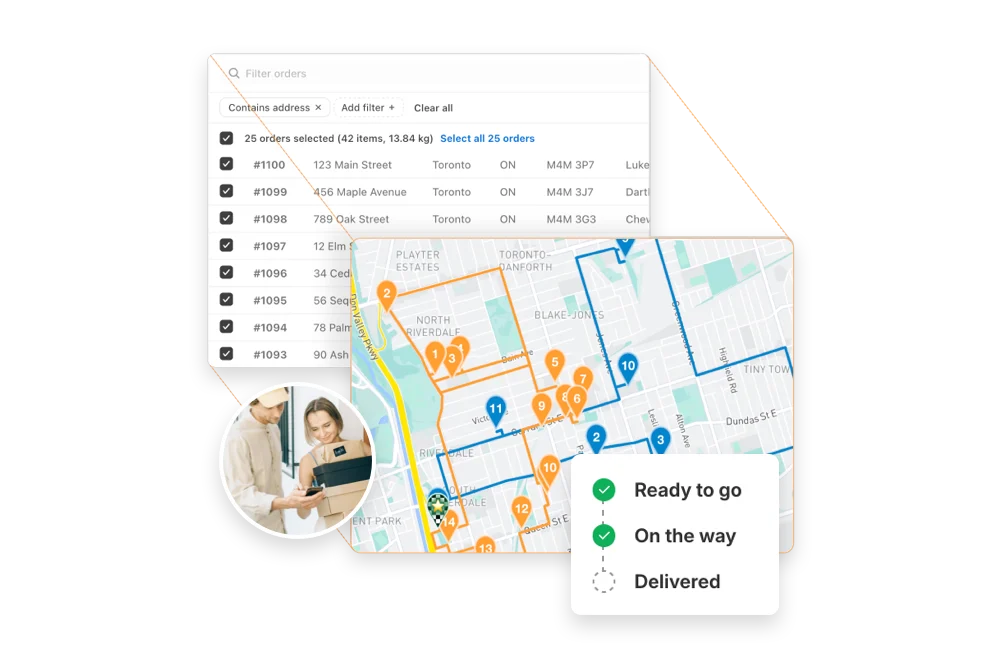
Tying all of this together is exactly what EasyRoutes is built for. As a Shopify-native delivery platform, it removes the busywork so you can focus on safe, on-time service:
- Direct order integration. EasyRoutes syncs with your Shopify orders automatically — mark a stop delivered and it updates instantly in Shopify, with no exporting and importing between tools.
- Optimized multi-stop routes. Its route-planning engine sequences as many stops as you need in seconds, respecting delivery windows so time-sensitive medications arrive when they should.
- Tracking, notifications & proof of delivery. Branded tracking pages and notifications keep patients informed, while photo and e-signature proof of delivery creates the auditable record regulated deliveries demand.
- Navigation and scheduling. Drivers send each stop to Google Maps, Apple Maps, or Waze, and recurring runs can be scheduled and re-optimized as constraints change.
Final Thoughts
A profitable medical or pharmacy delivery service is built on four pillars: understanding your market, respecting the regulations, protecting your products with the right cold-chain and handling setup, and running tight, well-tracked routes. Nail those, treat your drivers as the professionals they are, and lean on technology to do the heavy lifting, and you will be positioned to lead in one of last-mile delivery’s most durable, fastest-growing segments. Start your free EasyRoutes trial and put your deliveries on the most efficient path.