Electric Delivery Vehicles: Who’s Switching in 2026
By Joe SnyderSee which delivery giants are going electric in 2026, why fleet economics now favor EVs, and how route optimization keeps electric fleets efficient.

See which delivery giants are going electric in 2026, why fleet economics now favor EVs, and how route optimization keeps electric fleets efficient.
Not long ago, an electric delivery van was a novelty — a press-release prop wheeled out to signal that a company cared about the climate. In 2026 it is simply part of the streetscape. Battery-electric vans now hum through neighborhoods in Amazon blue, FedEx purple, and US Postal Service white, and the shift is no longer driven by goodwill alone. The economics have caught up. Global electric-car sales grew about 20% in 2025 to top 20 million, meaning roughly one in four new cars sold worldwide was electric, according to the International Energy Agency. Commercial fleets are riding that same wave, and for the businesses that move packages for a living, the question has flipped from “why would we electrify?” to “which routes should we electrify first?”
This guide looks at who is actually switching to electric delivery vehicles, why the math increasingly favors it, where the rollout has stumbled, and what it all means if you run a small or mid-sized delivery operation rather than a global logistics empire.
Electric vehicles are not new — the first crude examples date to the 1830s, and hybrids went mainstream when the Toyota Prius arrived in the late 1990s. What changed recently is scale. As Tesla proved the consumer market and public charging spread, battery costs fell far enough that electrification stopped being a moral statement and started being a line on a budget. The IEA estimates that the global EV fleet displaced around 1.7 million barrels of oil per day in 2025, and that battery-electric models now account for about two-thirds of all electric-car sales worldwide.
For delivery specifically, the centre of gravity is the electric van — the light commercial vehicle that handles the last mile. These vehicles are a near-ideal electrification candidate: they run predictable, return-to-base routes, rack up high daily mileage, and spend their nights parked where a charger can reach them. That is exactly the profile fleet operators look for, and it is why last-mile delivery has electrified faster than long-haul trucking. If you want the bigger picture of how the sector is decarbonizing, our overview of green transportation and sustainable delivery puts electric vans in context alongside the other levers fleets are pulling.
Two forces are doing the heavy lifting: cost and pressure. Regulatory pressure — emissions standards, urban low-emission zones, and corporate net-zero pledges — sets the direction. But the reason fleets are actually signing purchase orders is that the numbers increasingly work.
An electric van still costs more to buy than a diesel one, and that sticker gap is the single biggest reason operators hesitate. The trap is judging the vehicle on purchase price alone. Battery-electric vans are far cheaper to fuel and maintain — fewer moving parts, no oil changes, no exhaust after-treatment, and regenerative braking that spares the brake pads. Over a five-to-ten-year life, those savings can erase the price premium entirely. The International Council on Clean Transportation found that, even in a high-electricity-cost state like California, a battery-electric Class 2b–3 delivery van came out roughly $1,600 ahead of diesel over five years once fuel and maintenance were counted — and the gap widens on higher-mileage routes.
The lesson for any fleet owner is the same one that applies to fuel, tires, and labour: optimize for total cost, not the line item in front of you. (For the non-electric side of that equation, see our guide to cutting fuel costs in a delivery business and the full breakdown of what drives last-mile delivery costs.)

Dense urban routes are the sweet spot for EVs. Stop-and-go traffic — the enemy of a diesel engine — is where regenerative braking and electric efficiency shine, and short, predictable city loops sit comfortably inside an electric van’s range. Consider the US Postal Service’s new electric mail truck: it carries a 94 kWh battery good for roughly 70 to 120 miles, which sounds modest until you learn that the vast majority of the routes it replaces cover fewer than 40 miles a day. The range “problem” largely evaporates once the vehicle is matched to the right route. Our urban delivery tips dig into why optimizing for time rather than raw distance matters even more once your fleet is electric.
The headline commitments from the delivery giants are real, but the rollout has been messier than the original announcements implied. Here is where the biggest players actually stand.
Amazon made the splashiest bet: as part of its 2019 Climate Pledge to reach net-zero carbon by 2040, it ordered 100,000 custom electric delivery vans from startup Rivian and became the automaker’s largest shareholder. Six years on, the partnership is delivering — if not quite at the pace the round number suggested. Amazon now runs more than 30,000 Rivian vans across thousands of US cities, a fleet it grew by about 50% during 2025 alone. Counting its European vehicles — including nearly 5,000 Mercedes-Benz electric vans — Amazon passed 50,000 electric delivery vans globally in 2025, the halfway mark to its 2030 goal, with that fleet delivering more than 2.4 billion packages with zero tailpipe emissions.
The two legacy carriers show how easily an ambitious EV plan can hit reality. UPS announced in 2020 that it would buy 10,000 purpose-built electric vans from the British startup Arrival, even taking an equity stake. None of those vans were ever delivered: Arrival burned through its cash, was delisted, and collapsed into administration in 2024 without selling a single vehicle, its assets later swept up by Canoo, which itself filed for bankruptcy in early 2025. UPS has since gone vehicle-shopping across multiple manufacturers rather than betting on one supplier.
FedEx took a similar high-profile route, ordering thousands of BrightDrop electric vans from General Motors and pledging that 50% of its FedEx Express pickup-and-delivery purchases would be electric by 2025, rising to an all-electric pickup-and-delivery fleet by 2040. Yet GM wound down BrightDrop as a standalone brand, and industry reporting suggests the big carriers have together deployed only a few thousand electric step vans — a tiny slice of fleets that number in the hundreds of thousands — slowed by battery shortages and the high cost of electric step vans. The ambition is intact; the timelines have slipped. For a closer look at how these carriers squeeze efficiency out of every route, electric or not, see our breakdown of how Amazon, UPS and FedEx optimize delivery.
The most consequential US fleet electrification may be the quietest. The Postal Service is replacing its decades-old delivery trucks with Oshkosh-built Next Generation Delivery Vehicles, and of the 106,000-plus new vehicles under contract, the agency says about 66,000 will be zero-emission. Progress has been slow — repeated production delays meant only a few thousand electric units were on the road by late 2025, supplemented by thousands of off-the-shelf Ford E-Transit vans — but the sheer size of the order makes USPS one of the largest electric-fleet buyers in the country.
Retailers are in the mix too: IKEA has worked with logistics partners to electrify last-mile deliveries in major cities for years, proving that even companies that don’t own their fleets can push electrification through the partners who deliver for them.

If the case is so strong, why isn’t every van electric already? A few stubborn obstacles remain. Upfront cost is the obvious one — even with operating savings, a higher purchase price strains short budget cycles. Charging infrastructure is the second: a fleet is only as electric as its depot wiring, and installing chargers can rival the cost of the vans themselves. Battery and vehicle supply has been inconsistent, with several promising EV-van startups (Arrival among them) going under before reaching volume. And policy is a moving target — incentives that made early adoption pencil out, such as US purchase tax credits, have been scaled back, changing the math from one year to the next. The fleets succeeding today tend to electrify selectively: they start with the routes and depots where the economics already work, then expand as costs fall and charging matures. Our guide to sustainable delivery best practices covers how to sequence that transition without overcommitting.
You don’t need a 100,000-van order to benefit from what the giants have learned. For an independent courier, a local grocery delivery service, or a regional fleet, the same principles apply at smaller scale. Electric vans make the most sense on predictable, return-to-base routes under roughly 150 miles a day with overnight charging — precisely the kind of work most local delivery businesses do. Many operators start with a single EV or a hybrid fleet, electrifying the routes that fit and keeping combustion vehicles for the long or unpredictable ones.
The vehicle is only half the decision. Whether you lease or buy, run two vans or twenty, you’ll want a system to track usage, maintenance, and cost per mile — which is where fleet management software earns its keep. And the broader direction of travel is clear: electrification, automation, and smarter routing are converging, a trend we explore in our look at automation in logistics and the wider shift in on-demand delivery trends.
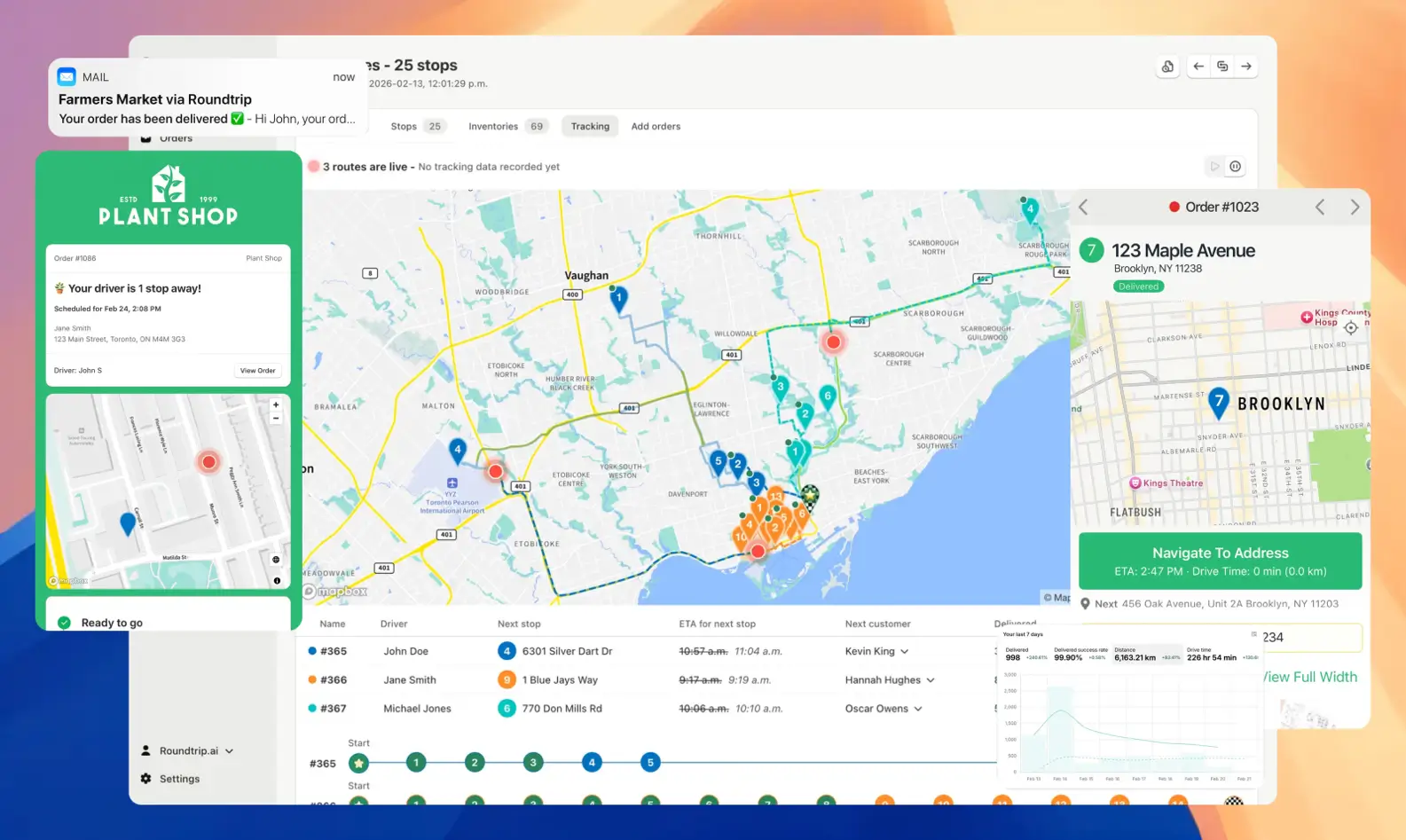
Here is the part fleet operators often miss: the single biggest way to cut a delivery vehicle’s emissions and energy cost is to make it drive fewer miles. An electric van on a sloppy, doubled-back route still wastes energy, time, and battery range. Tight, optimized routes stretch every charge further and let you fit more stops into the range you have — which is why smart route optimization is the natural companion to fleet electrification, not an afterthought.
That’s where EasyRoutes comes in. EasyRoutes lets you build multiple optimized delivery routes in seconds, balance stops across drivers, account for vehicle capacity and time windows, and keep daily mileage tight — all of which matter even more when range and charging are part of the equation. Add real-time tracking, customer ETAs, and proof of delivery, and a small business gets the kind of routing intelligence the delivery giants spend fortunes building in-house. Whether your fleet is electric, diesel, or somewhere in between, EasyRoutes helps you get more deliveries out of every vehicle and every charge. Try it for free!
The electrification of delivery is no longer a question of if, but of how fast and how smart. The giants have shown both the promise — Amazon’s 50,000 vans, the Postal Service’s sweeping order — and the pitfalls, from Arrival’s collapse to slipping timelines and shifting incentives. The throughline is that EVs reward operators who match the right vehicle to the right route and squeeze waste out of every trip. As battery costs keep falling and charging keeps expanding, the businesses that learn to run lean, well-routed fleets today will be the ones best positioned to go electric on their own terms tomorrow.
EasyRoutes optimizes deliveries using your selected orders, start & end locations, stop time intervals, time windows, and route limits. You can balance routes, respect capacities, and re‑optimize as plans change.
See: Route Options · EasyRoutes 101
Yes. EasyRoutes supports Vehicle Profiles you can configure and assign to routes. EasyRoutes also supports capacity planning via item or weight limits per route. Use these with other options (like time windows, or custom start/end locations) to keep plans realistic and drivers on schedule.
See: Vehicle Profiles · Max items/weight per route · Commercial/GPX Export
Yes. Routes display estimated distance and drive time after optimization, and update automatically when you add/remove stops and re‑optimize.
See: Route Mileage
Yes. EasyRoutes lets you set limits for maximum route duration, maximum stops per route, and maximum items per route. Configure these constraints in Route Options before planning, or when editing a route.
See: Route Options
Yes. Schedule routes across multiple days with configured start times/locations and add an overnight driver break to maintain accurate ETAs.
See: Multi‑Day Scheduling
Yes. You can set delivery time windows per stop or import them from supported third‑party date/time apps. EasyRoutes optimizes routes to meet these windows and calculates ETAs accordingly.
Yes. Schedule routes for specific dates/times, and ETAs will be calculated for each stop on a route. These ETAs can be shared via customer tracking links and email/SMS delivery notifications.
EasyRoutes is the AI-native delivery operations platform trusted by 5,000+ businesses across 75+ countries. Plan routes in seconds, dispatch drivers automatically, and delight your customers — from Shopify or any order source. Experience delivery operations that run themselves. Rated 4.9 stars and certified Built for Shopify.
⭐⭐⭐⭐⭐ 4.9 stars • Trusted by 5,000+ Businesses