Customer Retention Strategies for Delivery Businesses
By Joe SnyderProven customer retention strategies for delivery businesses in 2026: on-time delivery, real-time tracking, loyalty, subscriptions, and customer feedback.

Proven customer retention strategies for delivery businesses in 2026: on-time delivery, real-time tracking, loyalty, subscriptions, and customer feedback.
Winning a new customer is satisfying, but it is the customers who come back a second, third, and tenth time that quietly fund a delivery business. The economics are lopsided: roughly 65% of revenue at the average store comes from existing customers, and once a shopper makes that first purchase there is only about a 27% chance they return — but after a second order the odds of a third jump past 50%. Earning the next order is where durable growth begins.
For delivery-focused brands, retention is won or lost in the last mile. The package on the doorstep is the most tangible moment a customer has with your brand, and it shapes whether they reorder. Below are seven strategies that keep delivery customers loyal in 2026, plus how an integrated tool like EasyRoutes makes each one easier to execute.
Customer lifetime value (CLV) is the total revenue you can expect from one customer across the whole relationship — typically measured over 12 to 24 months. It is one of the most honest measures of a store's health because it folds acquisition cost, repeat-purchase behavior, and average order value into a single number. Returning customers raise CLV on two fronts at once: they buy more often, and they tend to spend more per order than first-time buyers, because they already trust your product and your delivery promise.
That trust is expensive to build and easy to break, which is exactly why retention deserves a dedicated strategy rather than being treated as a happy accident. It is worth tracking CLV in two ways: a historic figure that simply sums each customer's past transactions against acquisition and product costs, and a predictive figure that uses behavioral patterns to estimate future value. The predictive view is harder to calculate but more useful for deciding where to invest — and it sharpens as you learn how your customers behave over time. The rest of this guide breaks that strategy into concrete, delivery-specific moves.

Nothing erodes loyalty faster than a delivery that arrives late, damaged, or wrong. In Bringg's 2026 Delivery Experience Survey of more than 1,000 shoppers, late delivery was the single biggest driver of a negative experience — a missed window reads as a broken promise. The stakes are high: an Ipsos study found that 85% of online shoppers say a poor delivery experience would stop them ordering from that retailer again.
Consistency is what turns a one-time buyer into a regular. That means hitting promised windows, getting the right items to the right address, and doing it the same way every time. Optimized, traffic-aware route planning keeps drivers on schedule, while verifying order accuracy before dispatch cuts the returns and complaints that chip away at trust. Reliability sits at the heart of a strong delivery experience, and it starts with a disciplined order fulfillment process.

Visibility has shifted from a nice-to-have to an expectation. Recent consumer research shows 88% of shoppers consider real-time tracking critical to a positive experience, and 96% use tracking when it is offered. The flip side is just as clear in Bringg's data: when customers are left in the dark, a lack of tracking or communication becomes a top reason they sour on a brand.
Proactive updates do double duty. They reassure customers and let them plan their day, and they dramatically reduce “Where is my order?” (WISMO) inquiries that drain your support team. The goal is a steady drumbeat of communication — order confirmed, out for delivery, driver approaching, delivered — across the channels your customers actually check. Pairing live tracking with branded notifications turns an anxious wait into a reassuring one, and reinforces the reliability you established in the previous step. For a deeper playbook, see our guide to last-mile delivery best practices.
Personalization makes customers feel recognized rather than processed. By using order history and preferences, delivery businesses can tailor recommendations, remember preferred delivery windows, and time reminders around recurring needs — restocking pet food, reordering a favorite bakery item before a birthday, or suggesting complementary grocery products.
The practical drivers of loyalty are often more pragmatic than emotional, as eMarketer's 2026 loyalty research notes: product satisfaction and a smooth, relevant experience matter more than brand sentiment. Personalization that removes friction — fewer decisions, better-timed offers, the right delivery option pre-selected — is the kind customers reward with repeat orders.
A loyalty or rewards program gives customers a concrete reason to choose you again. Points toward future discounts, free local delivery after a threshold, early access to new products, or a small birthday perk all create a sense of being valued. You do not need an elaborate system to start — a simple points-per-order structure can be expanded later into tiers and personalized rewards as you learn what your best customers respond to.
The most effective programs also lower the effort of the next purchase. One-tap reordering, saved addresses, and pre-filled delivery preferences mean a returning customer can buy again in seconds. Loyalty members consistently report being more likely to stick with a brand that recognizes them, so even a lightweight program pays for itself by nudging occasional buyers toward becoming regulars. When loyalty perks and a frictionless reorder flow work together, you remove both the reason to leave and the effort to stay.
Subscriptions turn occasional buyers into predictable, recurring revenue — and they are a powerful retention mechanism for replenishable categories. The pattern is visible across the market: in pet supplies, recurring autoship orders can account for the large majority of a retailer's sales, and online grocery subscription services routinely retain customers at far higher rates than one-off purchases.
Subscriptions work because they remove a recurring decision and reward the customer with convenience, sometimes paired with discounted delivery or priority service. The key is flexibility: easy pause, skip, and reschedule options keep subscribers happy and reduce cancellations. Whether it is weekly groceries, monthly meal kits, or quarterly essentials, a well-run subscription program keeps your brand in the customer's routine.
The fastest way to keep customers is to understand them, and the cheapest way to understand them is to ask. Post-delivery ratings, short surveys, and review prompts surface exactly what is working — driver professionalism, delivery speed, packaging — and what is not. Collecting feedback at the moment of delivery, while the experience is fresh, yields the most accurate signal.
Feedback only builds loyalty when customers see it acted on. Closing the loop — fixing a recurring complaint, adding a requested delivery window, coaching a driver — signals that their opinion shapes your service. That responsiveness is itself a retention strategy, because customers stay with brands that visibly listen.

Sustainability can be a genuine differentiator, but the 2026 picture is nuanced. McKinsey's consumer research finds that while shoppers still value eco-friendly choices, price, quality, and convenience now rank ahead of environmental factors for most buyers, with environmental impact mattering most to younger and urban shoppers. In other words, sustainability wins loyalty when it does not force a trade-off on cost or convenience.
Practical, affordable moves resonate best: recyclable or right-sized packaging, consolidated delivery windows that cut miles driven, and lower-emission options like electric vehicles or bikes for dense urban routes. Route optimization helps here too, since fewer miles means both lower costs and a smaller footprint — a win for margins and for the eco-conscious segment of your customer base. Learn more about green transportation in last-mile delivery.
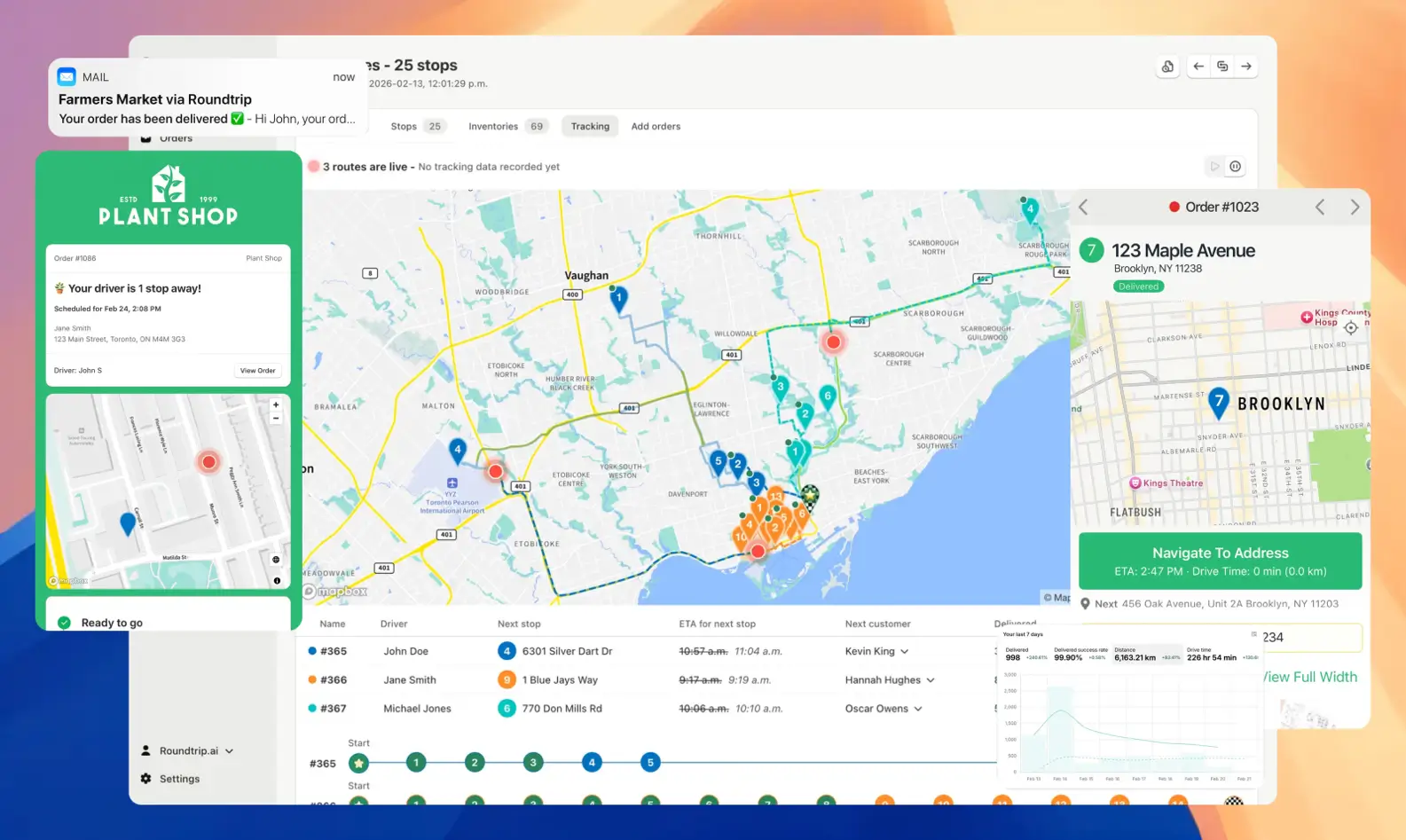
Most of the strategies above depend on one thing: a delivery operation that runs reliably and communicates well. EasyRoutes is a local delivery manager and route planner built directly into Shopify, designed to make that operation effortless. With a few clicks you can plan optimized local delivery routes from real order data, assign and dispatch them to drivers, and track delivery progress in real time.
On the customer side, EasyRoutes automates the communication that keeps shoppers loyal: branded tracking pages, customizable email and SMS delivery notifications, and proof of delivery with photos and signatures. It supports recurring subscription orders, lets customers leave delivery ratings, and keeps Shopify order statuses in sync automatically — so the on-time delivery, real-time tracking, feedback collection, and subscription support described above all run from one place. For more on capturing and sharing delivery confirmation, see the benefits and implementation tips for proof of delivery.
Customer retention is not a single tactic; it is the compounding result of getting the delivery experience right, communicating proactively, rewarding loyalty, and listening to feedback — order after order. Each reliable, well-tracked, on-time delivery makes the next purchase more likely, and every repeat purchase lifts your customer lifetime value.
Ready to turn your delivery experience into a retention engine? Learn more on the EasyRoutes website, or start your free trial of EasyRoutes today.
Go to your EasyRoutes Settings → Driver settings, and enable real‑time tracking. Have drivers allow location Always + Precise location in the EasyRoutes Delivery Driver app and their mobile device's settings.
Yes. With the Premium plan and above, fully customize email/SMS: add your logo and colors, edit copy/variables, and choose which events send. Works for Shopify orders and imported/manual stops.
Yes. Enable Delivery Ratings so customers can leave star ratings and optional comments on the tracking page after delivery. Export results or review per driver from their profile pages.
See: Delivery Ratings
Yes. You can show proof of delivery (photos, e‑signature confirmation, and driver notes) on customer tracking pages for delivered or attempted stops. Enable this from EasyRoutes' Order Tracking settings.
Yes. Subscription orders from Shopify can be planned like standard orders. EasyRoutes also integrates with popular subscription/checkout apps.
EasyRoutes is the AI-native delivery operations platform trusted by 5,000+ businesses across 75+ countries. Plan routes in seconds, dispatch drivers automatically, and delight your customers — from Shopify or any order source. Experience delivery operations that run themselves. Rated 4.9 stars and certified Built for Shopify.
⭐⭐⭐⭐⭐ 4.9 stars • Trusted by 5,000+ Businesses