Route Planning for Your Business: The 2026 Guide
By Joe SnyderRoute planning helps delivery businesses cut costs, speed up deliveries, and keep customers loyal. Here is how it works and how to get started in 2026.

Route planning helps delivery businesses cut costs, speed up deliveries, and keep customers loyal. Here is how it works and how to get started in 2026.
Every delivery a business makes is a promise, and every route is a series of small decisions that determine whether that promise is kept. Get routing right and you save fuel, finish faster, and keep customers coming back; get it wrong and costs creep up while complaints pile in. As online ordering keeps climbing — the global last-mile delivery market is projected to grow from roughly USD 194 billion in 2026 to over USD 410 billion by 2034 — the businesses that plan their routes well are the ones positioned to win. This guide explains what route planning is, how it differs from route optimization, how it works, and why it has become essential for any delivery operation.

Route planning is the process of mapping out the most effective path for delivery vehicles to follow, deciding which driver goes where and in what order. It is far more than figuring out how to get from point A to point B: it means making the best use of your resources by accounting for the sequence of stops, total distance, traffic patterns, delivery windows, and vehicle capacity. For any business that depends on timely deliveries — groceries, meal kits, flowers, medical supplies, or general ecommerce parcels — efficient route planning can be the difference between profit and loss.
The concept is as old as commerce itself, but it has changed dramatically. Planning routes with pen and paper, or assigning stops one by one in a consumer navigation app, is slow and error-prone, and it puts businesses at risk of missing customer expectations. Modern route planning uses algorithms and real-time data to build the most efficient delivery routes possible in seconds, replacing guesswork with precision.
People often use these terms interchangeably, but they describe two different stages of the same job. Route planning is the foundational step: it sets the framework, identifying every stop that needs to be made and ensuring no delivery is missed. Route optimization is the advanced step that refines that framework, using algorithms and live data — traffic, time windows, vehicle capacity, fuel cost — to determine the best possible sequence and path.
Put simply, planning identifies the stops; optimization determines the smartest way to complete them. Planning is relatively straightforward, while optimization is computationally complex and dynamic. The two work hand in hand: planning ensures completeness, optimization ensures efficiency. A business that does both can reliably turn a long list of addresses into a fast, cost-effective day on the road.

Behind a good route is a clear sequence of steps. First comes data collection: gathering every delivery address, the number of packages, and any specific time windows, along with constraints like traffic, road conditions, and how much each vehicle can carry. Next is algorithm application, where the software processes that data to find the route with the shortest practical distance, the least travel time, and the lowest fuel use. This is where route optimization algorithms do the heavy lifting that no spreadsheet can match, especially when a single day involves dozens or hundreds of stops across multiple drivers.
The work does not end once routes are dispatched. Strong platforms allow real-time adjustments: if a road closes or traffic spikes, the route can be recalculated on the fly so deliveries stay on schedule. This matters most for businesses juggling many stops at once, which is exactly the challenge that dedicated multi-stop route planning is built to solve. Consumer mapping apps work stop-by-stop and simply were not designed for it.

Transportation costs add up quickly, and fuel is one of the largest. Optimized routes mean less time on the road, less backtracking, and lower fuel consumption, plus reduced vehicle wear and tear and fewer maintenance bills. Driving style compounds the effect: the U.S. Department of Energy reports that aggressive driving can lower gas mileage by 15% to 30% at highway speeds and 10% to 40% in stop-and-go traffic. Planning smoother, shorter routes — and pairing them with steady driving — turns those percentages into real savings. For a deeper look at where the money goes, see our breakdown of transportation costs and practical ways to cut fuel costs in your delivery business.
Customer satisfaction is the cornerstone of any delivery business, and delivery is now part of the product. The data is stark: a 2026 consumer study found that 55% of shoppers stop buying from a brand after a single negative delivery experience, while 65% will buy again after a positive one even at a higher price. Yet reliability is rare — a Q2 2026 survey found fewer than one in ten consumers believe retailers always meet their delivery commitments. Route planning closes that gap by making on-time delivery the norm rather than the exception, and pairing it with real-time updates builds the trust that drives repeat business. Explore what separates the leaders in our guide to a great delivery experience and the role of real-time tracking that keeps customers informed.
Efficient routes let you do more with less. When routes are tight, you may need fewer vehicles to cover the same ground, which lowers maintenance and capital costs, and you can balance workloads so no driver is overburdened. Planning also adapts to demand: during holidays or sales events you can reassign resources and reroute drivers quickly without sacrificing service. Safety improves too — well-planned routes reduce last-minute lane changes and driver fatigue, and they can steer crews away from high-risk areas or severe weather, protecting both your people and your vehicles.
Delivering faster, more reliably, and at lower cost is a competitive weapon. In industries where perishable goods must arrive fresh and on time, dependable logistics set you apart from rivals who struggle with it. Optimized operations also generate data — on delivery performance, customer preferences, and efficiency — that you can use to refine your service and stay ahead of the curve.
Many owners assume the only way to grow profit is to grow sales. But chasing sales usually means hiring more drivers and buying more vehicles, which raises overhead in lockstep — and that is risky when margins are already thin. Logistics is a low-margin business: one 2026 benchmarking analysis pegged the transport and logistics sector net margin at about 4.65%, with most companies landing in the 5% to 15% range. On a million dollars of revenue, a few points of margin is the difference between a comfortable year and a precarious one.
That is why operational efficiency — not just top-line sales — is the surer path to higher profit. A route planner squeezes more deliveries out of the same drivers and the same vehicles, so each point of efficiency drops closer to the bottom line. It also protects revenue you already have: with accurate timestamps and proof of delivery, you can resolve disputes and shut down false non-delivery claims with evidence in hand, rather than absorbing the cost.
Not every tool is equal. The strongest route planners share a few traits: powerful optimization that accounts for traffic, time windows, and vehicle capacity; real-time tracking and adjustments; the ability to scale as your order volume and service area grow; integration with the systems you already use; and an interface simple enough that dispatchers and drivers actually adopt it. If your team is still routing by hand or in spreadsheets, the most important question is when to make the switch — our guide on manual route planning versus delivery software walks through the true cost of staying manual. For a structured way to compare options, see how to choose the right route planner for your delivery process.
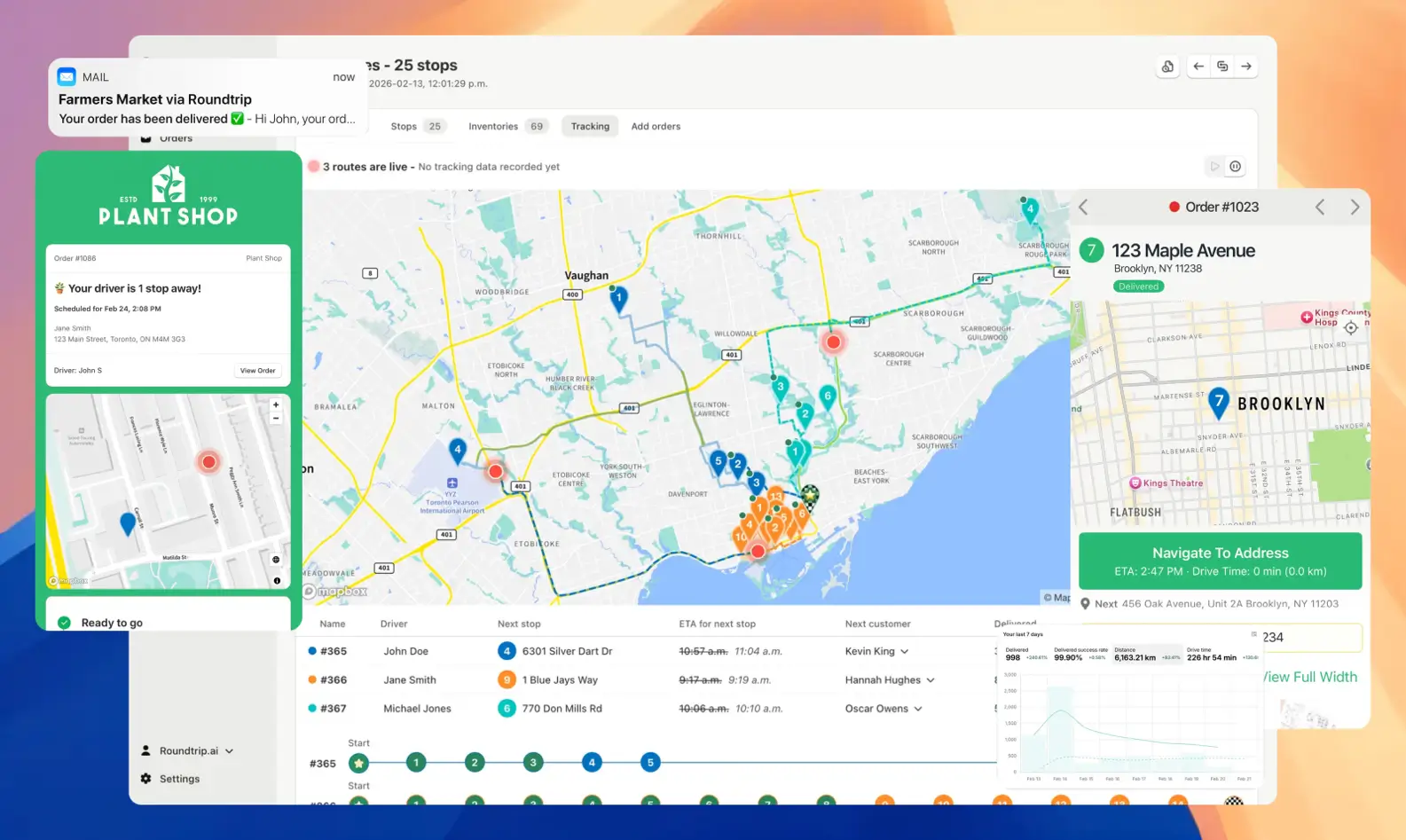
EasyRoutes turns your store’s orders into optimized delivery routes you can share with a driver or run yourself — in seconds rather than hours. You can import addresses from Shopify or spreadsheets, split orders into multiple balanced routes, and account for priority stops, time windows, and vehicle capacity automatically. Drivers receive mobile-friendly routes with turn-by-turn navigation in their preferred app, capture proof of delivery from their phones, and keep dispatch and customers updated with real-time tracking and notifications. If something changes mid-day, you can re-optimize the remaining stops without disrupting the rest of the plan.
EasyRoutes is web-based, so there is nothing to install, and it is a multi-time Shopify Staff Pick that is well reviewed and well supported, with plans and free trials for businesses of every size — including a free plan for operations just getting started.
Route planning has shifted from a back-office chore to a strategic necessity. Done well, it lowers transportation costs, lifts customer satisfaction, improves driver safety, protects thin margins, and gives you a real edge over competitors. Whether you run a handful of stops a day or coordinate a growing fleet, investing in the right approach — and the right software — pays for itself quickly. If you are ready to take your deliveries to the next level, explore everything EasyRoutes can do, or start your 14-day free trial today.
EasyRoutes optimizes deliveries using your selected orders, start & end locations, stop time intervals, time windows, and route limits. You can balance routes, respect capacities, and re‑optimize as plans change.
See: Route Options · EasyRoutes 101
Yes. Enable Balance routes to distribute stops as evenly as possible across multiple routes/drivers while respecting other route constraints (like time windows, or item/weight limits).
See: Balance routes · How many routes?
Yes. Schedule routes across multiple days with configured start times/locations and add an overnight driver break to maintain accurate ETAs.
See: Multi‑Day Scheduling
Yes. EasyRoutes supports Vehicle Profiles you can configure and assign to routes. EasyRoutes also supports capacity planning via item or weight limits per route. Use these with other options (like time windows, or custom start/end locations) to keep plans realistic and drivers on schedule.
See: Vehicle Profiles · Max items/weight per route · Commercial/GPX Export
Yes. You can set delivery time windows per stop or import them from supported third‑party date/time apps. EasyRoutes optimizes routes to meet these windows and calculates ETAs accordingly.
Yes. Schedule routes for specific dates/times, and ETAs will be calculated for each stop on a route. These ETAs can be shared via customer tracking links and email/SMS delivery notifications.
Yes. Import orders by CSV in Shopify or Web, including item‑level quantities and weights for capacity planning.
See: CSV Import
Yes. Re‑optimize at any time — after adding or removing stops, changing stop priorities, editing route options, or balancing loads. Drivers can also re-optimize routes delivered out of order, or re‑order stops if enabled from your EasyRoutes Settings.
Yes. Enable Real‑Time Tracking in Settings → Driver settings (Premium/Enterprise subscription plans) to view live driver location and progress in the Tracking tab of any route.
See: Real‑Time Tracking
Absolutely. Drivers can add photos, collect an e‑signature, and record notes at each stop; these appear in the route and customer tracking (if enabled).
See: Proof of Delivery
Yes. Drivers can launch directions via Google Maps, Apple Maps, or Waze from each stop, and pick a default navigation app in their mobile app settings.
Yes. Routes display estimated distance and drive time after optimization, and update automatically when you add/remove stops and re‑optimize.
See: Route Mileage
EasyRoutes is the AI-native delivery operations platform trusted by 5,000+ businesses across 75+ countries. Plan routes in seconds, dispatch drivers automatically, and delight your customers — from Shopify or any order source. Experience delivery operations that run themselves. Rated 4.9 stars and certified Built for Shopify.
⭐⭐⭐⭐⭐ 4.9 stars • Trusted by 5,000+ Businesses