How to Start an Alcohol Delivery Business in 2026
By Joe SnyderLearn how to start an alcohol delivery business in 2026 — licensing, business models, store setup, and route optimization for beer, wine, and spirits.
Learn how to start an alcohol delivery business in 2026 — licensing, business models, store setup, and route optimization for beer, wine, and spirits.
Done well — and where the law allows it — alcohol delivery can become a genuinely profitable business. It is an especially natural expansion for liquor stores, wineries, breweries, and restaurants that already hold a license and want to meet customers where they increasingly shop: online. The opportunity is real, but so is the homework. You will need to understand the rules in your market, build a workable business model, and get your deliveries out the door efficiently. This guide walks through every step, including the route planning that separates a profitable operation from one that quietly bleeds money on fuel and missed drops.
Is selling and delivering alcohol online actually worth it? The numbers say yes. The U.S. online beer, wine, and liquor retailing industry is worth roughly $2.4 billion in 2026, having grown steadily as online buying became a permanent habit rather than a pandemic blip. Globally, the picture is even bigger: drinks-data authority IWSR projects the online alcohol market will exceed $36 billion by 2028, growing about 20% over five years as the category settles into sustainable, predictable expansion.
Within that market, wine remains the dominant online category by revenue, while ready-to-drink cocktails and hard seltzers are the fastest-rising segments — a useful signal when you decide what to stock. Demand is strongest among younger buyers. Nearly half of Gen Z and millennial drinkers say they would prefer to buy alcohol from their favorite online retailers — more than double the rate of consumers aged 45 and older. In short, home alcohol delivery is large, growing, and still wide open for operators who can offer convenience and a polished experience. If you are weighing this against other niches, it helps to understand the fundamentals of how to start and scale a delivery business before committing.
Alcohol is one of the most heavily regulated products you can sell, and there is no single federal rulebook — the U.S. governs alcohol sales at the state and local level. Before anything else, confirm that what you intend to do is legal in your state, county, and even your specific delivery ZIP codes, since some jurisdictions remain dry.
The rules differ sharply by product. Direct-to-consumer (DtC) wine shipping is now permitted in nearly every state except Delaware and Utah, with Rhode Island allowing on-site purchases only. Spirits are far more restricted: as of the most recent industry reporting, only about nine states plus Washington, D.C. permit interstate DtC spirits shipping, and beer is similarly limited to roughly ten states. The landscape is shifting in operators' favor, though — California's Assembly Bill 1246 opened the nation's largest market to out-of-state craft distillers as of January 1, 2026.
Whatever your model, two compliance themes are universal: you must hold the correct state and local licenses, and you must verify age at the point of delivery. That means an adult signature and ID check at the door, every time. Bring a lawyer into the conversation early — the cost of getting licensing right is trivial next to the cost of getting it wrong.

Once you know you can legally operate, build a detailed plan for how the business will actually run. Work through the essentials: What will you sell — beer, wine, spirits, or a curated mix? Where will you source it, and will your suppliers permit online resale and delivery? How will customers find and order from you? And how will you make money — delivery fees, order minimums, premium markups, or recurring revenue?
Recurring revenue is worth special attention in this category. A monthly wine club or a beer-of-the-month subscription smooths out demand and builds loyalty. If that appeals to you, study the mechanics of switching to a subscription model before you price it, because billing cadence and churn make or break these programs.
One of the biggest decisions you will make is how the alcohol actually reaches the customer. You have two broad options: build and manage your own fleet of drivers and vehicles, or hand off fulfillment to a third-party platform like DoorDash, Uber Eats, or Minibar.
Running your own deliveries costs more to set up and maintain, but it gives you control over the customer experience and lets you keep more of each sale's margin over time. A third-party partner gives you instant reach and easy scaling with little upfront investment, at the cost of margin and brand control. Many operators start with a partner and bring delivery in-house as volume grows. The trade-offs are nuanced enough that it is worth reading a full breakdown of in-house versus third-party delivery before you decide.
With planning done, you need a storefront where customers can browse and order. Building from scratch with your own developers is one route, but most operators move faster with Shopify, which lets you stand up a compliant store and checkout quickly and layer on age-gating and delivery tools as you grow.
Shopify is also a strong fit because it natively supports local delivery and pickup, which is exactly how most alcohol orders are fulfilled — close to home, on the same or next day. If a defined delivery radius around your store is your model, our Shopify local delivery guide covers how to set up zones, fees, and fulfillment cleanly.

Unless you are operating out of an existing store, you will need space to hold inventory and stage orders. The good news is that a delivery-first business does not need expensive high-traffic retail frontage — a more affordable warehouse or back-of-house space, where local zoning permits alcohol storage, is often enough for inventory and a small team.
On the supply side, lock in your vendor relationships and confirm they are comfortable with online resale and delivery. If you already run a liquor store or restaurant, you likely have inventory in hand but may still need to-go packaging. Sturdy, spill-safe packaging matters more for alcohol than for most goods, and it is a real line item — controlling it is part of keeping margins healthy, much like the broader discipline of managing delivery costs.
A largely online business does not need a big headcount, but the people you do hire matter enormously. You will need staff to pick and pack orders, manage stock, and handle customer questions that FAQs cannot — and, if you deliver yourself, the right drivers.
Your drivers are the face of the business, so hire for friendliness and product knowledge, not just a clean license. Because you are delivering alcohol, every driver must be of legal age and trained to check IDs and refuse delivery to anyone underage or visibly intoxicated, in line with local law. Building that team well is its own discipline; our guide to hiring top delivery drivers walks through sourcing, screening, and onboarding.
Before you flip the switch, make sure customers know you exist. Use the channels where your buyers actually spend time — for the younger, online-first audience driving this category, that means social platforms like Instagram, TikTok, and Facebook, plus local search and email. Given how much alcohol discovery now happens on social media, having at least one capable social marketer on the team pays for itself quickly.
Here is where many alcohol delivery businesses quietly lose money. Handing a driver a stack of addresses and the keys is not a plan — it is guesswork that gets harder as you grow. Alcohol delivery has its own complications: demand spikes hard around holidays and events like the Super Bowl or July 4th, orders are heavy and bulky (cases of wine and beer add up fast), and external factors like traffic, weather, and road closures change the math every single day.
A dedicated route planner takes that burden off your plate and gets orders to customers faster. The payoffs compound. Optimized routes cut fuel use and let each driver complete more stops per shift, lowering your cost per delivery. Real-time tracking gives you a bird's-eye view of the whole operation so you can spot and fix problems before customers notice. And automating the planning that you would otherwise do by hand frees your team to focus on growing the business rather than untangling spreadsheets.
Routing software also tames the seasonality that defines this business. Because you can plan and schedule routes in advance, you can staff up and pre-build delivery windows ahead of a holiday rush, then re-optimize on the fly as last-minute orders land. For wine clubs and subscription boxes, the same engine handles recurring and even multi-day deliveries without anyone rebuilding routes by hand each cycle. Every one of those orders still gets an accurate ETA and a tracking link, so a spike in volume does not become a spike in support calls.
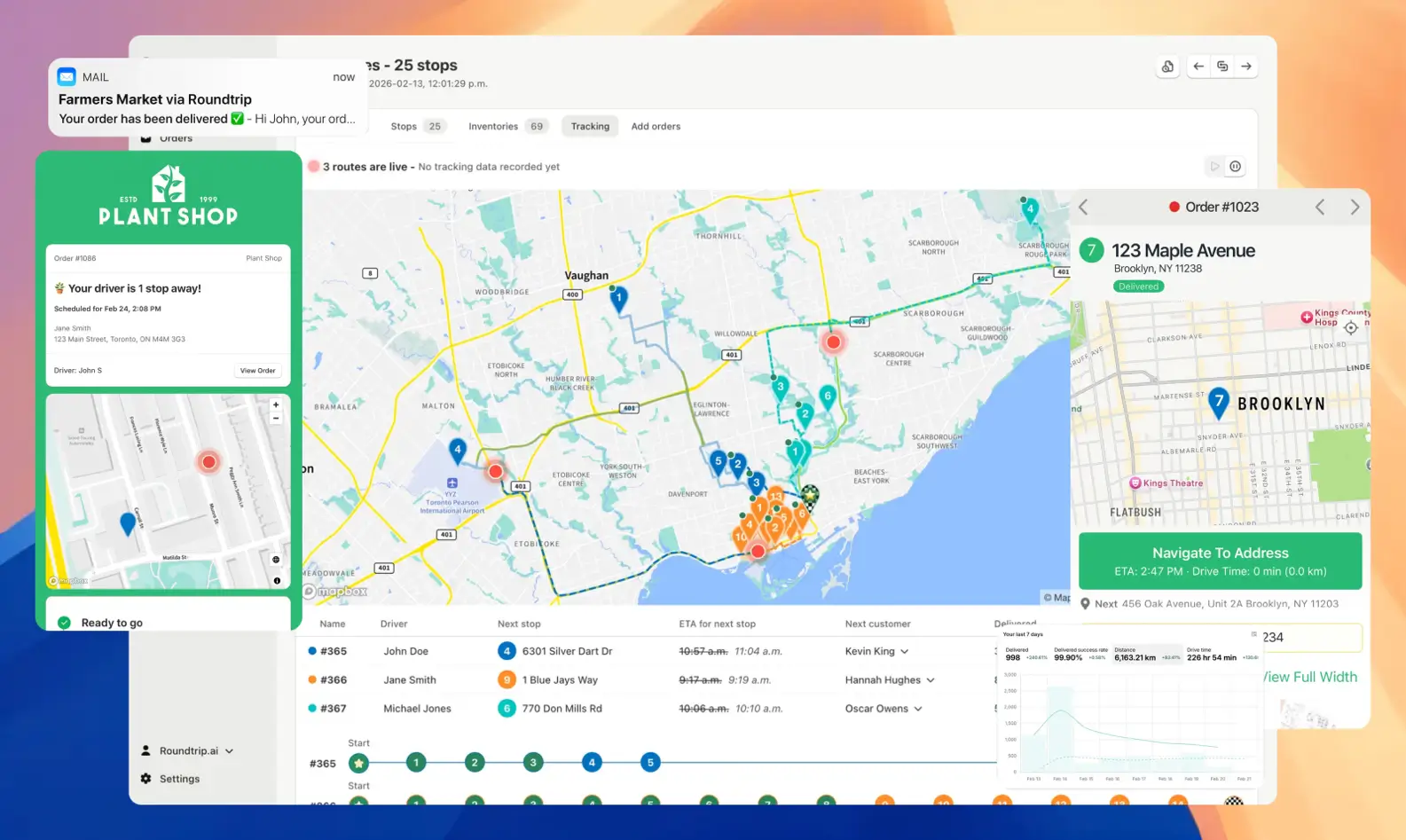
This is exactly what EasyRoutes does for Shopify and web-based merchants. You pick the orders you want to route, and EasyRoutes calculates the most efficient multi-stop sequence for each driver — accounting for vehicle capacity so a van full of cases is loaded and routed sensibly. Drivers get turn-by-turn navigation in the app they prefer, customers get SMS notifications and accurate ETAs, and drivers capture photo and signature proof of delivery at the door, which doubles as your record that an adult received the order. If you are choosing a tool, our overview of Shopify route planning software compares the options and what to look for.
The result is the same advantage the wine and beer specialists rely on: fewer late or failed deliveries, lower operating costs, and a delivery experience customers actually remember. That last point matters — reliability is what turns a one-time order into a repeat customer, which is the foundation of a great delivery experience.
Launching an alcohol delivery business takes real effort — legal diligence, a solid plan, the right team, and the right technology. But with online alcohol buying now a permanent fixture and younger drinkers actively asking for it, the work is worth it. Get the licensing right, build a model that fits your market, and route smart, and you can offer the kind of fast, dependable delivery that keeps customers coming back. Try EasyRoutes free for 14 days to see how much time optimized routing can save you.
EasyRoutes is the AI-native delivery operations platform trusted by 5,000+ businesses across 75+ countries. Plan routes in seconds, dispatch drivers automatically, and delight your customers — from Shopify or any order source. Experience delivery operations that run themselves. Rated 4.8 stars and certified Built for Shopify.
⭐⭐⭐⭐⭐ 4.8 stars • Trusted by 5,000+ Businesses