Route Management: A Complete Guide for Deliveries
By Joe SnyderRoute management means planning, optimizing, and tracking delivery routes to cut fuel and labor costs, speed deliveries, and keep customers happy.

Route management means planning, optimizing, and tracking delivery routes to cut fuel and labor costs, speed deliveries, and keep customers happy.
Every delivery business eventually runs into the same wall: orders grow faster than the team's ability to get them to the door efficiently. Route management is how you break through it. Done well, it turns a messy pile of stops into a smooth, predictable operation that saves fuel, time, and money on every shift.
This guide explains what route management really is, the challenges it solves, the benefits it delivers, how modern systems work, and how to choose the right tool for your operation.
Route management is the practice of planning, optimizing, and tracking delivery routes so that every trip is made in the most efficient way possible. It is broader than drawing a line between point A and point B. It looks at the whole picture: how many stops a driver has, where they are, when each customer expects their order, what each vehicle can carry, and how traffic and weather will affect the day. The goal is to get more out of the resources you already have, cutting mileage and fuel while increasing the productivity of your delivery operations.
At its core, route management combines two jobs. The first is route planning, which is the act of building the routes themselves. The second is route optimization, which is the work of arranging those stops in the smartest possible sequence. For an operation making more than a handful of deliveries a day, doing both by hand quickly becomes impossible, which is why dedicated software has become the backbone of modern delivery teams.
Delivery is no longer a niche cost center. The global last-mile delivery market reached roughly $167 billion in 2025 and is on track to nearly double to about $349 billion by 2033, growing close to 10% a year as online shopping keeps climbing. That growth means more vehicles on the road, more stops per route, and far less room for the kind of inefficiency that quietly drains a budget.
It matters because the cost of moving a vehicle is high and rising in the places that hurt most. According to the American Transportation Research Institute, the average cost of operating a truck reached $2.26 per mile in 2024, with driver wages near $0.80 and fuel near $0.48 per mile. Together, labor and fuel still make up well over half of every mile driven, and fuel alone accounts for more than a fifth of per-mile cost. When two line items dominate your spending like that, shaving even a small percentage off your total mileage flows almost directly to the bottom line. That is exactly what good route management is designed to do, and it is why understanding your full transportation costs is the first step toward controlling them.
Routing is a deceptively complex problem. It trips up seasoned managers because the number of moving parts grows explosively with every stop you add. Three challenges come up again and again.

A single route has to account for vehicle capacity, delivery time windows, driver availability, service durations, and the location of every stop. Add a few more drops and the possible combinations multiply far beyond what a person can weigh in their head. Trying to plan efficient routes with pen and paper or a spreadsheet takes too long and is prone to error, costing you both time and money. General navigation apps do not solve it either, because consumer mapping tools were never built to sequence dozens of stops across several drivers. Handling that complexity is the whole point of multi-stop route planning.
A route is only as good as its ability to survive contact with the real world. Manual plans are rigid: when a sudden weather warning, road closure, or last-minute order lands, you cannot easily re-sequence the day. You also cannot notify drivers of changes in real time, and once you reach them, they still have to work out a new path on their own. Every minute spent improvising is a minute not spent delivering. Many teams reach a tipping point where the friction of replanning by hand finally pushes them to switch from manual planning to software.
Because labor and fuel dominate delivery spending, the central challenge of route management is keeping those costs down while protecting a reasonable margin. Idle time, backtracking, failed first-attempt deliveries, and unbalanced driver workloads all quietly inflate the bill. The hidden expense of a badly planned route is one of the most underestimated drains in the business, and trimming it is where a focused delivery route optimization effort pays for itself fastest.

When route management is done right, the gains show up across the entire operation, from the fuel card to the customer inbox.
Optimized routes cut unnecessary miles, and fewer miles mean less fuel, less wear, and lower maintenance. The effect is measurable: a 2025 study of AI-driven routing models found that an ant-colony optimization approach reduced fuel use by about 16% per delivery route compared with conventional planning. Scaled across a full fleet over a year, that kind of reduction turns into serious savings without adding a single vehicle.
Route management enables precise scheduling, which means customers get accurate delivery estimates instead of vague all-day windows. That accuracy builds trust, reduces complaints, and encourages repeat business. Pair it with real-time tracking and notifications and customers can follow their order from dispatch to doorstep, which slashes the volume of where-is-my-order calls landing on your support team and lets people self-serve the information they want.
Balanced, well-sequenced routes give drivers a fair, achievable day rather than a chaotic one. No one is overloaded while someone else sits idle, and because each driver gets an efficient path, they can complete more stops without working harder or longer. That lifts the productivity of the whole fleet, lowers labor cost per delivery, and keeps drivers happier, which in turn helps with retention in a tight labor market.

Modern route management systems pull together several data sources, including mapping data, traffic patterns, vehicle constraints, and delivery priorities, to generate the optimal path for each driver. The strongest platforms do not just produce a plan once and walk away. They use dynamic routing technology to adjust in response to real-world conditions, re-sequencing around traffic, road closures, or last-minute orders so a route stays efficient throughout the day, not just at 6 a.m.
The other half of the picture is visibility. Route management software gives dispatchers a live view of where every driver is and how each route is progressing, so they can make adjustments on the fly and give customers reliable updates. This combination of smart planning and live tracking is what separates a true route management system from a static map, and it is increasingly powered by the same techniques the largest carriers use to squeeze inefficiency out of the last mile.
Not every tool fits every operation, so weigh a few factors before committing. Look at scalability (can it handle your busiest day, not just an average one?), integration (does it connect to the systems where your orders already live?), and real-time adaptability (can it re-optimize mid-route?). Then confirm it covers the capabilities that actually move the needle: route optimization, multi-driver and multi-stop support, vehicle capacity and time-window handling, driver navigation, proof of delivery, and customer notifications.
It also helps to think in terms of total value rather than sticker price, since the right tool typically pays for itself in fuel and labor savings within weeks. If you want a structured way to compare options, our guide on how to choose the right route planner walks through the questions to ask, and a broader look at delivery management software covers the features and ROI to expect from a complete platform.
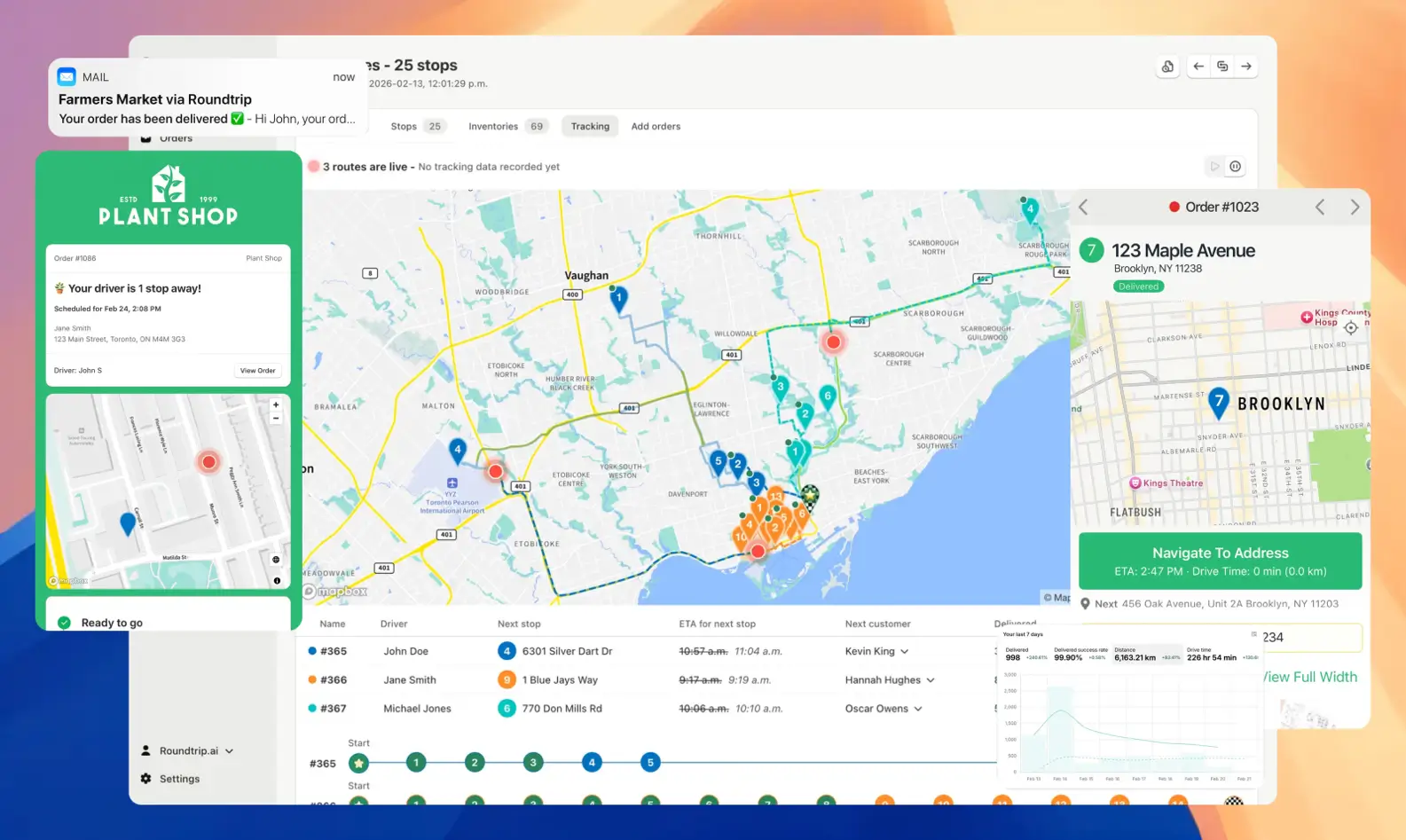
For Shopify and e-commerce merchants, EasyRoutes brings all of this together in one place. In seconds, it builds optimized multi-stop routes with turn-by-turn directions for your drivers, drawing orders directly from your store so you never have to wrestle with exporting and importing spreadsheets again. You select the orders you want to deliver, and EasyRoutes calculates the most cost-effective route.
From there, the platform handles the rest of the delivery day. Drivers get a mobile-friendly app for navigation and proof of delivery, dispatchers can track drivers in real time and send automated customer notifications, and the optimization engine accounts for vehicle capacity, delivery windows, and driver workload so each route is genuinely workable. The result is a route management workflow that scales with your orders instead of breaking under them.
Route management is no longer a nice-to-have. With delivery volumes rising and labor and fuel eating up more than half of every mile, the businesses that plan, optimize, and track their routes intelligently are the ones that stay profitable and keep customers coming back. Whether you run two vans or twenty, the right route management software turns your delivery operation from a cost you tolerate into an advantage you compete on.
If you're ready to stop guessing and start optimizing, EasyRoutes makes it simple to build, dispatch, and track better routes from day one. Start your 14-day free trial today!
EasyRoutes optimizes deliveries using your selected orders, start & end locations, stop time intervals, time windows, and route limits. You can balance routes, respect capacities, and re‑optimize as plans change.
See: Route Options · EasyRoutes 101
Yes. EasyRoutes supports Vehicle Profiles you can configure and assign to routes. EasyRoutes also supports capacity planning via item or weight limits per route. Use these with other options (like time windows, or custom start/end locations) to keep plans realistic and drivers on schedule.
See: Vehicle Profiles · Max items/weight per route · Commercial/GPX Export
Yes. You can set delivery time windows per stop or import them from supported third‑party date/time apps. EasyRoutes optimizes routes to meet these windows and calculates ETAs accordingly.
ETAs use route distance, stop service times, and historical traffic, and they update during the day as drivers progress. Accuracy improves when addresses and time windows are clean.
Yes. Enable Real‑Time Tracking in Settings → Driver settings (Premium/Enterprise subscription plans) to view live driver location and progress in the Tracking tab of any route.
See: Real‑Time Tracking
Yes. With the Premium plan and above, fully customize email/SMS: add your logo and colors, edit copy/variables, and choose which events send. Works for Shopify orders and imported/manual stops.
Absolutely. Drivers can add photos, collect an e‑signature, and record notes at each stop; these appear in the route and customer tracking (if enabled).
See: Proof of Delivery
Yes. Schedule routes across multiple days with configured start times/locations and add an overnight driver break to maintain accurate ETAs.
See: Multi‑Day Scheduling
EasyRoutes is the AI-native delivery operations platform trusted by 5,000+ businesses across 75+ countries. Plan routes in seconds, dispatch drivers automatically, and delight your customers — from Shopify or any order source. Experience delivery operations that run themselves. Rated 4.8 stars and certified Built for Shopify.
⭐⭐⭐⭐⭐ 4.9 stars • Trusted by 5,000+ Businesses