Shopify Local Delivery: The Complete Guide for Merchants
By Joe SnyderShopify local delivery, explained: how it works, why to offer it, building a logistics strategy, and how EasyRoutes optimizes routes for faster delivery.

Shopify local delivery, explained: how it works, why to offer it, building a logistics strategy, and how EasyRoutes optimizes routes for faster delivery.
Local delivery has gone from a pandemic-era workaround to a baseline expectation — and if you sell on Shopify, you already have most of the pieces in place to offer it. Shopify powers millions of businesses across more than 175 countries, and a growing share of those merchants are using it to get orders into customers’ hands the same day instead of handing every parcel to a national carrier.
Demand is real: roughly 70% of shoppers say shipping speed is critical to a good online experience, and many will abandon a purchase when delivery feels too slow. Offering local delivery is one of the most direct ways to meet that expectation, build a relationship with nearby customers, and own more of your last-mile delivery experience.
This guide covers what Shopify local delivery is, why it’s worth offering, how to set it up, how to build a logistics strategy around it, and how a purpose-built route planner like EasyRoutes takes you well beyond what Shopify’s native tools can do on their own.
Local delivery means customers buy from your online store and you deliver the order directly to their home or business, usually within a defined radius of your shop or warehouse. It sits alongside carrier shipping, in-store shopping, and in-store or curbside pickup as a fulfillment option — and for nearby customers it’s often the fastest and most personal of the bunch.
Because you (or your own drivers) handle the trip rather than a third-party carrier, you control the timing, the cost, and the experience from checkout to doorstep. That’s the same idea behind last-mile delivery: the final, most visible leg of the journey, where a smooth handoff does the most to win repeat business.
Adding a local delivery option does more than tick a convenience box. Done well, it drives measurable benefits across sales, loyalty, and customer experience.
Making it easy to shop locally helps you stand out, win new customers, and stay close to the loyal ones you already have. Shoppers increasingly seek out nearby, independent businesses, and a same-area delivery option signals that you’re part of the community rather than a faceless storefront.
Carrier shipping comes with delays, surprise fees, and a generic unboxing. Delivering locally lets you control all three. You can include a handwritten note or branded packaging insert, choose delivery windows that suit your customers, and keep them informed every step of the way. That matters because extra costs and slow shipping are leading causes of checkout abandonment — around 43% of shoppers have walked away from a retailer over slow shipping speeds.
Free, fast delivery has become the default expectation — a habit Amazon Prime normalized and that every store now competes against. Most shoppers prefer free shipping, and retailers have responded by raising free-shipping minimums: the average threshold climbed from about $82 in 2023 to $103 in 2025. A local delivery option lets you offer the speed customers want while protecting your margins — for example, by setting a minimum cart value for free local delivery or charging a modest flat fee, which can lift average order value directly.
The shift toward fast, local fulfillment has outlasted the pandemic that accelerated it. The same-day delivery market is on track to grow from roughly $12 billion in 2024 to well over $60 billion by 2033. Merchants who build local delivery into their operations now are positioning themselves for where customer expectations are already heading.
Turning on local delivery in Shopify is straightforward. From your Shopify admin, you’ll add the location you deliver from, enable local delivery for that location, and define your delivery area (by radius or by a list of zip/postal codes), delivery price, any order minimum, and optional delivery instructions for customers at checkout. Once enabled, eligible customers see local delivery as a checkout option automatically.
Rather than repeat every click here, we’ve put together a dedicated walkthrough: see EasyRoutes 101: Shopify Local Delivery for a step-by-step setup, including how to configure your delivery radius, set conditional pricing, and collect delivery instructions. It also shows how to bring in orders from outside Shopify as custom stops.
Enabling the checkout option is the easy part. The decisions below determine whether local delivery is profitable and sustainable for your store.
If you have one or more physical locations, decide which will fulfill local deliveries and whether you have the staff to dispatch from more than one. Single-location delivery is simplest, especially if you’re driving routes yourself; multiple origins let you reach more neighbourhoods but add coordination overhead.
Define your delivery zones with a radius or a zip/postal code list. A wider zone can mean more orders but requires more driver time and fuel; a tighter zone is easier to service with a small team. Start small, watch demand, and expand as you add capacity.
Your two main levers are the delivery fee and the minimum cart value. You can offer free local delivery above a threshold to lift average order value, or charge a flat fee — ideally lower than carrier shipping to keep the option attractive. Price it against the real delivery costs you incur: driver time, fuel, and distance. Larger zones generally justify a higher fee.
Faster delivery is a core selling point, but only if your schedule can support it. If you can’t deliver every day, set specific delivery days or windows and make them clear before, during, and after checkout. Same-day and next-day options command a premium; for a large area, consider a neighbourhood-based schedule.
Car is the obvious choice, but bike or on-foot delivery can be faster in dense areas. If you’re short on staff, a third-party courier service can fill gaps — at a cost. Deciding whether to keep delivery in-house or hand it to a third party is one of the bigger calls you’ll make, with real trade-offs in cost, control, and customer experience.
Whether you use your own staff or a courier, the driver is part of your brand. Communication is critical: customers want to know when their order is arriving, ideally with a live ETA, and they value a delivery confirmation with a photo at the door. Capture delivery instructions at checkout, keep a phone number on hand for the driver, and have a backup plan (and a generous return policy) for the inevitable missed or damaged delivery.
Announce it on your site with a banner or pop-up, and mention it on your shipping and checkout pages. Reach local shoppers through organic and paid social targeted to your delivery area, segmented email with a first-order incentive, and local SEO so you show up for “local delivery near me” searches. Old-school tactics — flyers in high-traffic spots, partnerships with neighbouring businesses — still work.
Local delivery should complement, not replace, your other options. Keep carrier shipping for customers outside your zone, and consider curbside or in-store pickup as an alternative — even a converted warehouse or a partner’s storefront can serve as a pickup point.
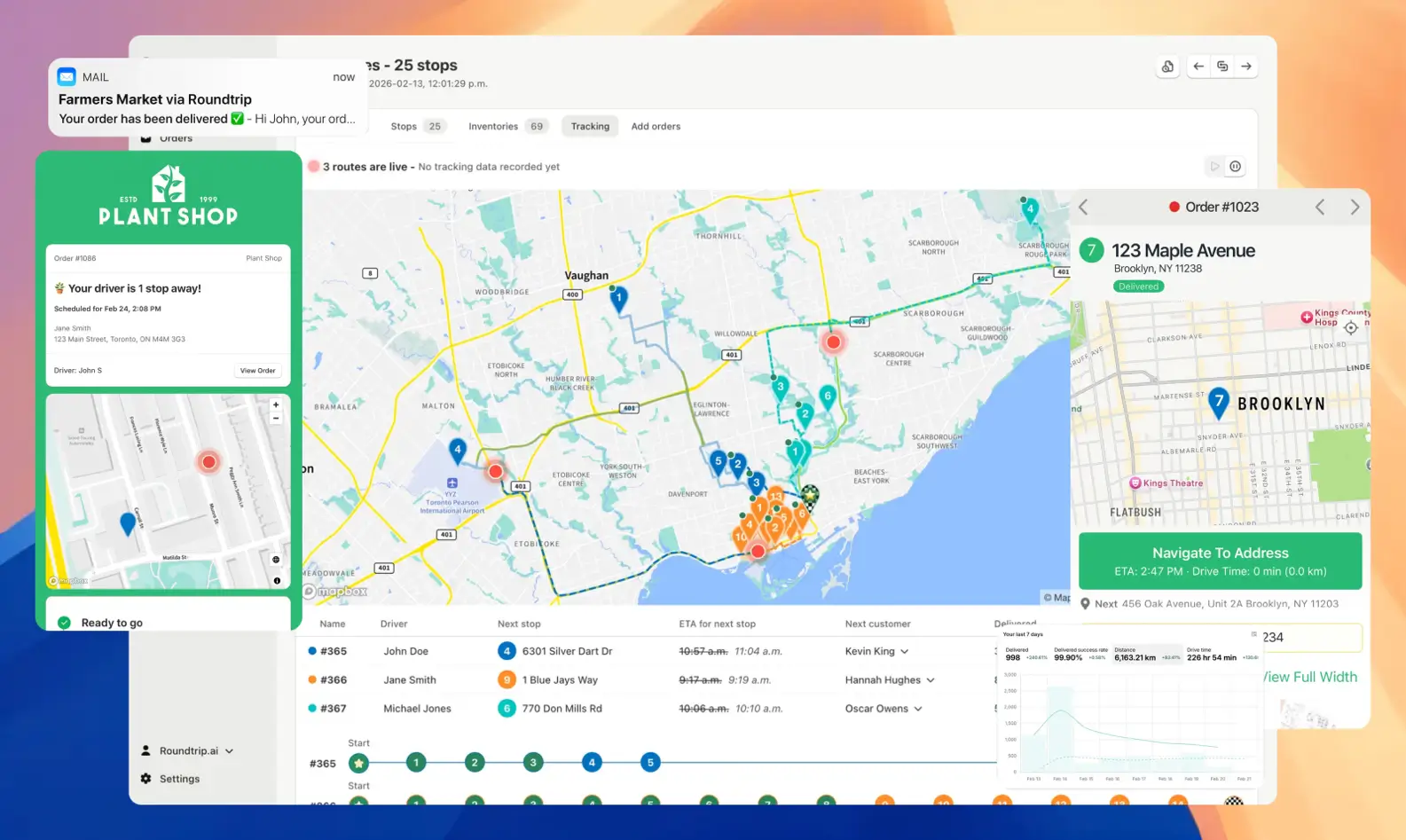
Shopify’s own Local Delivery app is free and covers the basics: automatic or manual route planning for up to 100 stops, customer delivery instructions, and automated status emails. For a small operation with a few dozen orders a day, that may be enough to start.
The limits show up as you grow. The biggest is capacity: Shopify Local Delivery caps a route at 100 stops, which can become a bottleneck during Black Friday, Cyber Monday, and other peaks. It also only works with orders marked for local delivery — you can’t easily pull in a pickup order, fix a bad address, or route an order placed earlier. And because it leans on basic Google Maps routing, optimization is limited.
EasyRoutes was built to go further while staying just as tightly integrated with Shopify. There’s no hard cap on deliveries, so you can scale from solo runs to large fleets. You can access and route any order regardless of status, create multiple optimized routes in a single click, balance stops across drivers, and fix or add stops on the fly. In short, Shopify Local Delivery is a convenient starting point; EasyRoutes is the all-in-one option for merchants who need flexibility and volume.

EasyRoutes is a full local delivery management suite that lives right inside your Shopify admin. Because it syncs directly with your Shopify orders, there’s nothing to export — your orders are ready to route the moment you open the app, and statuses flow back to Shopify automatically. No more wrestling with spreadsheets.
Its route optimization engine sorts through countless stop combinations to build the most efficient route, accounting for start and end points, time windows, service times, and limits like maximum stops or duration. Once a route is ready, you dispatch it to drivers, who use the EasyRoutes Delivery Driver app for iOS and Android to navigate stops, capture proof of delivery, and mark orders delivered — all while keeping Shopify up to date.
Your customers stay in the loop too, with branded tracking pages and delivery notifications that provide real-time tracking and dynamic ETAs. The result is fewer “where is my order?” messages, more on-time deliveries, and a delivery experience that strengthens your brand. EasyRoutes is available on a flexible, seat-based plan, and you can try any paid plan free for 14 days.
Local delivery is one of the highest-leverage things a Shopify merchant can offer: it meets rising expectations for fast, free delivery, deepens customer loyalty, and lets you own the last mile instead of outsourcing it. Shopify gives you the checkout option and a basic route planner to begin; a purpose-built app like EasyRoutes gives you the capacity, optimization, and customer communication tools to scale it.
Decide how and where you’ll deliver, set pricing that protects your margins, and put the right tools in place — then turn local delivery into a genuine competitive advantage. Install EasyRoutes from the Shopify App Store and start planning smarter routes today.
EasyRoutes for Shopify is best suited for merchants who already sell goods or services within the Shopify ecosystem. Users can plan optimized delivery routes with all orders received through their Shopify storefront, created via draft orders, or imported manually as custom stops.
EasyRoutes for Shopify integrates seamlessly with the Shopify Admin and dozens of leading third-party apps, making it the ideal choice for Shopify merchants seeking a streamlined local delivery solution.
Yes. EasyRoutes supports Shopify Local Delivery and can include Pickup orders on routes when you need a driver or staff task at your store or pickup point. Local Delivery instructions appear directly on the stop when available.
Yes. New and updated Shopify orders flow into EasyRoutes automatically so your Orders page stays current for planning. If something looks off, refresh and check your date/location filters.
EasyRoutes optimizes deliveries using your selected orders, start & end locations, stop time intervals, time windows, and route limits. You can balance routes, respect capacities, and re‑optimize as plans change.
See: Route Options · EasyRoutes 101
Yes. Create routes in minutes, add last‑minute stops, and re‑optimize during the day. Dispatch instantly to drivers with live tracking and customer notifications.
See: Re‑optimize · Dispatch
Yes. Draw custom delivery zones on the map to select orders in a specific geographical area, and reuse the same workflow whenever you plan routes for the same local area.
See: Delivery Zones
Yes. When you fulfill through EasyRoutes, a tracking link is added to the Shopify fulfillment so customers can follow their delivery from their order status page.
Pricing is based on plan tier plus the number of driver seats in your subscription; optional SMS is usage‑based. Scale seats up/down anytime.
See: Pricing · Pricing & Plans FAQ
EasyRoutes is the AI-native delivery operations platform trusted by 5,000+ businesses across 75+ countries. Plan routes in seconds, dispatch drivers automatically, and delight your customers — from Shopify or any order source. Experience delivery operations that run themselves. Rated 4.9 stars and certified Built for Shopify.
⭐⭐⭐⭐⭐ 4.9 stars • Trusted by 5,000+ Businesses