How to Handle Last-Minute Delivery Changes
By Joe SnyderLearn how to handle last-minute delivery changes with flexible routing, real-time tracking, dynamic route optimization, and proactive customer updates.

Learn how to handle last-minute delivery changes with flexible routing, real-time tracking, dynamic route optimization, and proactive customer updates.
A customer messages to say they will not be home until evening. A driver hits a road closure. An urgent order lands after routes are already built. Last-minute delivery changes are not the exception in modern logistics — they are a daily reality, and how you absorb them decides whether you keep your margins and your customers. The last-mile delivery market is projected to reach about $181.6 billion in 2026 on its way to $348.85 billion by 2033, and that growth comes with rising order volumes, tighter windows, and customers who expect to be kept in the loop. This guide breaks down the strategies and tools that let you adapt quickly without throwing the rest of your day into chaos.

Every late edit, missed window, or wrong turn carries a real price. Roughly 8% of first-time deliveries fail, costing an average of $17.20 per failed order once you add up the re-attempt, the driver dwell time, the warehouse re-sort, and the support ticket. During peak season the picture gets worse: up to 20% of packages can miss the first attempt, with address errors alone driving about 45% of failures. Because the last mile now represents roughly 53% of total shipping costs, up from 41% in 2018, even a modest failure rate eats into profit fast.
The reputational cost is bigger still. When a delivery goes wrong, 41% of consumers blame the retailer rather than the carrier, and 85% say they would not return after a poor delivery experience. The takeaway is simple: last-minute changes will happen, so the goal is not to eliminate them but to build an operation that handles them gracefully. The rest of this guide shows you how, and you can avoid the most frequent missteps along the way in our roundup of common delivery mistakes.
Flexibility starts with a delivery plan that is structured but never rigid. A solid route plan gives your day a backbone — sequenced stops, realistic timing, balanced driver workloads — but the real test is how easily you can change that plan when reality intervenes. Operations that depend on spreadsheets and manual sequencing struggle here, because a single mid-day edit forces a planner to rebuild everything by hand. Beyond a few hundred deliveries a month, those mid-day replans quietly pile up into overtime and missed windows.
Building flexibility in means choosing systems and processes designed for change: routes you can re-sequence in seconds, stops you can add or move without starting over, and capacity buffers that leave room for the unexpected. It also means planning for predictable surges. Demand spikes around holidays and promotions are not really last-minute — they are forecastable — so prepare with the tactics in our guide to managing local deliveries in peak times. The more your operation expects change, the less any single change costs you.
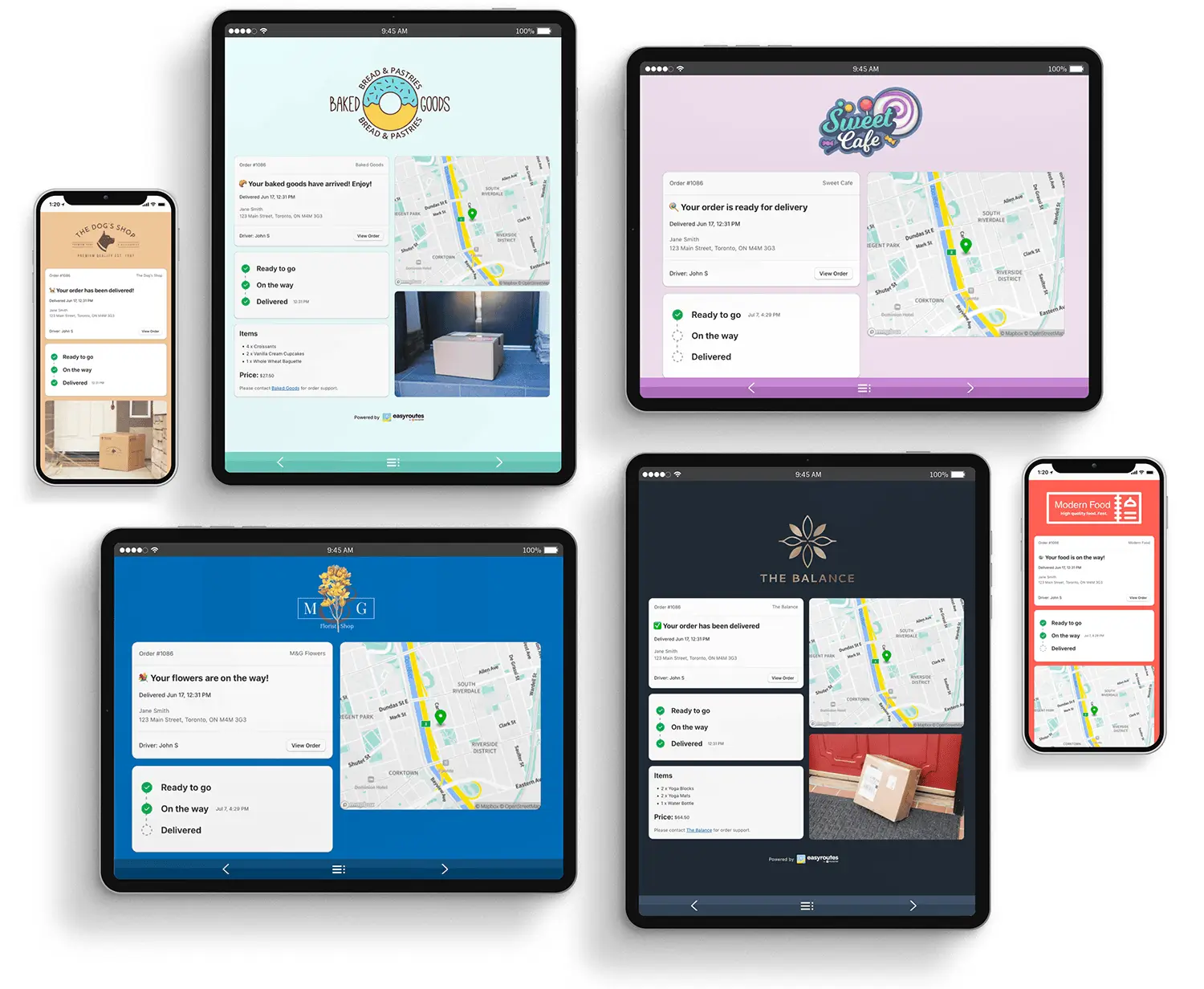
Transparency is the single most effective way to keep a changing delivery from becoming an angry customer. Expectations are now firmly set: 88% of consumers consider real-time tracking critical, 73% want to follow an order throughout delivery, and 96% use tracking when it is offered. Notably, 62% say an accurate estimated delivery date matters more to them than raw speed — which means an honest, updated ETA often beats a fast-but-uncertain one.
Done well, proactive communication also pays for itself operationally. Tracking-related “where is my order” questions account for 30–40% of e-commerce support tickets, and more than half during peak periods; a live tracking link and automatic status updates deflect most of them before a customer ever picks up the phone. This is exactly why a strong real-time tracking and notification setup belongs at the center of any plan for handling change. Give customers a live map, a moving ETA, and SMS or email alerts when something shifts, and a rescheduled stop turns from a complaint into a non-event.

When a stop drops off or a rush order comes in, the question is how fast you can rebuild a smart route around the change. This is where route optimization earns its keep. A good optimization engine weighs traffic, delivery windows, vehicle capacity, and stop priorities to produce an efficient sequence in seconds — and just as importantly, it can re-optimize the moment something changes, so an added or removed stop does not unravel the whole route.
The difference between a static plan and a responsive one is the heart of dynamic routing technology: instead of committing to a fixed sequence at the start of the day, the system continuously rebalances as conditions shift. For operations juggling many stops across several drivers, pairing dynamic routing with disciplined scheduled deliveries and clear time windows gives you both structure and the freedom to adjust. The result is fewer wasted miles, fewer blown ETAs, and a lower chance that today's curveball becomes tomorrow's failed delivery — a core tactic in any plan to reduce missed deliveries.
.webp)
Plans change once the van is moving, and the driver is the person best positioned to respond — if you give them the tools to do it. A capable driver app lets them re-sequence remaining stops, capture proof of delivery, update an order's status, and follow turn-by-turn navigation without calling the dispatcher. That autonomy matters: when drivers are not fighting their own tools, they make better real-time decisions and stay on schedule.
It also protects retention. Friction and constant firefighting burn drivers out, while the right technology removes busywork and keeps routes fair and predictable — a connection we explore in how routing technology boosts driver morale. Train drivers on the app before peak periods, not during them, so that when a last-minute change lands they can absorb it calmly instead of scrambling.
Speed of communication beats perfection. Customers are remarkably forgiving when you get ahead of a problem: they become far more understanding when a provider proactively flags a likely delay and offers the option to modify or cancel. A silent delay breeds frustration; a heads-up with a new ETA and a simple way to respond builds trust.
Practically, that means automating the moments that matter — order received, out for delivery, delayed, arriving soon, delivered — across SMS, email, and a live tracking page, and giving customers a low-effort channel to reschedule or leave instructions. Use multiple channels rather than relying on one, and let customers self-serve where possible so your team is freed up for genuine exceptions. Proactive, multi-channel updates are one of the highest-ROI habits in last-mile delivery, and they turn the inevitable change into a moment that actually reinforces your brand.

The strategies above only scale when they live in one connected system. Stitching together a separate routing tool, a tracking widget, and a messaging app leaves gaps exactly where last-minute changes slip through. A unified delivery management app keeps planning, optimization, driver workflow, customer notifications, and proof of delivery in sync, so a change made in one place updates everywhere automatically.
For teams that dispatch across multiple drivers or vehicles, layering in dispatch management software adds the control room view: assign and reassign stops, balance workloads, and push updated routes to drivers instantly. When your tools talk to each other, a same-day change becomes a few taps instead of a fire drill, and nothing falls through the cracks between systems.
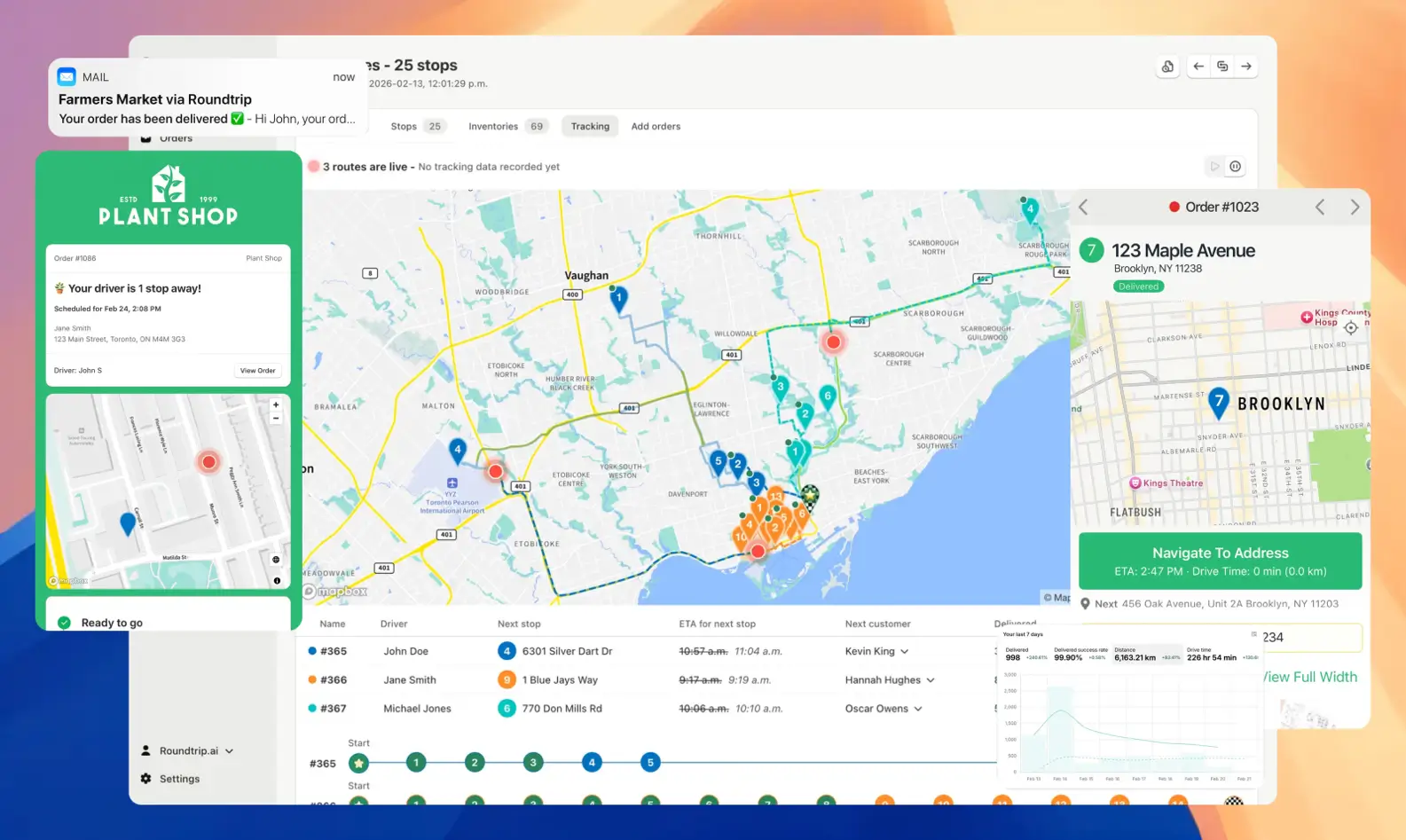
EasyRoutes brings these capabilities together for Shopify and other commerce platforms. You can re-optimize a route after it has been created, add or reorder stops on the fly, and balance workloads across drivers without rebuilding your day from scratch. The built-in tracking and notifications tools give customers a live map of their driver, accurate ETAs, and automatic SMS or email updates — including delay alerts — so a schedule shift never leaves them guessing.
On the road, the EasyRoutes Delivery Driver app lets drivers re-sequence stops, capture photo proof of delivery, and follow turn-by-turn navigation, while dispatchers track every route in real time and reassign work as conditions change. Features like vehicle capacity limits, delivery time windows, and multi-day route optimization mean the plan you build already accounts for constraints — so when the unexpected arrives, the system bends instead of breaking.
Last-minute delivery changes are not a sign that something has gone wrong; they are a normal feature of a fast-moving last mile. The businesses that thrive are the ones that expect change and design for it — with flexible routing, dynamic optimization, empowered drivers, real-time tracking, and proactive communication, all running on a single connected platform. Get those pieces working together and the daily curveballs stop threatening your margins and your reputation.
Ready to handle whatever the day throws at your routes? EasyRoutes gives you the route optimization, real-time tracking, and customer communication you need to adapt fast and keep deliveries on track. Start turning last-minute changes into a competitive advantage with a 14-day free trial today.
Add or remove stops on existing routes, then re‑optimize to refresh ETAs and send updates to the driver app. Changes can be made anytime during the day.
Yes. Re‑optimize at any time — after adding or removing stops, changing stop priorities, editing route options, or balancing loads. Drivers can also re-optimize routes delivered out of order, or re‑order stops if enabled from your EasyRoutes Settings.
Yes. Add/remove stops, drag‑and‑drop stops to reorder them, change drivers or schedules, and re‑optimize at any time.
See: Edit Routes
Yes. Use the customizable Rescheduled notification (email/SMS) to explain delays, provide a new ETA/date, and include the tracking link.
Yes. Enable Real‑Time Tracking in Settings → Driver settings (Premium/Enterprise subscription plans) to view live driver location and progress in the Tracking tab of any route.
See: Real‑Time Tracking
Yes. On Premium/Enterprise plans you can display a live driver pin on tracking pages when the driver is 1–10 stops away.
ETAs use route distance, stop service times, and historical traffic, and they update during the day as drivers progress. Accuracy improves when addresses and time windows are clean.
Yes. Schedule routes for specific dates/times, and ETAs will be calculated for each stop on a route. These ETAs can be shared via customer tracking links and email/SMS delivery notifications.
Yes. You can set delivery time windows per stop or import them from supported third‑party date/time apps. EasyRoutes optimizes routes to meet these windows and calculates ETAs accordingly.
Absolutely. Plan with item and weight limits to reflect the capacities of your fleet. Configure and assign Vehicle Profiles for an additional indicator for routes that have specific restrictions by vehicle.
Yes. Schedule routes across multiple days with configured start times/locations and add an overnight driver break to maintain accurate ETAs.
See: Multi‑Day Scheduling
Yes — if enabled. Planners can allow drivers to manually reorder stops and or re‑optimize remaining stops mid‑route.
Yes. If a scheduled start time is set, routes can be auto‑assigned and dispatched to the selected driver when created.
See: Auto‑Dispatch
Yes. With the Premium plan and above, fully customize email/SMS: add your logo and colors, edit copy/variables, and choose which events send. Works for Shopify orders and imported/manual stops.
EasyRoutes is the AI-native delivery operations platform trusted by 5,000+ businesses across 75+ countries. Plan routes in seconds, dispatch drivers automatically, and delight your customers — from Shopify or any order source. Experience delivery operations that run themselves. Rated 4.9 stars and certified Built for Shopify.
⭐⭐⭐⭐⭐ 4.9 stars • Trusted by 5,000+ Businesses