« Back to articles
How to Start (and Scale) a Delivery Business in 2026
Learn how to start and scale a delivery business in 2026: the opportunity, setup steps, costs, route optimization, hiring, and sustainable growth.
Learn how to start and scale a delivery business in 2026: the opportunity, setup steps, costs, route optimization, hiring, and sustainable growth.
Few business models have ridden the e-commerce wave as directly as delivery. As online ordering became the default rather than the exception, the unglamorous work of getting a package from a warehouse to a doorstep turned into one of the most valuable links in the entire retail chain. If you have been thinking about starting a delivery business, the timing has rarely been better — and the path from a single van to a profitable, scalable operation is more navigable than it looks.
This guide walks the full arc: the opportunity in front of you, how to choose a niche, the practical steps to launch legally and lean, how to plan routes so you are profitable from day one, and how to scale without drowning in chaos once the orders start stacking up.
The headline numbers are hard to ignore. The global last-mile delivery market was valued at roughly USD 167 billion in 2025 and is projected to reach about USD 349 billion by 2033, growing at a 9.8% compound annual rate, with North America holding the largest regional share. That growth sits on an even larger foundation: global e-commerce is expected to reach USD 7.9 trillion in 2026, nearly a quarter of all retail spending worldwide.
What does that mean for a new entrant? Demand for delivery is not a pandemic-era blip that is fading — it has normalized into how people shop. Every one of those online orders has to physically reach someone, and a growing slice of that work is handled not by the giants but by nimble local and regional operators who can serve a town, a category, or a service window better than a national carrier ever could.
Consumer expectations are also reshaping the market in favor of speed and reliability. Shoppers now treat fast, trackable delivery as a default rather than a perk, and they reward businesses that deliver on the promise — and abandon those that do not. For a local operator, that shift is an opening: the bar customers care about most is not lowest price but dependable, well-communicated service, and that is exactly the ground a focused small business can win.
The big names — UPS, FedEx, DHL, Amazon — are familiar for good reason. They have brand recognition, established distribution networks, fleets of vehicles, and sophisticated routing algorithms refined over decades. On paper, that looks like an impossible wall to climb.
It is not. Smaller operators win precisely where the giants are weakest: flexibility, responsiveness, and relationships. A local courier can offer same-day and last-minute service, handle delicate or specialized cargo, and build the kind of personal trust with customers that a national call center cannot. Low overhead lets you price sharply for the right jobs. The trick is to compete with the giants on your terms — speed, specialization, and service — rather than trying to out-scale them on theirs.
Consider a florist that needs blooms delivered intact within a two-hour window, a lab that needs samples moved on a strict chain of custody, or a restaurant that wants meals at the door still hot. National carriers optimize for volume and standardization; they are not built for these exceptions. A small operator who makes those exact jobs their specialty can command premium rates and lock in recurring contracts that the giants will never bother to chase.
Most operators begin with a single van, but the vehicle is dictated by the cargo. Bicycles and e-bikes excel for dense urban food and document runs; cargo vans suit retail and grocery; box trucks handle furniture and bulk. The bigger decision is your niche, because it shapes everything else — pricing, vehicles, insurance, and marketing. There is no shortage of viable delivery business ideas, but a few perennial categories stand out:

Once you know what you are delivering and to whom, the launch itself comes down to a handful of concrete tasks:

The single biggest lever on a delivery business’s profitability is how efficiently its vehicles move. Fuel alone can account for nearly a quarter of a fleet’s total operating costs, according to American Transportation Research Institute data — so every wasted mile comes straight out of your profit.
This is where route optimization earns its keep. Planning a multi-stop route by hand is deceptively hard: with just a dozen stops there are millions of possible orderings, the classic “Travelling Salesperson Problem.” Optimization software solves it in seconds, sequencing stops by location, time windows, and urgency, then adapting to traffic in real time. The payoff is fewer miles, lower fuel and labor costs, more deliveries per shift, and happier drivers — without adding a single vehicle. Adopting it on day one, rather than after the chaos sets in, is one of the highest-return decisions a new operator can make.

Early on, marketing is less about big budgets and more about being findable and reliable. A simple website, a Google Business Profile, and active local social media get you discovered; word-of-mouth keeps you growing. The most powerful marketing in delivery is an excellent delivery itself — customers who get accurate ETAs, real-time tracking, and on-time drop-offs become the referrals that compound. Decide early whether you are serving a tight local area, where you can dominate a community, or a wider region that calls for paid search and broader advertising.
A few low-cost moves punch above their weight in the first months. Partner directly with the businesses you want to serve — local shops, restaurants, or clinics — and pitch a reliability guarantee they cannot get from a national carrier. Ask every satisfied customer for a review, since social proof is what turns a stranger’s search into a booking. And keep your pricing transparent: hidden fees are the fastest way to lose the trust a small operator depends on. Consistency in those early weeks builds the reputation that later does your selling for you.
Many businesses wait too long to scale, usually until something breaks: missed stops, overwhelmed drivers, and a rising tide of “where is my order?” tickets. The warning signs are worth watching, because scaling well is about adding structure, not just adding vehicles. Three moves do most of the work:

Sustainability is no longer a nice-to-have; it is increasingly a buying criterion. More than half of shoppers — around 54%, according to recent retail research, say they will pay more for sustainably packaged products. On the operations side, greener transportation is becoming both cheaper and expected: electric vans cut fuel and maintenance costs in stop-and-go urban routes, and major carriers are committing hard — DHL, for example, is targeting 60% electric vehicles in its fleet by 2030. Even without an EV, optimizing routes to cut mileage is the fastest way to shrink both your fuel bill and your carbon footprint at once. Investing in driver training and retention rounds out a foundation that grows with you rather than against you.
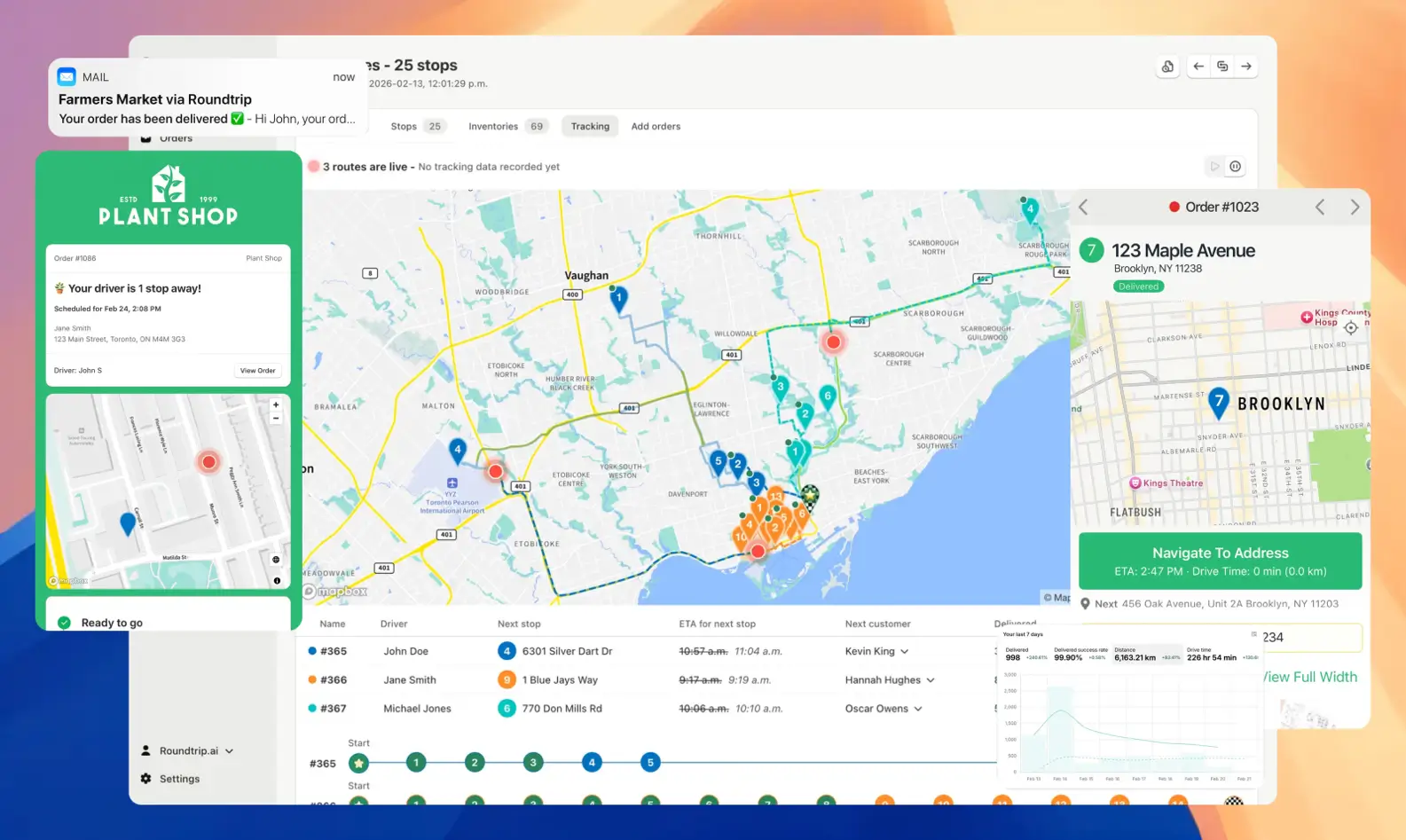
For eCommerce merchants and local delivery businesses, EasyRoutes is built to handle exactly this journey. It pulls your orders in automatically, builds optimized multi-stop routes in seconds, and dispatches them to drivers through a dedicated app with turn-by-turn navigation and proof-of-delivery capture. Customers get automated notifications and real-time tracking with accurate ETAs, while you get the delivery logs and performance data to manage the operation. Whether you are planning your first ten stops or coordinating a growing fleet, the same platform scales with you — turning routing, tracking, and dispatch from daily firefighting into a system that simply runs.

Starting a delivery business in 2026 means stepping into a large, growing market where speed, specialization, and service let small operators thrive alongside the giants. Launch lean and legal, choose a niche you can own, optimize your routes from the very first day, and build the systems that let you scale without sacrificing reliability. Get those fundamentals right and growth becomes not a source of chaos but the natural reward for doing the work well.
Ready to plan your first routes? Start your 14-day free trial of EasyRoutes today.
EasyRoutes is the AI-native delivery operations platform trusted by 5,000+ businesses across 75+ countries. Plan routes in seconds, dispatch drivers automatically, and delight your customers — from Shopify or any order source. Experience delivery operations that run themselves. Rated 4.8 stars and certified Built for Shopify.
⭐⭐⭐⭐⭐ 4.8 stars • Trusted by 5,000+ Businesses