Meal Kit Delivery in 2026: Trends, Stats & How to Start
By Joe SnyderYour 2026 guide to meal kit delivery: market size and trends, who's buying, how to start a service, and the delivery strategy that keeps subscribers.

Your 2026 guide to meal kit delivery: market size and trends, who's buying, how to start a service, and the delivery strategy that keeps subscribers.
Meal kit delivery has grown up. What began as a pandemic-era convenience has matured into a multi-billion-dollar global industry shaped by dietary personalization, sustainability expectations, AI-driven operations, and a fierce battle for customer loyalty. Whether you're researching the market or planning to launch your own service, this guide brings together the current data and the practical steps you need to build a meal kit delivery business in 2026.
We'll cover the size and shape of the market today, who's buying and why, how to start a service from the ground up, the competitive landscape you'll be entering, and the single operational factor that quietly makes or breaks most meal kit businesses: delivery.

The meal kit market is large, growing, and notoriously hard to size precisely — different research firms draw the boundaries differently. Estimates of the 2025 global market range from roughly $21 billion on the narrower end to around $29 billion, and up to $39 billion when broader ready-to-eat segments are included. The exact figure matters less than the direction: every major forecast has the market expanding through the early 2030s, with conservative models projecting steady high-single-digit annual growth and broader ones forecasting double-digit rates.
Geographically, North America is still the largest regional market, accounting for somewhere between 42% and 45% of global revenue in 2025. Asia-Pacific is the fastest-growing regional market, driven by urbanization, rising disposable incomes, and changing food culture across markets like China, India, and South Korea.
The United States is the single largest meal kit market in the world. According to IBISWorld, U.S. meal kit delivery revenue reached roughly $9.1 billion in 2026. Notably, growth has cooled: revenue rose just 2.8% in 2025, a sharp deceleration from the pandemic boom as some consumers shifted back to grocery-store prepared foods and quick-service restaurants. The market remains competitive and crowded, with around 397 businesses operating in the space as of 2025.
That slowdown isn't a reason to stay away — it's a signal that the easy pandemic growth is over and execution now wins. Providers are sustaining growth by expanding assortments (snacks, wine, ready-to-eat add-ons) and lifting average order values, and niche operators continue to find room to grow even as the overall market normalizes.

A meal kit is a food service delivered on a subscription basis, in the same family as other recurring consumer products. The model is straightforward: a customer selects meals on the company's website, the company portions and packages the ingredients, and the boxes are shipped or delivered to the customer's door, typically on a weekly cadence. Each kit pairs pre-measured ingredients with a step-by-step recipe so the customer can cook at home without planning or shopping.
People subscribe for a consistent set of reasons:
Understanding your customer is the foundation of a viable meal kit business. A few trends define the 2026 buyer:
Convenience is still the top driver. Dual-income households, working professionals, and busy families consistently cite time savings as their main reason to subscribe. Millennials and Gen Z remain the core demographic, comfortable with subscriptions and digital ordering, while Gen X parents looking for family-friendly solutions are broadening the base.
The market splits into 'cook & eat' and 'heat & eat.' Traditional cook-and-eat kits — raw, pre-portioned ingredients with a recipe — still dominate, accounting for roughly 60% of global revenue in 2025. Heat-and-eat options that require only reheating are growing faster as companies chase maximum convenience. The strongest operators increasingly offer both, letting customers choose based on how much time and energy they have on a given night.
Personalization is now a requirement, not a perk. Non-vegetarian kits still hold the largest share at roughly 63% of the global market, but plant-based options are the fastest-growing segment — the U.S. vegan meal kit category alone is projected to grow at about a 9.4% annual rate through the early 2030s. Beyond broad diets, customers increasingly expect keto, paleo, gluten-free, high-protein, and allergen-friendly choices, plus recommendations tailored to their past orders.
Sustainability is a genuine purchase factor. Recyclable, compostable, or reusable packaging is now table stakes, and excessive plastic has become a real reason customers churn. Brands that source locally, communicate their supply chain transparently, and minimize delivery emissions earn loyalty from the highest-value segments.
Technology is reshaping operations. AI is being used for menu personalization that reduces decision fatigue, for demand forecasting that cuts ingredient waste, and for route optimization that keeps perishable deliveries fresh and on time. For an operator, these aren't futuristic extras — they're the levers that protect margins in a thin-margin business.

Launching a meal kit business blends food-service fundamentals with logistics and e-commerce. Here's a practical sequence to work through as you build your business plan:
You don't need to get everything perfect on day one, but the businesses that survive treat fulfillment as a core part of the product — not an afterthought bolted on once orders start coming in.
The 2026 market is defined by a few scale leaders and a vibrant long tail of niche players. HelloFresh is the clear global and U.S. leader; in transaction-panel data it and its sister brands accounted for the large majority of direct-to-consumer meal kit sales among major players, per Bloomberg Second Measure. Its budget brand EveryPlate and acquisitions like Green Chef and Factor extend its reach across price points and diets.
The rest of the field has consolidated under larger parents. Blue Apron, one of the original pioneers, is now part of Wonder Group following its 2023 acquisition, and has been folded into Wonder's broader 'mealtime' platform. Home Chef is owned by grocery giant Kroger, illustrating how traditional retailers have entered the category through acquisition and private-label kits. Marley Spoon, Gousto, and Sunbasket round out the mid-tier.
The most dynamic part of the market, though, is the niche and local segment. Small and mid-sized operators that focus on a specific cuisine, dietary need, or regional delivery area can offer what the mass-market brands can't: a personal touch, community connection, and highly differentiated products. There is real room for a well-run local meal kit business to win loyal customers — provided it can deliver reliably.
If there's one number every aspiring operator should constantly analyze, it's churn. Meal kit retention is structurally low across the entire industry. Among customers who first subscribed in early 2022, after 11 months only about 15% remained at Blue Apron, 11% at Home Chef, and 9% at HelloFresh. Customers are easy to acquire with a discount, but harder to keep engaged and subscribed as more time passes.
That reality shapes how successful businesses operate:

Here's the part of the business that's easy to underestimate. Your product is perishable, your customers expect it on time, and your margins are thin — which means delivery isn't just logistics, it's the experience. As you grow from a handful of orders to dozens or hundreds, planning routes by hand becomes impossible, and tools like consumer mapping apps break down once you're juggling more than a few stops.
This is where dedicated route optimization earns its keep. The problem is genuinely hard: calculating the most efficient sequence across many stops, while respecting delivery windows and keeping ingredients within safe temperature ranges, is far beyond what manual planning can handle.
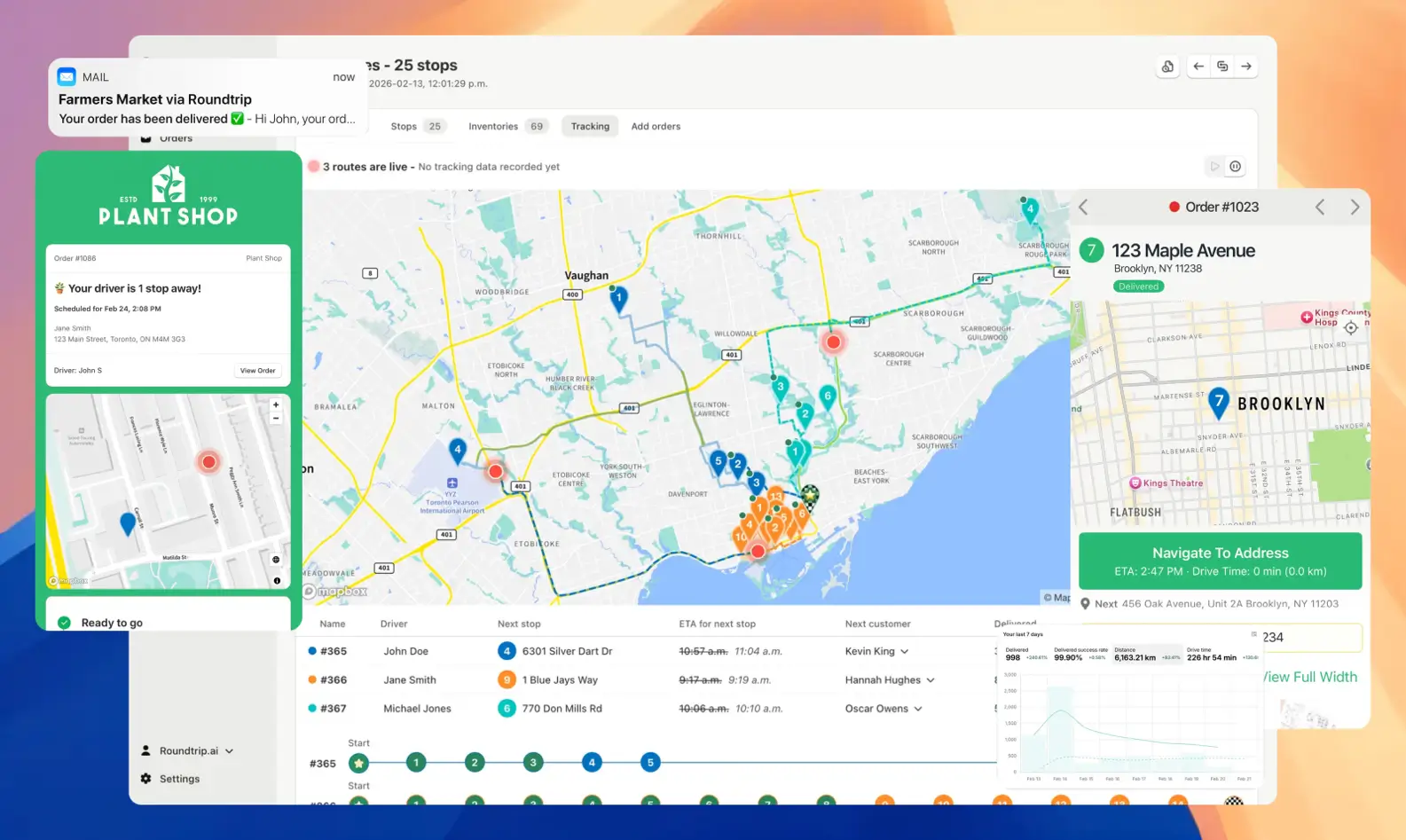
EasyRoutes is built for exactly this type of delivery operation. For meal kit businesses, it turns your orders into optimized multi-stop routes in seconds, then supports the rest of the delivery experience:
The payoff is twofold: fresher kits that arrive within their delivery windows, and lower mileage, fuel, and time costs — savings you can reinvest in your recipes, ingredients, and customers. When your product spoils and your margins are tight, your delivery infrastructure is your competitive advantage. You can start your free trial of EasyRoutes to see how it fits your operation.
The meal kit delivery industry in 2026 is a large, growing, and competitive market that rewards operators who execute the fundamentals better than everyone else. The headline data is encouraging — a multi-billion-dollar global market still expanding steadily — but the day-to-day winners are the businesses that personalize relentlessly, lead on sustainability, keep customers through flexibility, and treat delivery as a core part of the product rather than an afterthought.
If you're building a meal kit business on Shopify, EasyRoutes helps you deliver fresh ingredients on time, every time — with optimized routes, real-time tracking, and customer notifications built for perishable goods. Start your free trial today and turn delivery into your advantage.
Yes. Automate with Workflows to create routes on a custom, recurring schedule, or duplicate prior routes and re‑use their settings/stops in just a few clicks.
See: Workflows · Duplicate routes
Yes. Subscription orders from Shopify can be planned like standard orders. EasyRoutes also integrates with popular subscription/checkout apps.
Yes. You can set delivery time windows per stop or import them from supported third‑party date/time apps. EasyRoutes optimizes routes to meet these windows and calculates ETAs accordingly.
EasyRoutes supports delivery photos, e‑signature, driver notes, and automatic timestamps (with GPS location when available) to provide a complete delivery record.
See: Proof of Delivery
ETAs use route distance, stop service times, and historical traffic, and they update during the day as drivers progress. Accuracy improves when addresses and time windows are clean.
EasyRoutes is the AI-native delivery operations platform trusted by 5,000+ businesses across 75+ countries. Plan routes in seconds, dispatch drivers automatically, and delight your customers — from Shopify or any order source. Experience delivery operations that run themselves. Rated 4.9 stars and certified Built for Shopify.
⭐⭐⭐⭐⭐ 4.9 stars • Trusted by 5,000+ Businesses