Top Route Planning Tools for Businesses in 2026
By Sevaan FranksA ranked comparison of the 16 best route planning and delivery management platforms for delivery and service businesses in 2026.

A ranked comparison of the 16 best route planning and delivery management platforms for delivery and service businesses in 2026.
Managing multi-stop routes efficiently has never been more critical — or more complex. Whether you're a delivery business fulfilling eCommerce orders across multiple platforms, a service company scheduling daily field appointments, or a retailer coordinating phone, in-store, and online orders into a single daily route, the tool you use to plan and optimize those routes has a direct impact on your bottom line.
The right route planning software doesn't just save you time mapping stops — it reduces fuel costs, increases the number of deliveries or service calls you can complete in a day, keeps your customers informed, and gives you visibility into your entire operation. The wrong tool (or no tool at all) means wasted hours, inefficient routes, and a customer experience that can't keep pace with growing expectations.
We've evaluated the leading route planning and delivery management platforms available in 2026 to help you find the right fit — whether you're a solo operator running a handful of stops or a growing fleet managing hundreds of daily deliveries and service calls.
Pricing information reflects publicly available data as of March 2026 and may vary. Contact each provider for the most current pricing.
Before diving into specific tools, it's worth establishing what separates a capable route planning platform from one that will leave you scrambling. Here are the key criteria to evaluate:
Route Optimization & Multi-Stop Planning: The foundation. Can the software build efficient routes across dozens or hundreds of stops, accounting for time windows, vehicle capacity, and real-world traffic conditions? Can it split orders across multiple drivers intelligently?
Driver or Technician Mobile App: Your team in the field needs a clean, intuitive mobile experience. Look for apps that provide turn-by-turn navigation, stop-by-stop instructions, and the ability to capture proof of delivery or service completion on the go.
Proof of Delivery or Service Completion: Photo capture, digital signatures, timestamps, and driver notes. These protect your business from disputes and give your customers confidence that their order arrived (or their service was completed) as expected.
Customer Notifications & Tracking: Automated SMS or email updates, real-time tracking pages, and accurate ETAs reduce "Where is my order?" inquiries and elevate your customer experience.
Integrations: Does the platform connect with your eCommerce backend (Shopify, WooCommerce, BigCommerce, etc.), your POS system, or your CRM? The fewer spreadsheets you need to export and import, the better.
Support for Mixed Order Sources: Many businesses don't operate purely online. The ability to route orders taken over the phone, in-store, or through manual entry alongside eCommerce orders — without workarounds — is a major differentiator.
Pricing & Scalability: Can you start small and grow? Beware of platforms that price per vehicle or per driver at rates that become unsustainable as your operation scales.
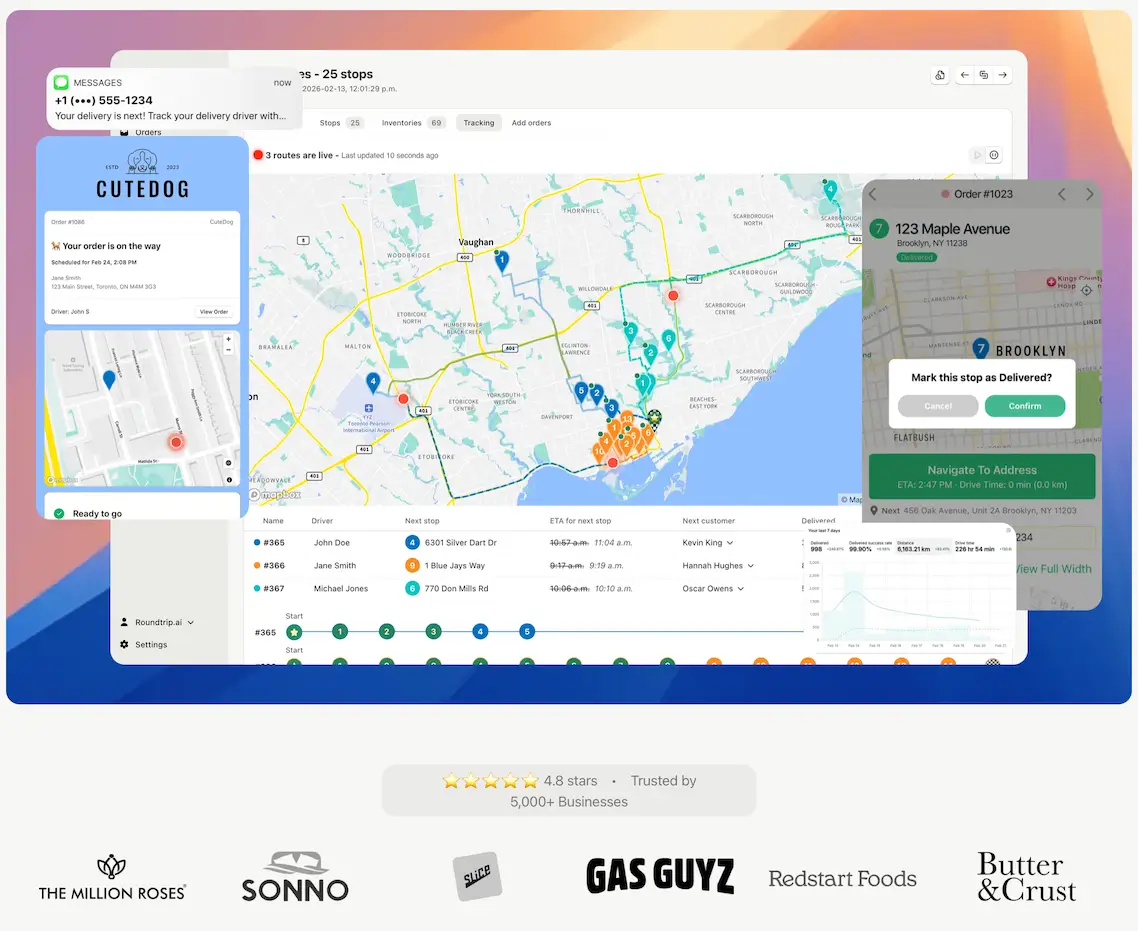
A versatile route planning and delivery management platform built for businesses of any size — from local delivery operations and eCommerce merchants to service companies managing daily field appointments.
EasyRoutes stands out for its flexibility. Unlike many tools in this space that lock you into a single platform or use case, EasyRoutes is designed to work with orders from any major eCommerce platform, as well as orders taken over the phone, in-store, or through any other channel. That makes it a natural fit for businesses that don't operate purely online — think HVAC companies scheduling service calls, retailers offering same-day local delivery alongside their online storefront, or catering businesses juggling phone orders and web orders on the same route.
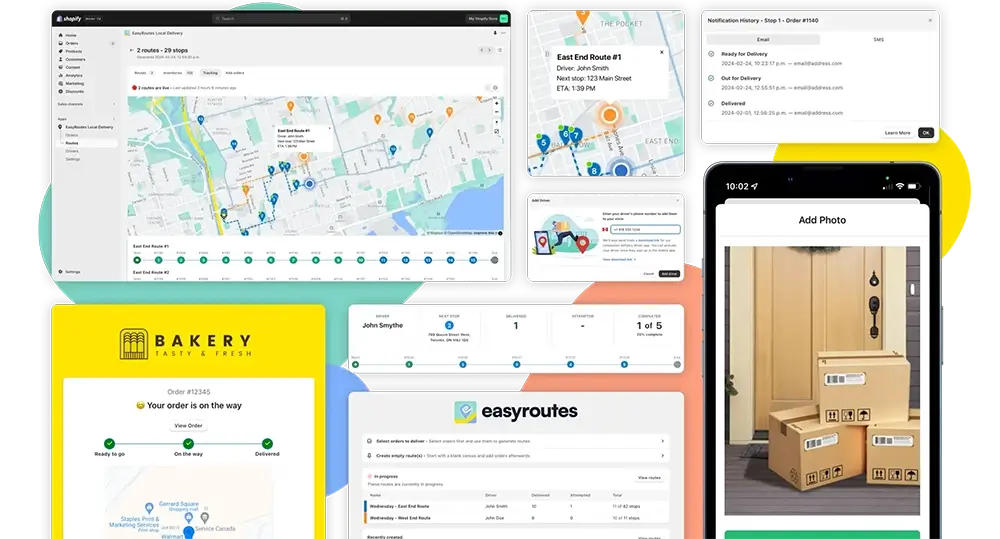
At its core, EasyRoutes offers intelligent route optimization, a polished driver mobile app for iOS and Android, real-time customer notifications and order tracking, photo and signature proof of delivery, smart route splitting across multiple drivers, and detailed delivery analytics. Routes can be built, edited, and dispatched in seconds — whether you're routing five stops or five hundred.
Best suited for: Small to mid-sized businesses that need a single platform to handle route planning across mixed order sources — eCommerce, phone, in-store, or service appointments. Especially strong for businesses that want enterprise-grade features without enterprise-grade complexity or cost.
Considerations: Businesses operating massive multi-depot logistics networks with hundreds of drivers may eventually need a more enterprise-focused platform like Bringg or Onfleet, though EasyRoutes scales comfortably for the vast majority of growing operations.
Pricing: Free plan available (up to 50 orders/month); paid plans from $39–$59/month per driver. 14-day free trial.
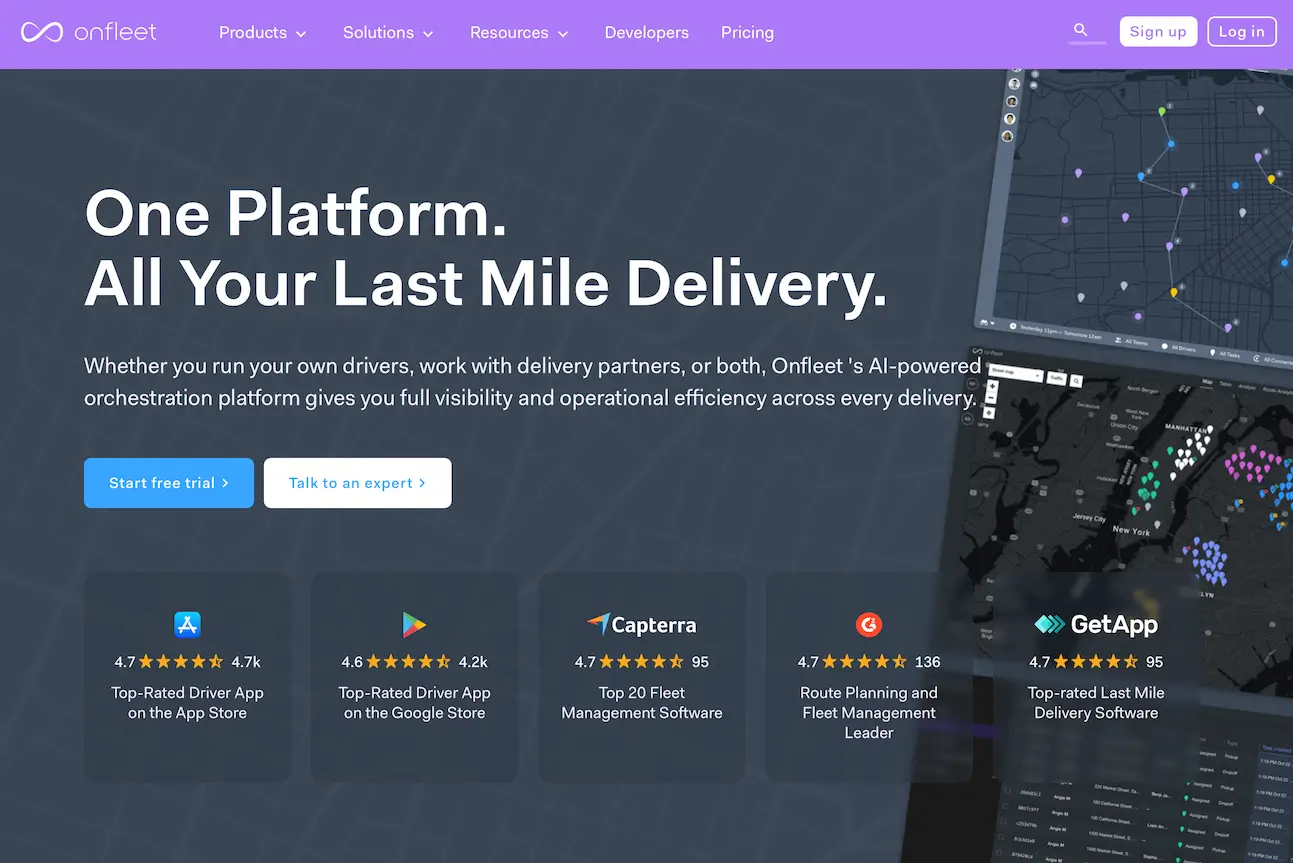
An enterprise-grade delivery management platform built for large-scale operations with complex logistics, multiple depots, and high delivery volumes.
Onfleet is one of the most recognized names in delivery management, and for good reason — it's built to handle the operational complexity that comes with scaling. If your business operates across multiple regions with large driver teams and strict service-level agreements, Onfleet offers the depth of tooling to coordinate it all: advanced auto-dispatch, predictive ETAs, barcode scanning, robust analytics, and a real-time dashboard that gives dispatchers full visibility into every active route.
Its API is a major selling point for businesses that need to integrate delivery management deeply into their existing tech stack, and its driver app is solid and well-maintained. Onfleet is particularly popular in industries like pharmacy delivery, grocery logistics, and regional courier operations where compliance and precision are non-negotiable.
Best suited for: Mid-to-large delivery operations with dedicated dispatch teams, multiple depots, and complex routing requirements. Businesses already running at scale who need granular control over fleet operations.
Considerations: Onfleet's power comes with a steeper learning curve and higher price point than most SMB-focused tools. Smaller businesses or those just starting out with local delivery may find it overkill — both in features and cost — compared to more accessible options like EasyRoutes or Routific.
Pricing: Starts at ~$599/month (Launch plan, ~2,500 tasks); Scale ~$1,299/month; Enterprise ~$2,999/month. No free tier; 14-day free trial.
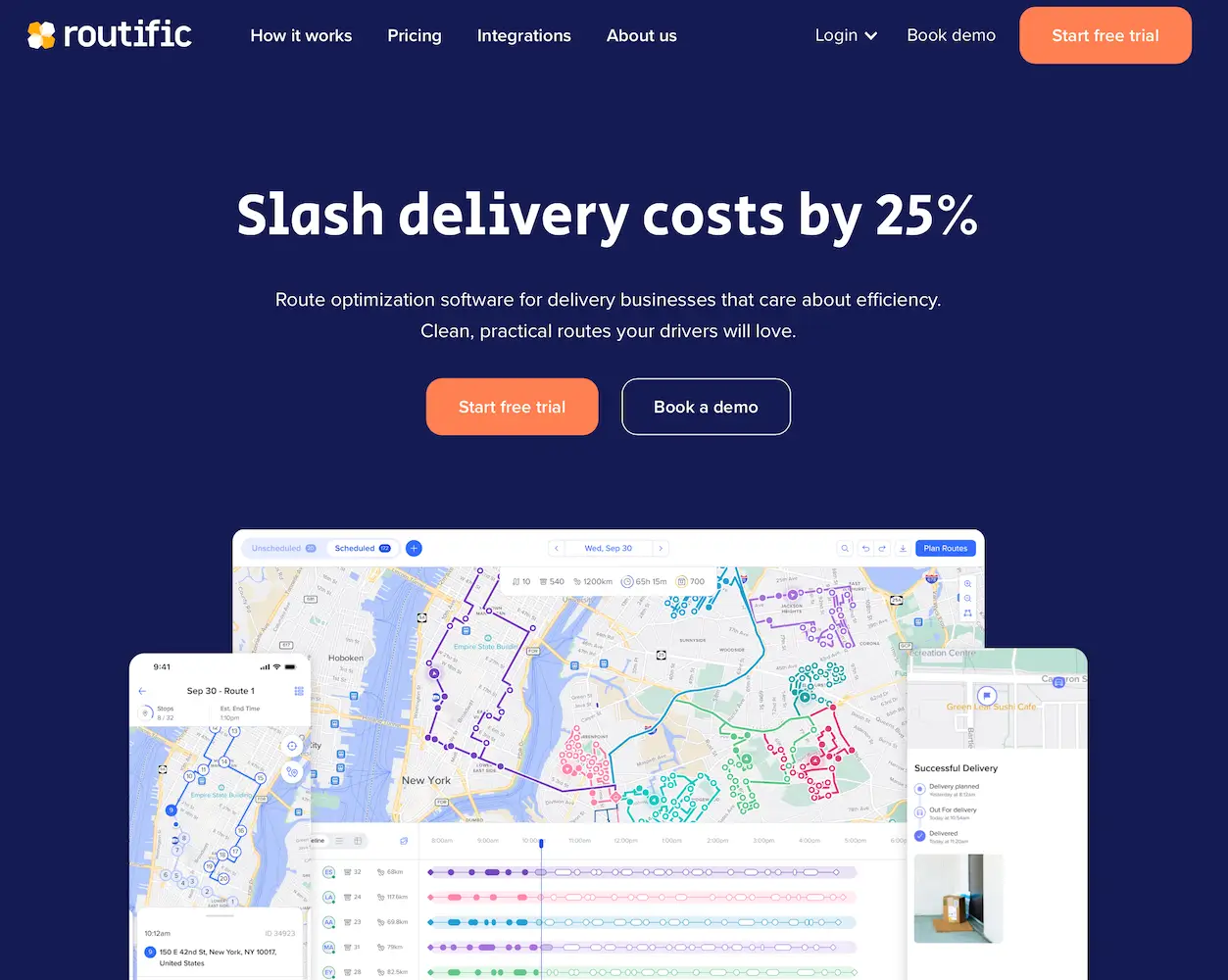
A route optimization platform focused on efficiency and cost reduction, popular with delivery businesses that want solid optimization without unnecessary complexity.
Routific has built a strong reputation around its core optimization engine, which helps businesses reduce drive time and increase delivery density on every route. It's a clean, focused tool that does route planning well and doesn't try to be everything to everyone.
The platform includes customer notifications, fleet tracking, and proof of delivery, along with flexible pricing models that make it attractive for lean operations or businesses with seasonal delivery volumes. Routific also offers a Shopify integration, making it a common choice for eCommerce merchants exploring route optimization for the first time.
Best suited for: Small to mid-sized delivery businesses that prioritize operational efficiency and want a straightforward, focused route optimization tool. A good fit for businesses doing daily local delivery runs where cost-per-delivery is a key metric.
Considerations: Routific's focus on route optimization means it's lighter on features outside of that core — businesses that need deep integrations across multiple eCommerce platforms, support for mixed order sources (phone, in-store), or service-business workflows may find it limiting compared to more versatile platforms like EasyRoutes.
Pricing: Free tier for up to 100 orders/month; $150/month for up to 1,000 orders, then per-order pricing (as low as $0.03/order at volume). 7-day free trial.
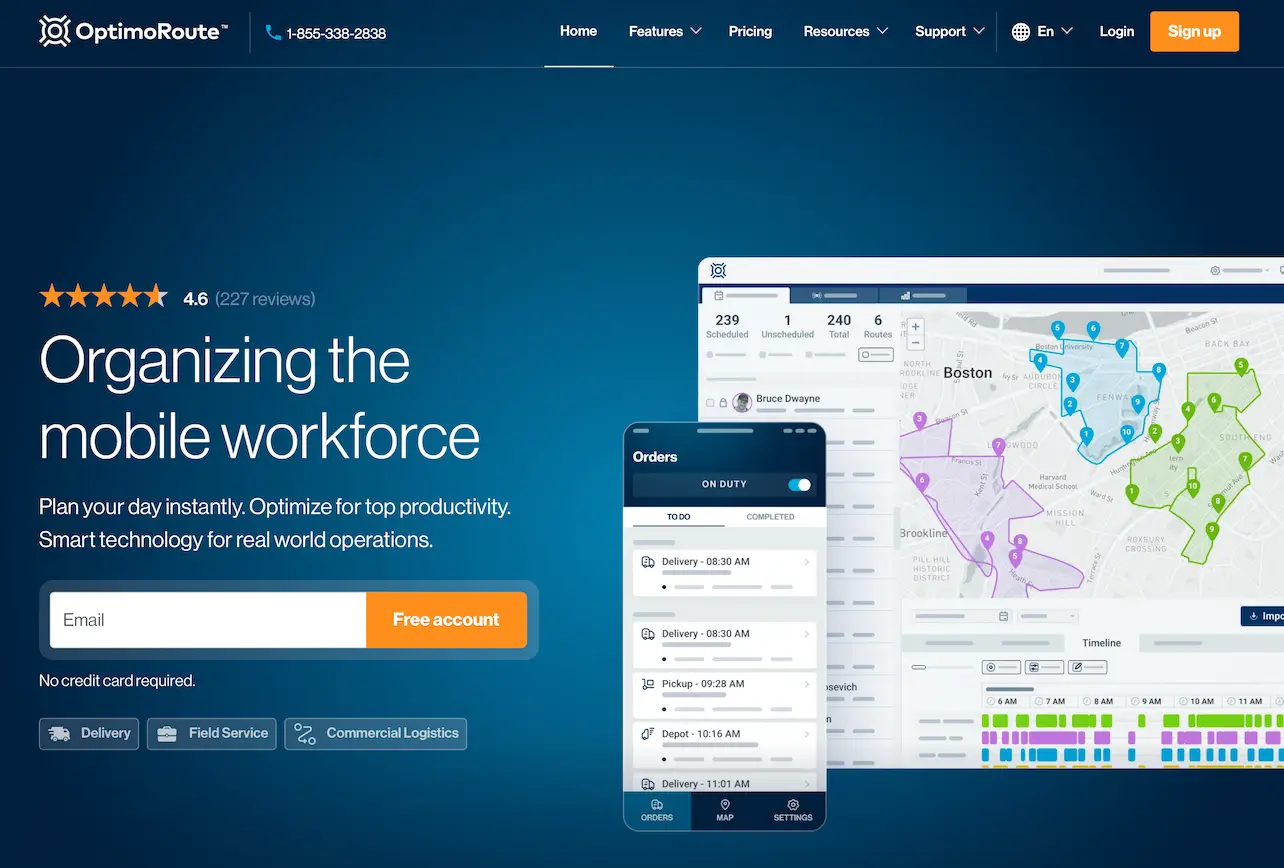
A cloud-based route planning platform with applications across delivery, field service, and sales, known for its planning depth and multi-day route capabilities.
OptimoRoute positions itself as a tool for organizing mobile workforces broadly — not just delivery drivers. Its feature set includes live tracking, real-time order tracking, proof of delivery, workload balancing across drivers, and the ability to plan routes across multiple days or weeks in advance. That multi-day planning capability is a standout feature for businesses with long-haul or recurring service routes.
The platform also accounts for driver working hours, vehicle specifications (like refrigeration or capacity limits), and can automatically redistribute orders when things change — a sick driver, a cancelled stop, a last-minute addition.
Best suited for: Delivery and field service businesses that need advanced planning features, particularly multi-day route planning, workload balancing, and vehicle-specific routing.
Considerations: The interface can feel dated compared to newer platforms, and some users report that the learning curve is steeper than expected. Pricing scales per driver, which can add up quickly for growing teams.
Pricing: Lite $39/driver/month; Pro $49/driver/month. No free tier; 30-day free trial. 10% discount for annual billing.
A route planning tool for small to mid-sized businesses covering delivery, field sales, and territory management, with a broad feature set and wide platform availability.
Route4Me has been in the route planning space for a long time and offers a wide range of features: GPS tracking, territory management, barcode support, dispatch management, driver performance analytics, and more. It's available on web, iOS, Android, Mac, and Windows, making it one of the most platform-accessible options on this list.
The tool is particularly popular with field sales teams and businesses that need territory management alongside route optimization. Route planning is fast — Route4Me claims routes can be generated in under a minute — and routes can be edited, renamed, and duplicated easily.
Best suited for: Small to mid-sized fleets that need a combination of route planning, territory management, and driver tracking. Also a common choice for field sales organizations.
Considerations: The interface can feel cluttered, and building routes requires clicking through multiple screens. Some users report that completed stops occasionally disappear from daily logs, leading to data integrity concerns. Pricing is on the higher end for SMBs.
Pricing: Route Optimization plan from ~$199/month; team plans require $200/month minimum. No free tier; no free trial as of early 2026.
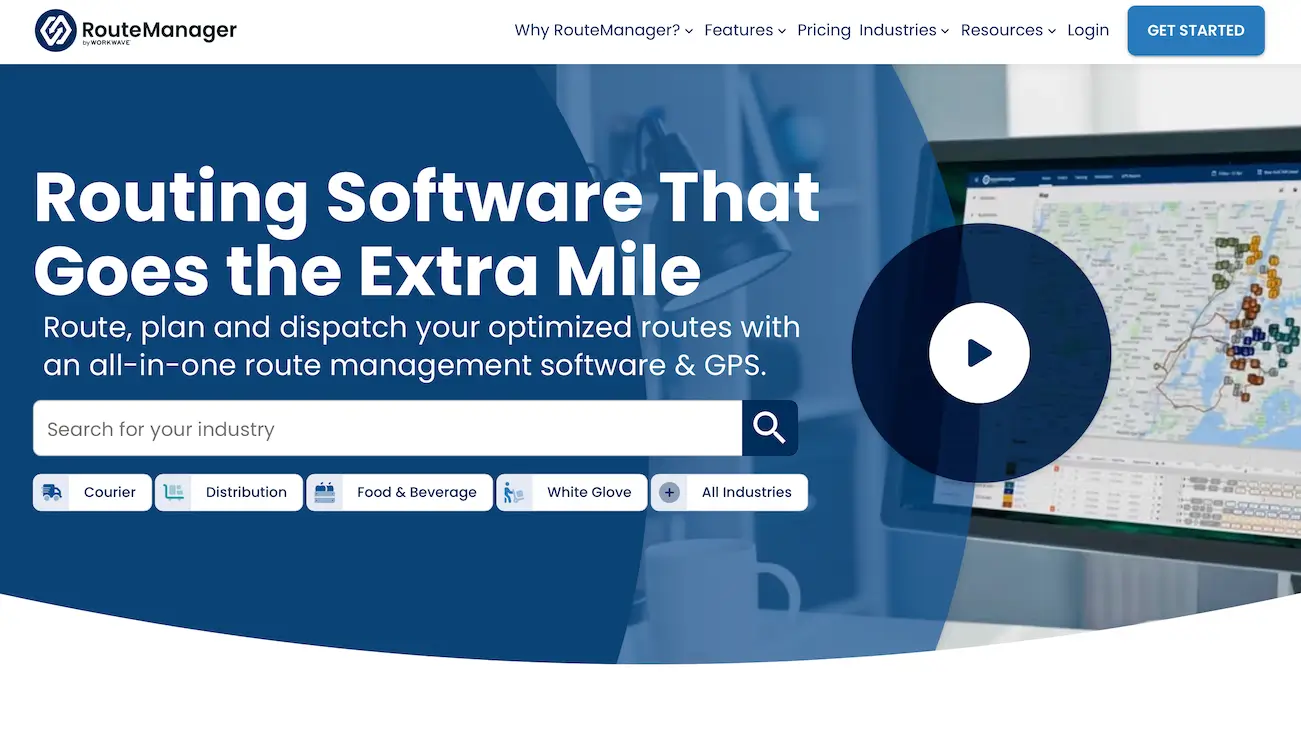
A cloud-based fleet management and route planning solution aimed at businesses managing mobile workforces across delivery and field service.
WorkWave Route Manager focuses on helping businesses schedule around customer demands and time windows. It supports drag-and-drop scheduling, violation alerts for service-level breaches, and last-minute order assignment. The mobile app allows drivers to receive routes, capture proof of delivery, and check in and out of stops with GPS verification.
WorkWave has a strong presence in field service industries — lawn care, pest control, cleaning services — in addition to delivery. Its barcode recognition feature is a useful differentiator for businesses that need to scan and verify packages.
Best suited for: Field service companies and delivery businesses that need scheduling flexibility, time-window management, and GPS-verified stop completion. Strong in industries like lawn care, cleaning, and pest control.
Considerations: The optimization speed could be faster, and the filtering options are limited. The interface has a learning curve that may frustrate less tech-savvy team members. Pricing is not publicly transparent, requiring a sales conversation.
Pricing: Quote-based; contact sales for details. No publicly listed pricing or free tier.
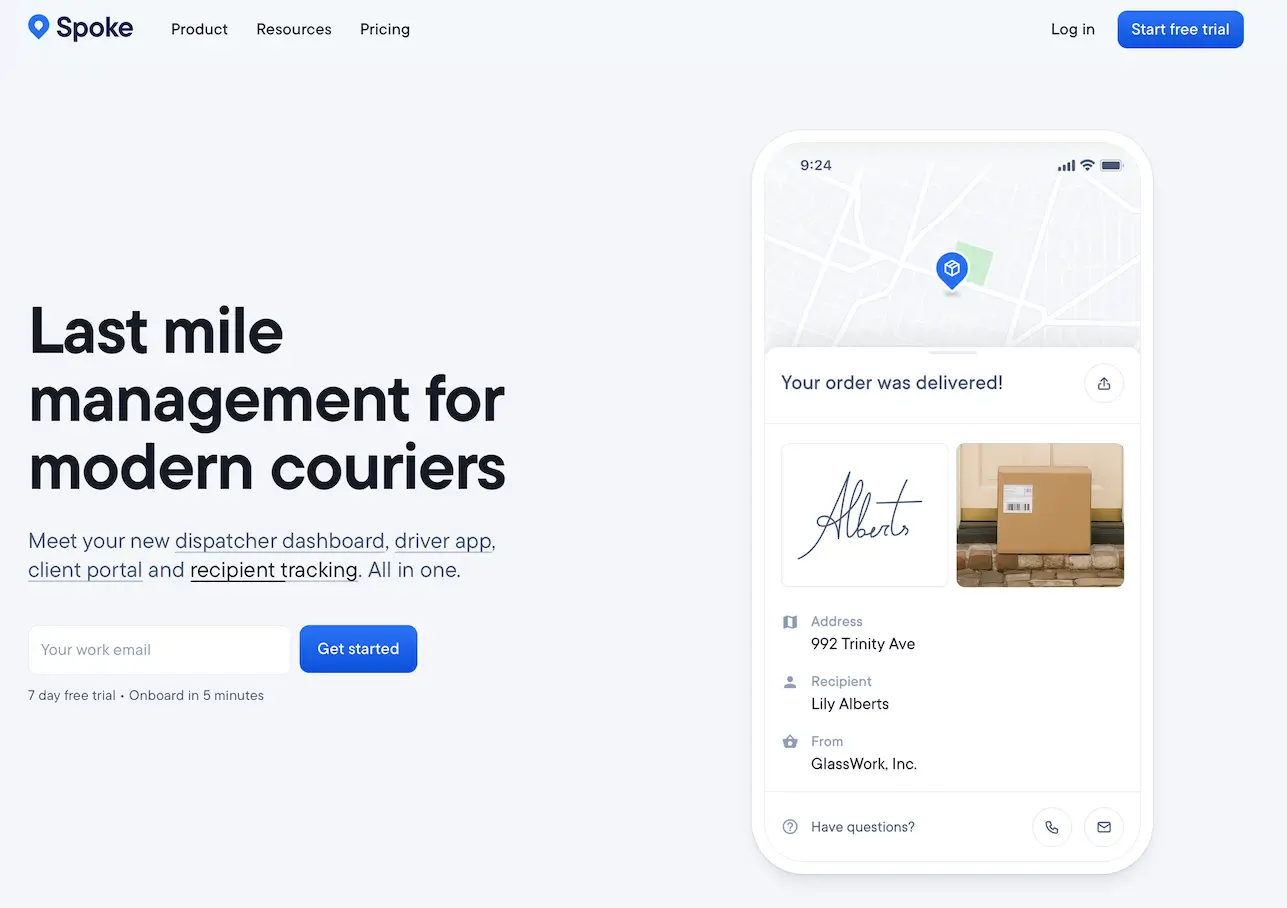
A multi-stop route planner focused on simplicity and speed, with a clean interface and straightforward pricing.
Spoke (formerly Spoke Route Planner) keeps things simple. It's designed to get routes built and dispatched quickly — the platform can accept thousands of stops and convert them into optimized routes for multiple drivers in minutes. Real-time tracking, accurate ETAs, customer notifications, and proof of delivery are all included.
The mobile app is intuitive and well-designed, which means less onboarding time for drivers. Spoke also offers hands-free voice entry for building routes, which is a nice touch for teams that work on the go. Its API is surprisingly polished for a tool at this price point.
Best suited for: Small to mid-sized delivery businesses, courier companies, and retail operations that want a clean, easy-to-use route planner without a steep learning curve.
Considerations: Spoke is less deeply integrated with eCommerce platforms than tools like EasyRoutes, so businesses pulling orders from Shopify, WooCommerce, or other platforms will likely need to do more manual work to get orders into the system. Route editing flexibility after dispatch is also limited.
Pricing: Starts at ~$125/month (Starter, 500 stops included); overage charged per stop. No free tier; free trial available.
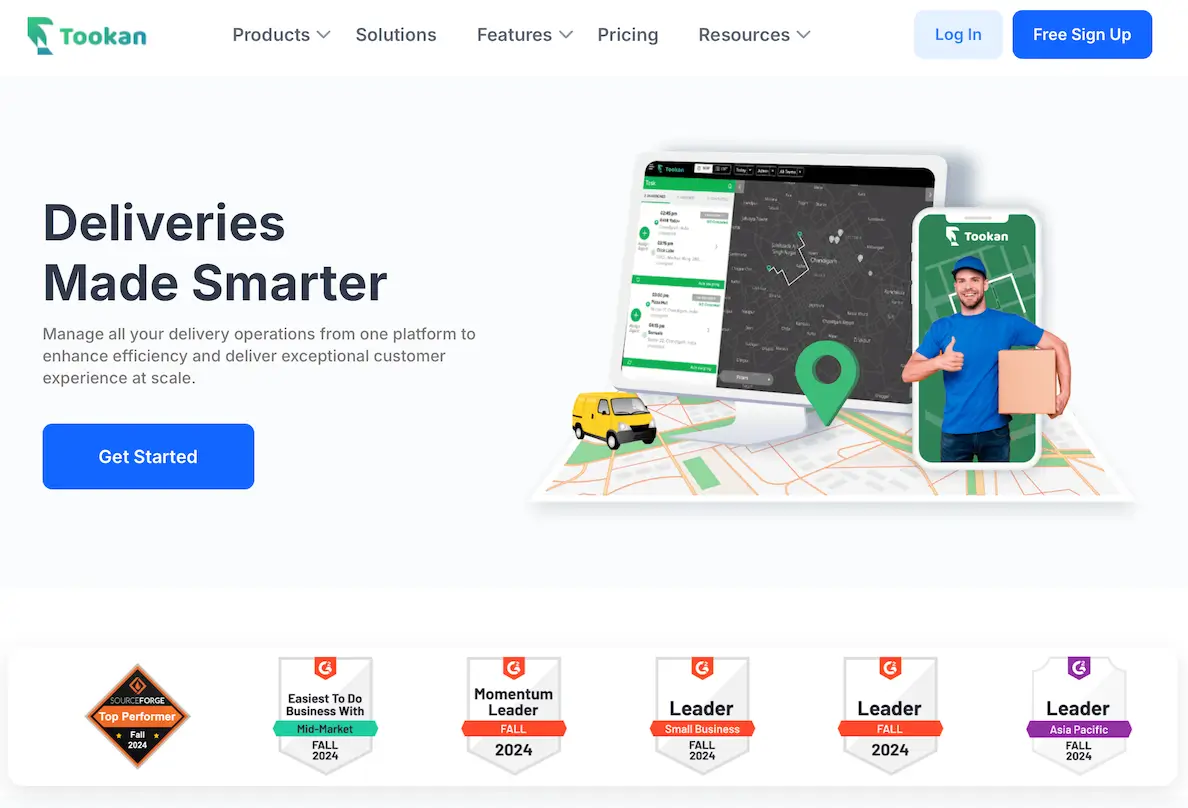
A modular delivery management platform known for its flexibility and customization, serving a wide variety of industries through APIs and configurable workflows.
Tookan takes a different approach than most tools on this list — it's designed to be highly modular, letting businesses build custom delivery workflows through a combination of features and API integrations. That makes it adaptable across a wide range of use cases, from hyperlocal food delivery to long-haul logistics to mobile cleaning services.
The platform covers route optimization, real-time tracking, automated dispatch, customer notifications, and agent management. Its marketplace of add-ons and integrations allows businesses to bolt on features as needed rather than paying for an all-in-one package upfront.
Best suited for: Tech-savvy teams that want a highly customizable delivery management platform they can tailor to their specific workflows. Strong for businesses operating in niche verticals that need flexible configurations.
Considerations: That flexibility comes at the cost of setup complexity. Tookan is not a "sign up and start routing" experience — it requires more configuration time than simpler tools. Businesses that just need fast, clean route optimization without extensive customization may find it more platform than they need.
Pricing: Starts at ~$39/month; route optimization and other advanced features are paid add-ons. 14-day free trial.
An enterprise-grade delivery orchestration platform built for large retailers and logistics firms managing omnichannel fulfillment at scale.
Bringg sits at the enterprise end of the spectrum. It's designed for businesses managing complex fulfillment operations across multiple channels — in-store pickups, home delivery, curbside, ship-from-store — with a unified view of inventory and deliveries across regions. Third-party courier management, advanced analytics, and orchestration tools round out a platform built for operational complexity.
If you're managing deliveries across dozens of locations with multiple carrier partners and need a platform that ties it all together, Bringg is built for that challenge.
Best suited for: Large retailers, logistics firms, and enterprise operations managing omnichannel fulfillment across multiple regions and carrier partners.
Considerations: Bringg is almost certainly overkill for small to mid-sized businesses — both in complexity and cost. It's a platform you grow into at scale, not one you start with. Most growing businesses will be better served by more accessible tools until their operations genuinely demand enterprise-level orchestration.
Pricing: Quote-based; enterprise sales engagement required. No publicly listed pricing or free tier.
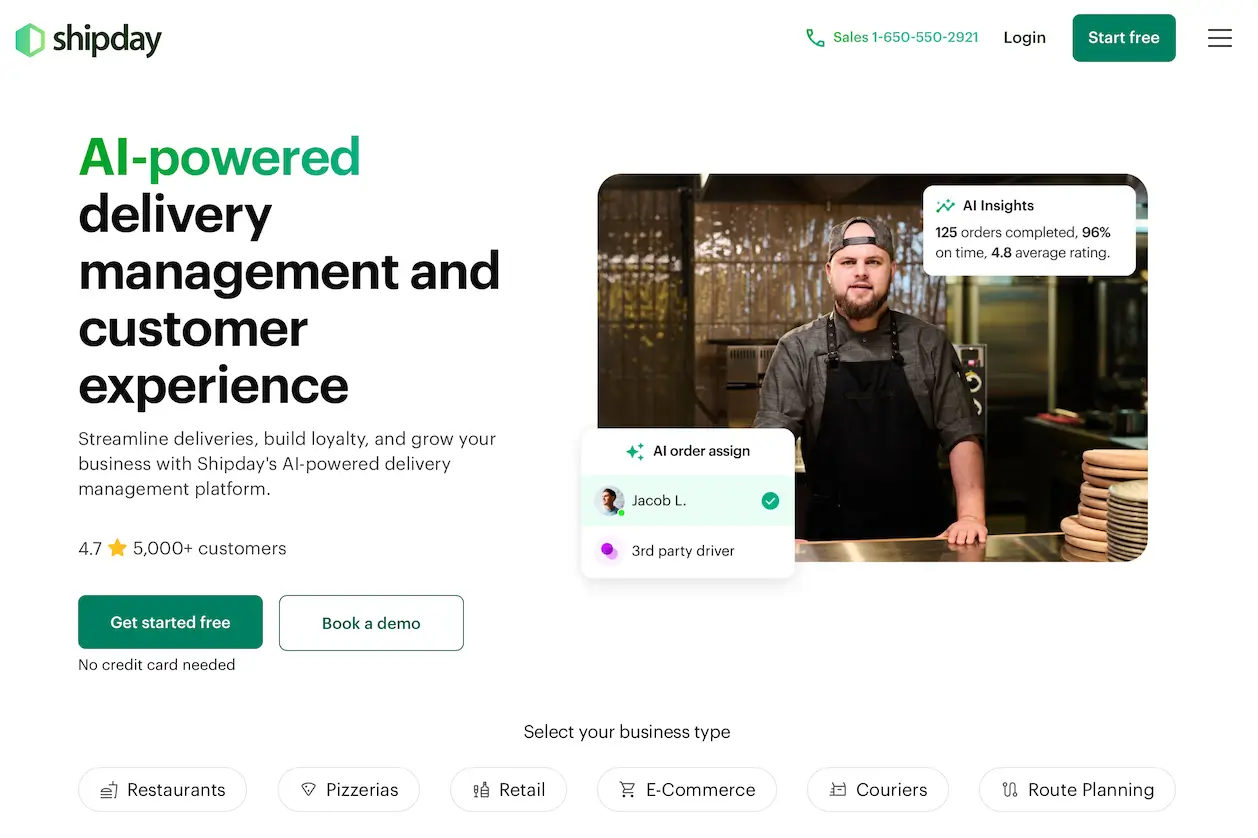
A delivery tracking platform focused on real-time visibility and customer communication, popular with restaurants and local delivery businesses.
Shipday's core strength is making delivery tracking easy and transparent. If your business prioritizes giving customers an Uber-like tracking experience — live driver location, branded SMS updates, accurate ETAs — without building that infrastructure yourself, Shipday delivers on that promise.
It integrates with various POS systems and includes proof of delivery, driver tracking, and a clean dispatcher dashboard. Shipday is particularly popular with restaurants, pizzerias, and local food delivery operations where customer communication is the top priority.
Best suited for: Restaurants, food delivery businesses, and local delivery operations that prioritize customer-facing tracking and communication above all else.
Considerations: Shipday doesn't offer the full depth of route optimization found in platforms like EasyRoutes or OptimoRoute. It's more of a tracking and communication layer than a comprehensive route planning tool. Businesses that need advanced optimization, multi-driver route splitting, or service-business workflows will likely need to look elsewhere.
Pricing: Free for up to 300 orders/month; paid plans available for higher volumes.
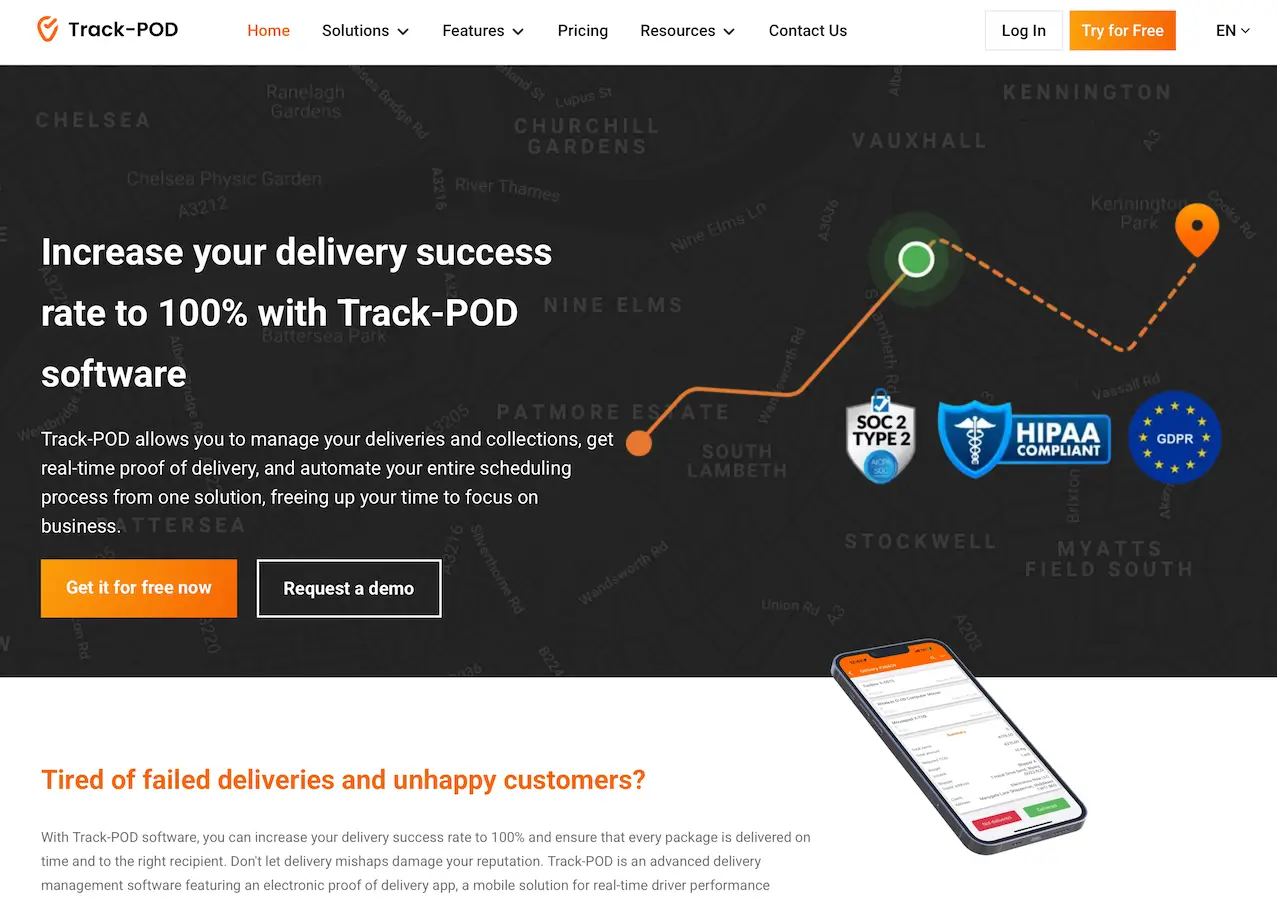
A delivery management platform with a strong focus on proof of delivery, vehicle tracking, and route optimization for logistics-heavy operations.
Track-POD is built around accountability and verification. Its proof of delivery capabilities are among the most robust on this list — supporting photo capture, digital signatures, barcode scanning, and timestamped GPS verification. The platform also includes route optimization, vehicle tracking, and analytics.
It's widely used by logistics companies and can be customized to suit various delivery scenarios, from daily local runs to complex multi-stop distribution routes.
Best suited for: Logistics and distribution companies where proof of delivery, compliance, and delivery verification are top priorities. Strong for businesses that need detailed delivery documentation.
Considerations: The platform is more logistics-focused than eCommerce-focused. Businesses looking for tight integration with Shopify, WooCommerce, or other eCommerce platforms may find the integration options limited compared to tools like EasyRoutes or Routific.
Pricing: From ~$29/driver/month; 3-driver minimum may apply. No free tier.
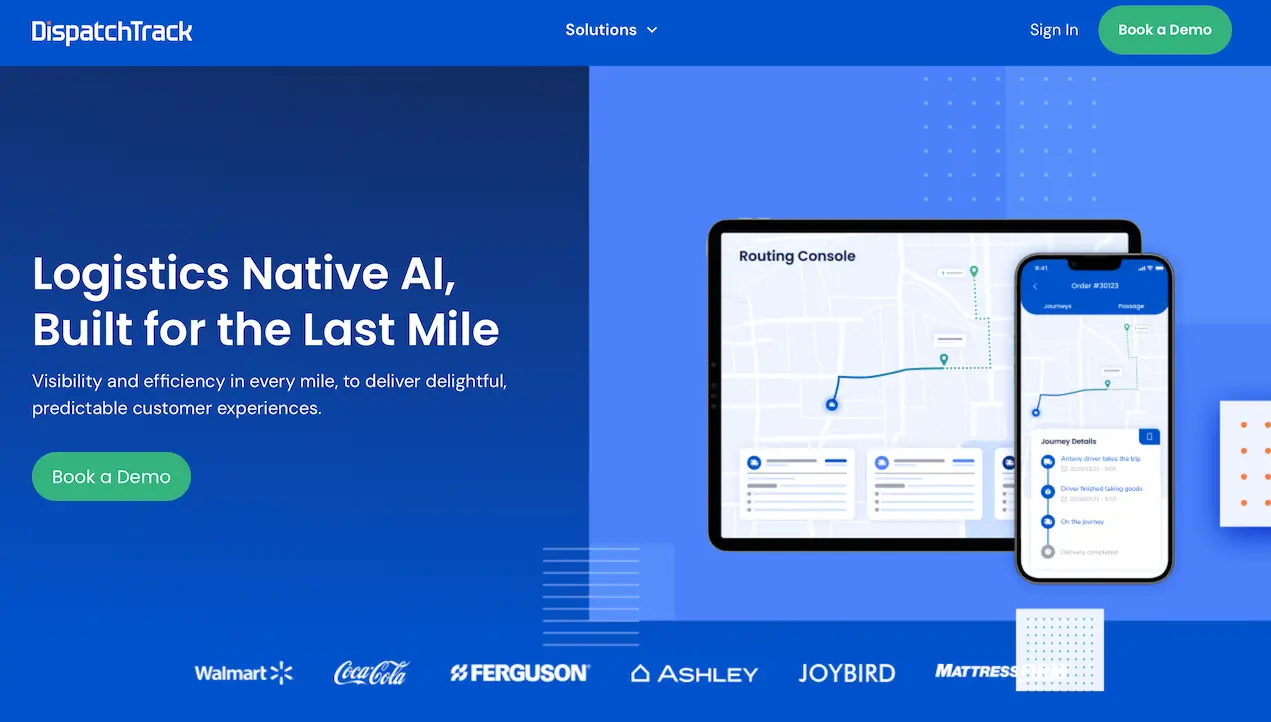
A last-mile delivery optimization platform specializing in delivery accuracy, customer experience, and operational transparency.
DispatchTrack focuses specifically on optimizing the last mile — the most expensive and complex leg of the delivery chain. Its AI-powered routing engine accounts for real-time traffic, delivery time windows, and driver capacity to produce highly accurate ETAs and efficient routes. Customer-facing communication tools, including branded tracking pages and automated notifications, are built in.
The platform is particularly strong in industries where delivery precision matters — furniture, appliances, and other "big and bulky" goods where a missed time window means a wasted trip and an unhappy customer.
Best suited for: Delivery businesses where last-mile precision, accurate time windows, and customer communication are critical — particularly in big-and-bulky, home delivery, and scheduled delivery industries.
Considerations: DispatchTrack is optimized for delivery operations specifically. Service businesses, field sales teams, or businesses needing to route mixed order types (online, phone, in-store) may find it less flexible than more versatile platforms.
Pricing: Quote-based; contact sales for details. No publicly listed pricing or free tier.
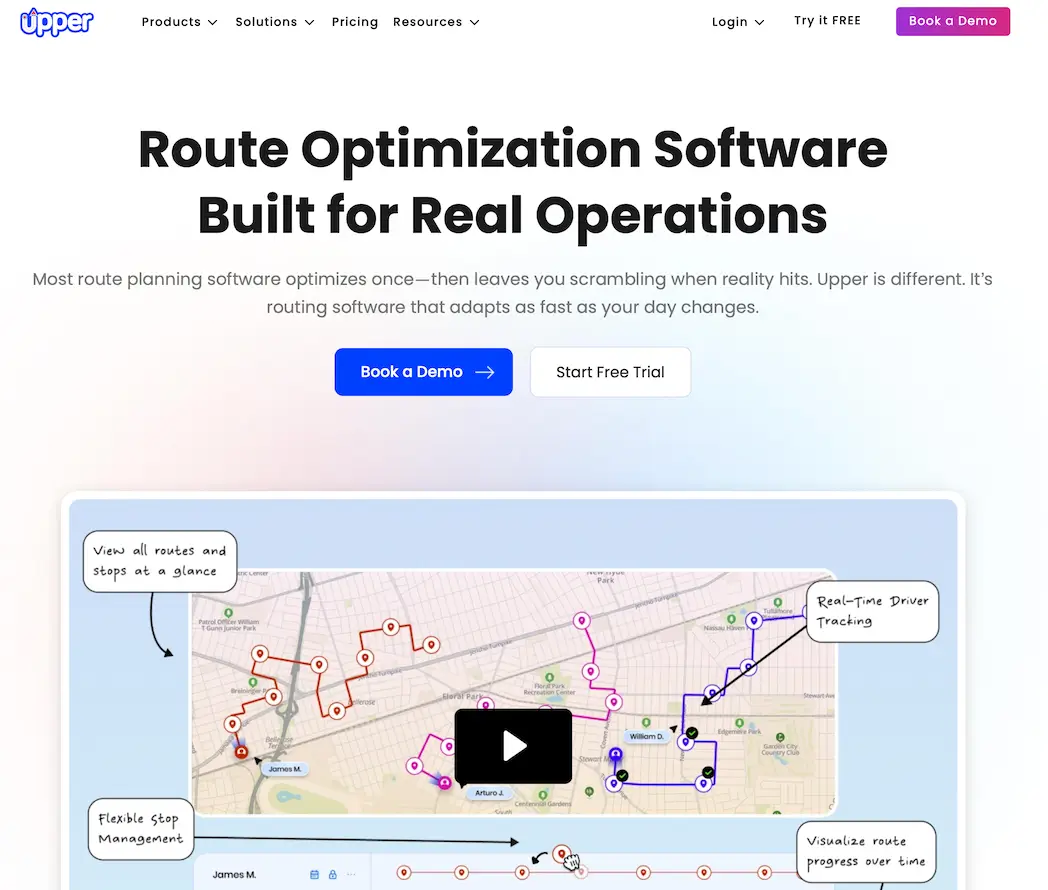
A route planning tool aimed at SMB delivery teams, with a focus on fast route creation and straightforward usability.
Upper Route Planner positions itself as a simple, effective route optimization tool for small and medium-sized delivery businesses. Its optimization algorithms help reduce planning time and drive time, and the platform includes features like proof of delivery, customer notifications, and route analytics.
The interface is clean and the learning curve is minimal, making it a reasonable option for businesses that want to get started with route optimization quickly without a lengthy onboarding process.
Best suited for: Small delivery teams and independent operators who need basic route optimization and planning without the complexity of enterprise-level platforms.
Considerations: Upper Route Planner is relatively lightweight compared to more full-featured options. Businesses needing deep eCommerce integrations, mixed order source support, or advanced features like smart route splitting and service-business workflows may need a more versatile tool like EasyRoutes.
Pricing: From $40/user/month. No free tier; 7-day free trial.
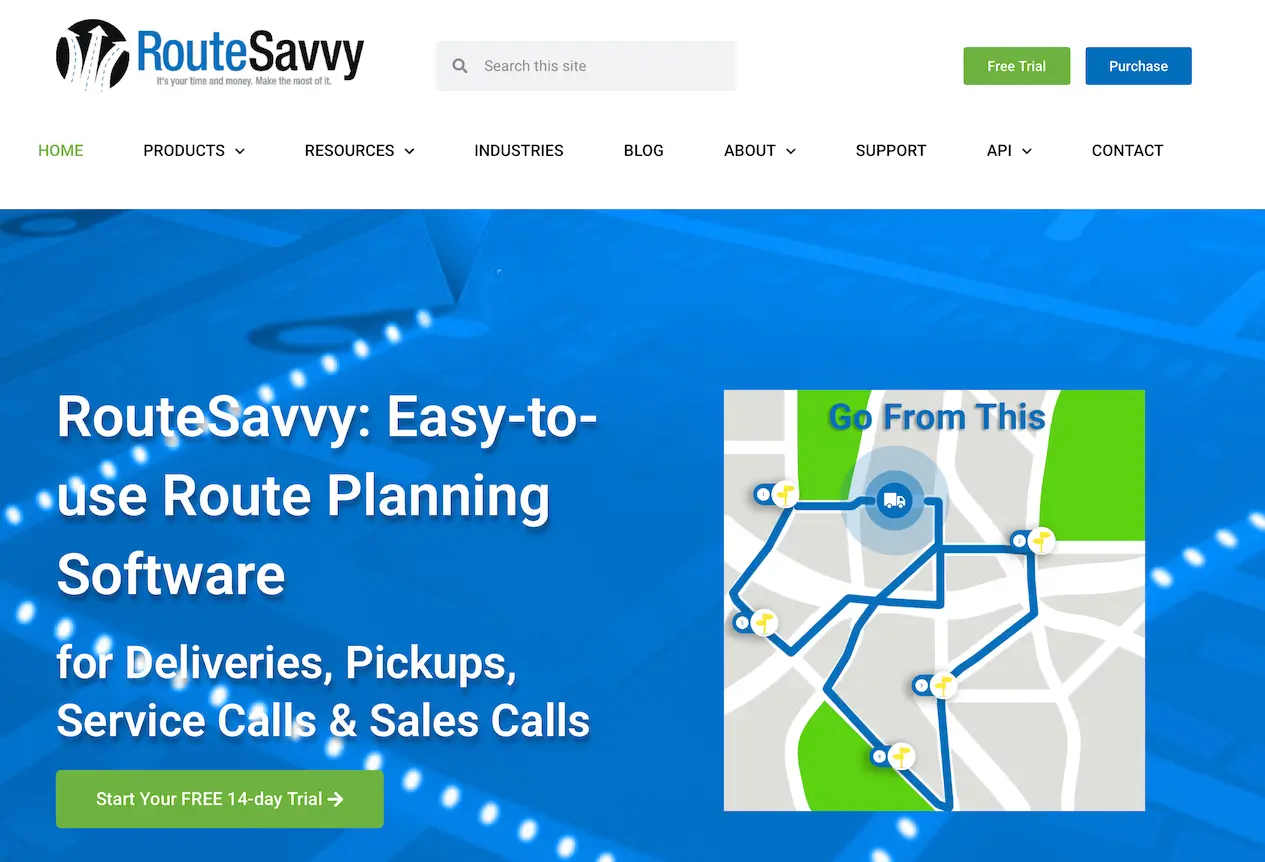
A route planning tool for small to mid-sized fleets, with GPS tracking and multi-stop route creation capabilities.
RouteSavvy is built for businesses that need to create efficient multi-stop routes for their delivery or service fleets. It supports round-trip and start-to-finish routing, can display multiple routes simultaneously, and includes GPS tracking through a phone-based system that's significantly cheaper than traditional hardware trackers.
Turn-by-turn navigation is available through the mobile app, and route data can be exported to Excel for record-keeping. RouteSavvy has carved out a niche with a range of industries you might not expect — dog walking services, airport shuttles, and septic tank cleaning among them.
Best suited for: Small to mid-sized fleets that need straightforward multi-stop route planning with basic GPS tracking. Useful for niche service industries with recurring route needs.
Considerations: RouteSavvy lacks the eCommerce integrations, customer notification features, and proof of delivery capabilities that are standard in more modern platforms. Businesses looking for a comprehensive delivery management solution will likely need more than what RouteSavvy offers.
Pricing: Subscription-based; limited public pricing details. Contact vendor for current rates.
A technology-powered logistics platform offering same-day and next-day delivery, real-time tracking, and a managed courier network — recently rebranded from DeliveryApp after five years.
Zippd (formerly DeliveryApp) has evolved from a straightforward delivery management tool into a broader logistics platform. The rebrand reflects an expanded focus: Zippd now combines route optimization and real-time tracking with a managed network of drivers and fleet partners, offering businesses access to courier capacity alongside the software to manage it.
The platform includes geo-tagged proof of delivery, instant booking, real-time tracking, and support for on-demand and scheduled deliveries. Zippd is particularly active in the UK market, serving retail, eCommerce, and B2B logistics operations with both same-day and next-day fulfillment options.
Best suited for: UK-based delivery businesses and retailers looking for a logistics platform that combines delivery management software with access to a managed courier network. Strong for businesses that need same-day and store-to-door fulfillment at scale.
Considerations: Zippd's strength as a logistics network may be less relevant for businesses that already have their own drivers and just need route planning software. Its geographic focus is currently strongest in the UK. Businesses outside of that market or those looking for a pure software tool without the network layer may find more focused options elsewhere.
Pricing: Quote-based; contact Zippd for details. No publicly listed pricing.
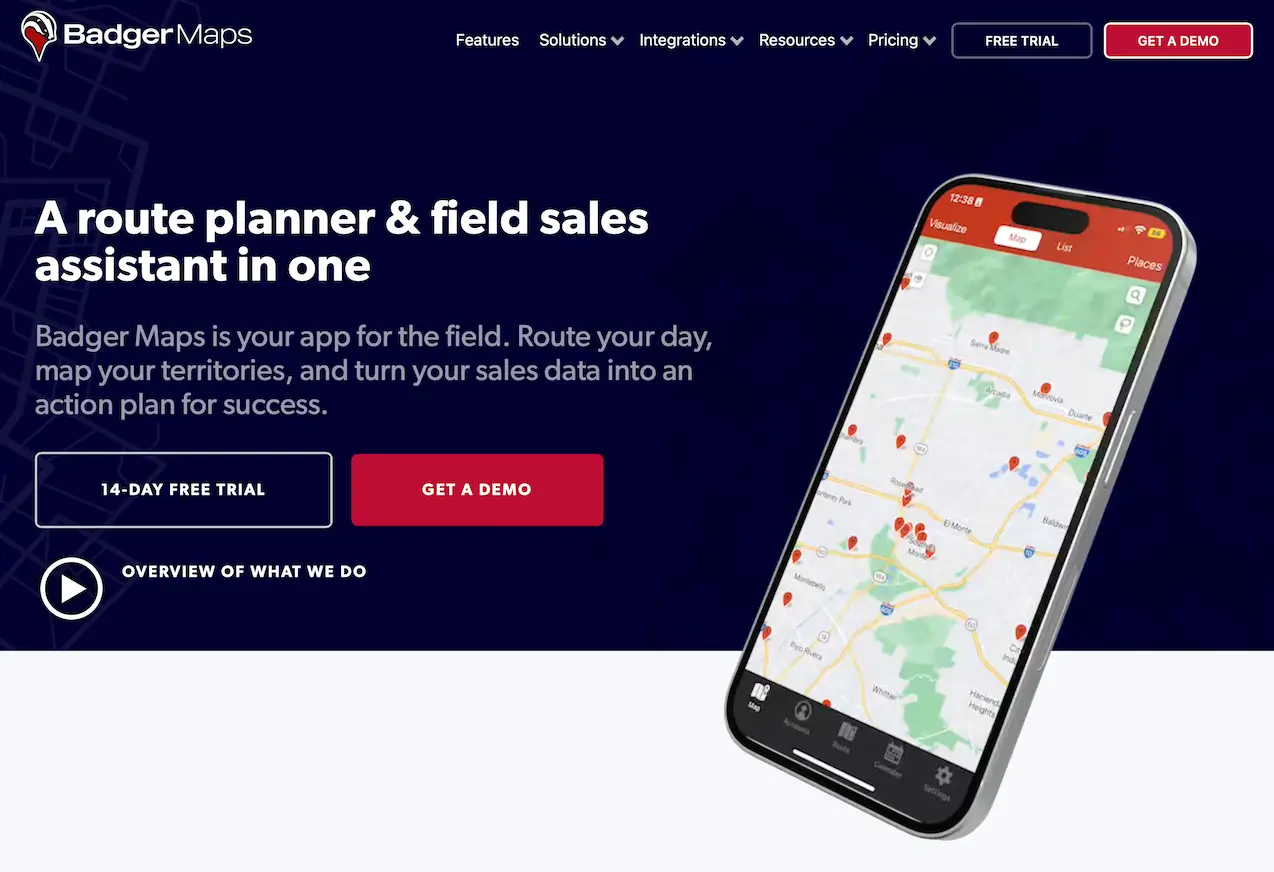
A route planning tool designed specifically for field sales teams, with CRM integration, territory management, and lead generation features.
Badger Maps is the outlier on this list — it's not built for delivery businesses. It's built for sales teams. And it does that job well. The platform combines route optimization with CRM data visualization, territory management, schedule planning, and lead generation, helping field reps plan their days more efficiently and close more deals.
If your team is in the business of visiting prospects and customers rather than delivering goods, Badger Maps offers a focused toolset that delivery-oriented platforms simply don't provide. It integrates with popular CRMs, maps customer data visually, and includes features like the "Lasso" tool for quickly building routes around high-priority accounts.
Best suited for: Field sales teams and organizations with outside sales reps who need route planning combined with CRM integration, territory management, and prospecting tools.
Considerations: Badger Maps is not designed for delivery or service operations. It lacks proof of delivery, customer tracking, eCommerce integrations, and the dispatch workflows that delivery businesses need. If you're routing deliveries or service calls, this isn't the right tool — but if you're routing sales visits, it's one of the best.
Pricing: $49/user/month. 14-day free trial; 90-day money-back guarantee.

If you've searched for route planning solutions, you've almost certainly come across free tools like Google Maps, Waze, and MapQuest. These are excellent navigation apps — but they're not route planning software, and the distinction matters.
Google Maps, for example, limits you to around 10 stops per route with no optimization beyond basic sequencing. There's no driver management, no proof of delivery, no customer notifications, no integration with your order system, and no way to split routes across multiple drivers. Waze and MapQuest have similar limitations — they're built for getting one person from point A to point B, not for managing a business that needs to hit 50 stops before noon.
Free tools like RouteXL and Speedy Route get a step closer by offering basic multi-stop route sequencing, but they're still web-only tools without driver apps, delivery verification, customer communication, or the kind of optimization engine that accounts for time windows, vehicle capacity, and real-world constraints.
These tools can work in a pinch — particularly if you're a solo operator with a handful of stops — but most businesses outgrow them quickly. The time you spend manually copying addresses, the lack of driver tracking, and the absence of customer-facing features all add up to inefficiencies that a purpose-built platform eliminates from day one.

With 17 capable platforms to choose from, the right one depends on your specific situation. Here's a quick decision guide:
You're an eCommerce merchant on any platform (Shopify, WooCommerce, BigCommerce, or others) and want to manage your own deliveries → EasyRoutes. Its platform-agnostic integrations, combined with strong route optimization and customer-facing features, make it the most versatile choice for merchants who want full control of their delivery experience.
You run a service business — HVAC, pest control, cleaning, installations, maintenance — and need to optimize daily multi-stop routes for your technicians → EasyRoutes or WorkWave. EasyRoutes offers the flexibility to handle service appointments alongside deliveries in a single platform, while WorkWave has deep roots in field service industries specifically.
You take orders by phone, in-store, and online, and need to consolidate them all into efficient daily routes → EasyRoutes. Its support for manual order entry alongside eCommerce orders means you're not stuck maintaining parallel systems for different order channels.
You're a mid-to-large operation with multiple depots, dedicated dispatch teams, and complex logistics → Onfleet or Bringg. These platforms are built for the operational complexity that comes with scale.
You're a field sales organization routing rep visits, not deliveries → Badger Maps. It's purpose-built for sales teams with CRM integration and territory management.
You're budget-conscious and need solid route optimization without all the bells and whistles → Routific or Upper Route Planner. Both offer focused optimization at accessible price points.
You need maximum customization and are comfortable with configuration → Tookan. Its modular approach lets you build exactly the workflow you need, if you're willing to invest the setup time.
The route planning tool you choose will shape your daily operations, your customer experience, and ultimately your profitability. The good news is that the landscape in 2026 offers strong options across every business size and use case — from solo operators running their first delivery routes to enterprise teams orchestrating nationwide logistics.
The key is finding a tool that fits your workflow today while scaling with you tomorrow. For the vast majority of delivery and service businesses, that means a platform that's flexible enough to handle wherever your orders come from, powerful enough to optimize complex multi-stop routes, and simple enough that your team actually uses it every day.
Ready to see how route optimization can transform your operations? Give EasyRoutes a try and start building smarter routes today.
EasyRoutes is a delivery management and route optimization platform for merchants, local delivery teams, and logistics operators. It helps you plan routes, dispatch to drivers, track progress in real time, and notify customers. Works with Shopify and integrates with other e-commerce platforms via EasyRoutes for Web.
EasyRoutes optimizes deliveries using your selected orders, start & end locations, stop time intervals, time windows, and route limits. You can balance routes, respect capacities, and re‑optimize as plans change.
See: Route Options · EasyRoutes 101
Yes. Enable Balance routes to distribute stops as evenly as possible across multiple routes/drivers while respecting other route constraints (like time windows, or item/weight limits).
See: Balance routes · How many routes?
Yes. EasyRoutes supports Vehicle Profiles you can configure and assign to routes. EasyRoutes also supports capacity planning via item or weight limits per route. Use these with other options (like time windows, or custom start/end locations) to keep plans realistic and drivers on schedule.
See: Vehicle Profiles · Max items/weight per route · Commercial/GPX Export
Yes. You can set delivery time windows per stop or import them from supported third‑party date/time apps. EasyRoutes optimizes routes to meet these windows and calculates ETAs accordingly.
Yes. Drivers can launch directions via Google Maps, Apple Maps, or Waze from each stop, and pick a default navigation app in their mobile app settings.
EasyRoutes supports delivery photos, e‑signature, driver notes, and automatic timestamps (with GPS location when available) to provide a complete delivery record.
See: Proof of Delivery
Yes. With the Premium plan and above, fully customize email/SMS: add your logo and colors, edit copy/variables, and choose which events send. Works for Shopify orders and imported/manual stops.
Yes. Enable Real‑Time Tracking in Settings → Driver settings (Premium/Enterprise subscription plans) to view live driver location and progress in the Tracking tab of any route.
See: Real‑Time Tracking
ETAs use route distance, stop service times, and historical traffic, and they update during the day as drivers progress. Accuracy improves when addresses and time windows are clean.
Yes. EasyRoutes for Web lets you plan and manage deliveries without a Shopify store. Import orders by CSV/API/webhooks or add manual stops.
See: Apps & Integrations
Delivery Analytics shows totals and trends for stops and routes, including completed vs. missed deliveries, average delivery time, per‑driver performance, and route metrics over a chosen period.
See: Delivery Analytics
EasyRoutes is the AI-native delivery operations platform trusted by 5,000+ businesses across 75+ countries. Plan routes in seconds, dispatch drivers automatically, and delight your customers — from Shopify or any order source. Experience delivery operations that run themselves. Rated 4.9 stars and certified Built for Shopify.
⭐⭐⭐⭐⭐ 4.9 stars • Trusted by 5,000+ Businesses