Regional Delivery Services: A Global Carrier Guide
By Joe SnyderA guide to the best regional delivery services worldwide — top parcel, courier and last-mile carriers across Germany, the UK, Australia, Asia and beyond.
A guide to the best regional delivery services worldwide — top parcel, courier and last-mile carriers across Germany, the UK, Australia, Asia and beyond.
If you sell online across borders, one truth shows up fast: there is no single “best” delivery company. The right carrier in Berlin is the wrong one in Auckland, and the locker network that dominates Amsterdam barely exists in Sydney. Each market has its own incumbents, its own quirks, and its own emerging players reshaping the last mile.
This guide walks through the delivery landscape in eight markets — Germany, the United Kingdom, Australia, New Zealand, the Netherlands, Singapore, Japan, and the Nordics — with refreshed figures and the recent shake-ups that older roundups miss. If you want the fundamentals first, start with our last-mile delivery guide, then use this as your country-by-country map.
Germany is the largest parcel market in Europe, home to more than 12,000 active courier, express, and parcel companies. Its domestic CEP market was worth roughly USD 19.5 billion in 2025, with the Rhine-Ruhr, Berlin, Hamburg, Munich, and Frankfurt regions generating over 60% of parcel volume despite holding about a third of the population.
The market leader is DHL, the express and parcel arm of DHL Group (the Bonn-based logistics company that operated under the Deutsche Post name until its 2023 rebrand). DHL offers everything from economy to time-definite express, deep tracking, and one of the most aggressive green-fleet programs in the industry. The trade-off is complexity: the sheer number of service tiers can make it hard to pin down the right plan.
Hermes Germany, owned by Hamburg e-commerce group Otto, remains a strong domestic and European player with reliable next-day service and small-business pricing, though it is less suited to shippers who need worldwide reach. DPD (part of France’s La Poste/GeoPost) leans on a simple tariff structure, carbon-neutral delivery, and a dense network of pickup parcel shops. GLS — now part of International Distribution Services, the group taken over by Daniel Křetínský’s EP Group in 2025 — competes on straightforward pricing and broad European coverage. UPS rounds out the top tier with its global air network, strongest for international and time-critical freight.
German shoppers are demanding and increasingly green-minded: fast, predictable delivery is the baseline, surprise shipping costs are a leading cause of abandoned carts, and a meaningful share of buyers will pay more for environmentally friendly options. That has pushed carriers toward dense pickup-and-locker grids — open networks like OneStopBox are expanding in stations, malls, and campuses — and toward electric vans and hydrogen pilots to meet looming low-emission-zone rules. For a merchant, the lesson is that price alone does not win German customers; convenience and sustainability increasingly do.
The UK moves around five billion parcels a year, and its domestic parcel sector generated about £9.1 billion in revenue in 2024-25, according to regulator Ofcom. Next-day services still account for roughly 63% of domestic volume, but the bigger story is consolidation and the shift to out-of-home delivery, with lockers and shops handling around 12% of parcels.
Royal Mail remains the household name and volume leader; in 2025 its parent, International Distribution Services, became the first foreign-owned owner of the 500-year-old postal service after the EP Group takeover, and Royal Mail folded Parcelforce into its core network. The most-watched challenger is Evri — the carrier formerly known as Hermes UK until its 2022 rebrand — which delivered a record 807 million parcels in 2024-25 and announced a merger with DHL eCommerce UK that creates an operator handling over a billion parcels annually. Meanwhile, DPD is investing heavily in new UK distribution centres, and Polish locker giant InPost acquired Yodel in 2025 to build locker density. For a business, the practical takeaway is that no single carrier wins on price, speed, and reliability at once — which is exactly why many UK retailers run a multi-carrier mix.
Australia’s parcel market was projected to reach around AUD 13.7 billion in 2025, and competition is fierce. Australia Post (with its premium B2B arm StarTrack) offers unmatched reach — including remote postcodes — plus more than 800 free 24/7 parcel lockers and 4,800-plus collection points. Private couriers such as CouriersPlease (owned by Singapore’s SingPost) and Aramex (the rebranded Fastway, on a franchise model) routinely undercut Australia Post on metro-to-metro lanes.
One major caveat for anyone relying on an older guide: Sendle, the carbon-neutral small-business courier that many roundups still recommend, abruptly ceased Australian operations in January 2026 after its US merger ran into financial trouble. The episode is a sharp reminder of single-carrier risk — and why a flexible, multi-carrier or self-delivery setup is increasingly the norm for Australian sellers.
New Zealand’s domestic market is dominated by two players: NZ Post (which absorbed the former CourierPost brand) with the widest rural network, and Aramex (formerly Fastway Couriers), whose franchise model and Parcel Connect agent network often win on inter-island pricing. A distinctive local trick: many Kiwis avoid over-the-counter rates by booking through aggregators like TradeMe’s “Book a Courier” service, which piggybacks on the marketplace’s wholesale rates with NZ Post and Aramex. Rural delivery surcharges are a real budget line here, thanks to the country’s rugged geography, so they are worth pricing in up front.
PostNL dominates with roughly 60% of the B2C parcel market and a record 345 million parcels handled in 2025, reaching 99% of Dutch addresses within 24 hours. DHL holds about a third of the market and DPD roughly 5%. What makes the Netherlands stand out is its out-of-home culture: PostNL opened its locker network to rival carriers in early 2024 and is scaling toward 3,600 lockers by 2028. Swedish challenger Budbee has gone all-in on lockers, and second-hand-fashion volumes flow through Vinted Go. Layer on the zero-emission delivery zones that took effect across 16 municipalities in January 2025, and the Dutch market is a preview of where sustainable, low-emission delivery is heading everywhere.

In a dense city-state, the model is consolidation rather than fragmentation. SingPost has built a sprawling collection network and now folds in the 1,084-locker Pick Network plus over 2,500 touchpoints, putting 80% of the population within a 10-minute reach. The clever part is that Pick is a neutral, nationwide locker grid open to multiple carriers — a shared-infrastructure approach few countries have matched. Around it compete e-commerce specialists like Ninja Van, J&T Express, and Shopee’s SPX, alongside DHL, FedEx, and UPS for cross-border shipping. For sellers, Singapore shows how lockers and drop-off points can scale convenience without every carrier building its own network.
Japan’s last mile runs on a uniquely local backbone. Yamato Transport pioneered door-to-door delivery with its TA-Q-BIN service in the 1970s and remains the market leader, ahead of Sagawa Express and Japan Post’s Yu-Pack. What sets the country apart is the konbini network: 24/7 convenience stores such as 7-Eleven, FamilyMart, and Lawson double as parcel drop-off and pickup points, and shippers can choose precise delivery time windows at no extra charge, send chilled or frozen goods, or even forward luggage to airports and hotels. It is a customer-experience standard the rest of the world is still catching up to.

Scandinavia is the proving ground for locker-first, low-carbon delivery. Instabee — formed by the 2022 merger of locker pioneer Instabox and home-delivery specialist Budbee, and now operating its Budbee, Instabox, and Porterbuddy brands across six markets — built its reputation on fossil-free deliveries and lockers that never silently reroute your parcel. National incumbents PostNord (pan-Nordic) and Posten Bring (Norway) still anchor the market, but parcel lockers are the fastest-growing option: in Norway they were more than twice as common in 2026 as in 2024.
Step back and a few patterns repeat everywhere. Ownership is consolidating fast, as the Royal Mail, Evri-DHL, and InPost-Yodel deals show. Out-of-home delivery — lockers and shop drop-offs — is rising across Germany, the UK, the Netherlands, Singapore, and the Nordics alike. Sustainability has moved from nice-to-have to procurement criterion, with electric fleets and zero-emission zones reshaping cost structures. And the giants keep raising the bar: it is worth understanding how Amazon, UPS, FedEx, and Walmart optimize delivery if you want to compete on speed and reliability. Two cost pressures cut across borders, too: carriers have shifted to volumetric (dimensional) pricing that penalizes bulky-but-light parcels, and a persistent shortage of drivers across Europe is squeezing margins and nudging operators toward automation and denser drop-off models.
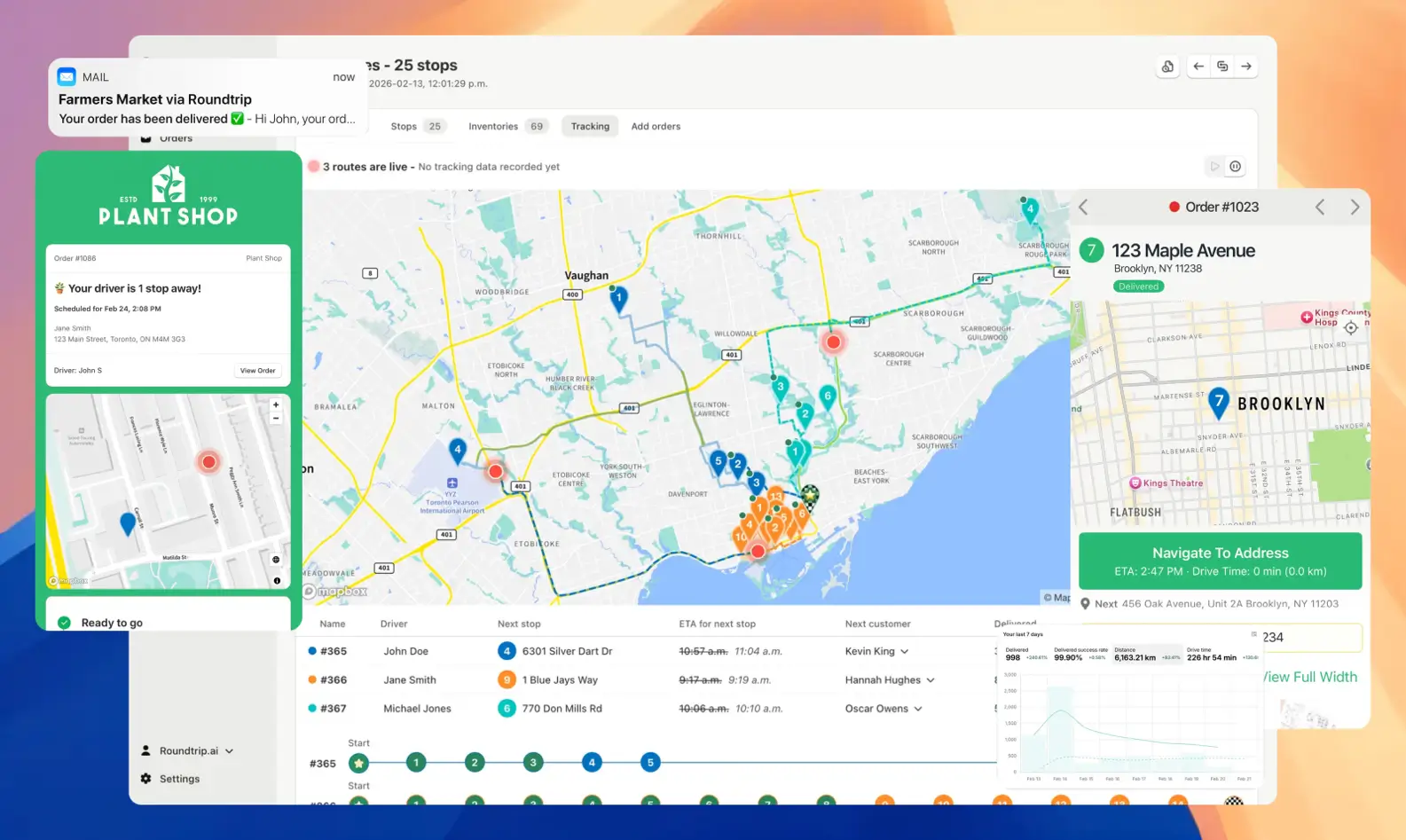
Every carrier above charges for safe, on-time, trackable delivery — and keeps the margin. For local and regional orders, there is another option: keep that revenue and control the experience by running deliveries yourself. The in-house versus third-party decision usually comes down to volume, geography, and how much the customer experience matters to your brand.
That is where EasyRoutes comes in. EasyRoutes is a route optimization app that turns your orders into efficient, driver-ready routes in seconds, then hands drivers a mobile app with turn-by-turn navigation, live ETAs and customer notifications, and photo or signature proof of delivery. It integrates seamlessly with Shopify local delivery and pickup orders — no spreadsheet exports — and also works with imported orders if you are not on Shopify. Because on-time delivery drives reviews, repeat business, and word of mouth, owning the last mile can become a genuine competitive advantage rather than just a cost line.
You can install EasyRoutes from the Shopify App Store, or create an account on EasyRoutes' standalone web app to begin your free 14-day trial today.
Whether you ship a handful of parcels a week or run a growing fleet, the right delivery strategy is rarely about one carrier — it is about matching the carrier, method, and region to each order, and knowing when it makes more sense to deliver yourself. Markets shift quickly: brands rebrand, couriers merge, and some shut down overnight. Keep your options flexible, watch the local players, and the last mile becomes a strength instead of a headache.
EasyRoutes optimizes deliveries using your selected orders, start & end locations, stop time intervals, time windows, and route limits. You can balance routes, respect capacities, and re‑optimize as plans change.
See: Route Options · EasyRoutes 101
Yes. EasyRoutes supports Vehicle Profiles you can configure and assign to routes. EasyRoutes also supports capacity planning via item or weight limits per route. Use these with other options (like time windows, or custom start/end locations) to keep plans realistic and drivers on schedule.
See: Vehicle Profiles · Max items/weight per route · Commercial/GPX Export
Yes. Schedule routes across multiple days with configured start times/locations and add an overnight driver break to maintain accurate ETAs.
See: Multi‑Day Scheduling
Yes. Enable Real‑Time Tracking in Settings → Driver settings (Premium/Enterprise subscription plans) to view live driver location and progress in the Tracking tab of any route.
See: Real‑Time Tracking
Yes. EasyRoutes Premium and Enterprise plans support branded SMS notifications with usage‑based pricing per message segment. Configure templates and funding in Settings.
EasyRoutes supports delivery photos, e‑signature, driver notes, and automatic timestamps (with GPS location when available) to provide a complete delivery record.
See: Proof of Delivery
Yes. EasyRoutes supports Shopify Local Delivery and can include Pickup orders on routes when you need a driver or staff task at your store or pickup point. Local Delivery instructions appear directly on the stop when available.
Yes. EasyRoutes for Web lets you plan and manage deliveries without a Shopify store. Import orders by CSV/API/webhooks or add manual stops.
See: Apps & Integrations
EasyRoutes is the AI-native delivery operations platform trusted by 5,000+ businesses across 75+ countries. Plan routes in seconds, dispatch drivers automatically, and delight your customers — from Shopify or any order source. Experience delivery operations that run themselves. Rated 4.9 stars and certified Built for Shopify.
⭐⭐⭐⭐⭐ 4.9 stars • Trusted by 5,000+ Businesses