« Back to articles
Shopify Route Planning Software: 2026 Guide
A 2026 guide to Shopify route planning software: how it works, its benefits, how to choose the right app, and why EasyRoutes leads for local delivery.

A 2026 guide to Shopify route planning software: how it works, its benefits, how to choose the right app, and why EasyRoutes leads for local delivery.
Shopify has turned the dream of running an online store into something almost anyone can do in an afternoon. It now powers roughly 2.8 million live stores across more than 175 countries, and since it first launched back in 2006 it has grown into the leading ecommerce platform in the United States, commanding roughly 30% of the U.S. platform market. Selling is the easy part. Getting every order to the right doorstep, on time, without drowning in spreadsheets is where most growing merchants get stuck.
That is exactly the gap Shopify route planning software fills. An app like EasyRoutes plugs straight into your Shopify admin, turns your orders into optimized delivery routes, and keeps customers informed from checkout to doorstep. The question isn't whether you need it as you scale — it's which route planning software actually fits your business. Let's break it down.

It helps to understand the platform your delivery operation sits on top of. A few numbers worth knowing in 2026:
The common thread is integration. Shopify's open API lets third-party apps read your orders, customers, and fulfillment status in real time — which is precisely what makes automated, end-to-end delivery management possible without manual data entry.
If you run deliveries yourself, you already know the manual version of this job: export orders to a spreadsheet, paste addresses into a maps app, guess at an efficient order of stops, print a list for the driver, then update each order by hand once everything is delivered. It works until volume climbs — and then it quietly eats hours every day.
Shopify route planning software like EasyRoutes removes that busywork. Because it is fully integrated with Shopify, your orders are already there, ready to be added to routes and dispatched to drivers. There is no exporting and re-importing, and orders are updated automatically in Shopify the moment a stop is marked delivered. Automating order delivery this way lightens your team's workload and lifts productivity at the same time, which is where the real return shows up.
It also closes the loop with the customer. Instead of fielding status questions by phone or email, the software sends automated tracking updates and records proof of delivery, so the people waiting on an order always know where it is. The result is fewer support tickets, fewer redelivery attempts, and a delivery experience that feels deliberate rather than improvised — the kind of consistency that turns a one-time buyer into a repeat one.

Integrating a route planner with your store does more than save a few clicks. Here is where it earns its keep.
A connected route planner builds a synchronized order-management loop that strips out flaws and inefficiencies while raising the productivity of both your people and your fulfillment process. You merge your delivery ecosystem and eliminate manual order entry, which helps you avoid late or misplaced deliveries and protects the customer experience as you grow.
Automation cuts the hours spent organizing and dispatching orders, freeing your team to focus on higher-value work. Removing latency and offering quick, reliable delivery helps you retain customers and stand out from competitors. Bottlenecks get resolved faster, and the time and money you reclaim can be reinvested into core operations rather than logistics firefighting.
Thanks to the seamless integration, your logistics operations can be optimized and order details update in real time as deliveries happen. You can scale your operations and infrastructure to handle the complexity of modern delivery, monitoring front-end and back-end activity in real time and clearing roadblocks before they become problems. If you want to go deeper here, our guide to delivery management software covers the wider toolset.
A good route planner lets you see the whole operation at a glance — from dispatch to delivery — and manage it with a few clicks. That visibility lets you optimize how resources are used, organize order data, shorten delivery times, and improve the overall quality of the customer experience.
As demand grows, many merchants lean on third-party delivery providers — and lose control of the experience their customers receive. A poor handoff can dent future sales and invite negative reviews. Bringing routing in-house lets you own the delivery experience end to end, which builds loyalty and encourages repeat purchases while keeping your margins healthier.

Planning a route is easy. Picking the right software to do it is the hard part. Before you commit, work through a short evaluation rather than installing the first app you find.
Start by naming what you actually need. Are you after a simple way to sequence stops, or do you need to manage a fleet of drivers, time windows, and proof of delivery? Matching the tool to the job up front saves you from paying for complexity you'll never use — or outgrowing a tool in three months.
Write down the practical constraints: how many drivers you dispatch, whether deliveries vary in distance or handling, and which systems the software has to play nicely with. If you sell on Shopify, that last point is decisive — native integration removes the import/export tax that generic planners impose. Think about the edge cases too: time windows, fragile or refrigerated goods, signature requirements, and whether drivers need to work offline in areas with poor signal. Getting these on paper now prevents an expensive switch later. For deliveries with many stops per driver, our guide to multi-stop route planning is a useful reference.
Reviews from businesses like yours surface the issues a feature list won't. Then weigh pricing honestly: route planners range from free to enterprise-grade, and the cheapest option isn't a bargain if it can't do the job. A ranked, side-by-side look at the field — like our roundup of the best route planning tools — is a fast way to shortlist.
Confirm the software handles your must-haves: multiple routes at once, driver assignment, re-optimization on the fly, and useful route optimization rather than just stop-sequencing. Finally, demo it. A free trial shows you how the tool feels in your team's hands before any money changes hands — and tells you whether onboarding will be painless or a headache.
The mechanics are refreshingly simple with the right app. With EasyRoutes, you install it from the Shopify App Store, accept a few permissions, and you're ready. There's no exporting and importing — your orders are already there. Select the orders you want to deliver and how many drivers you have, and the app generates multiple optimized routes in seconds rather than hours, each with a route inventory you can use as a packing list. Order Tags and Order Attributes let you fine-tune the workflow to your exact needs.
If your deliveries run through Shopify's local delivery features, it's worth setting those up first; our EasyRoutes 101 walkthrough for Shopify local delivery covers the store-side setup step by step, so there's no need to repeat all of it here. For the bigger picture on local fulfillment strategy, see our Shopify local delivery guide.
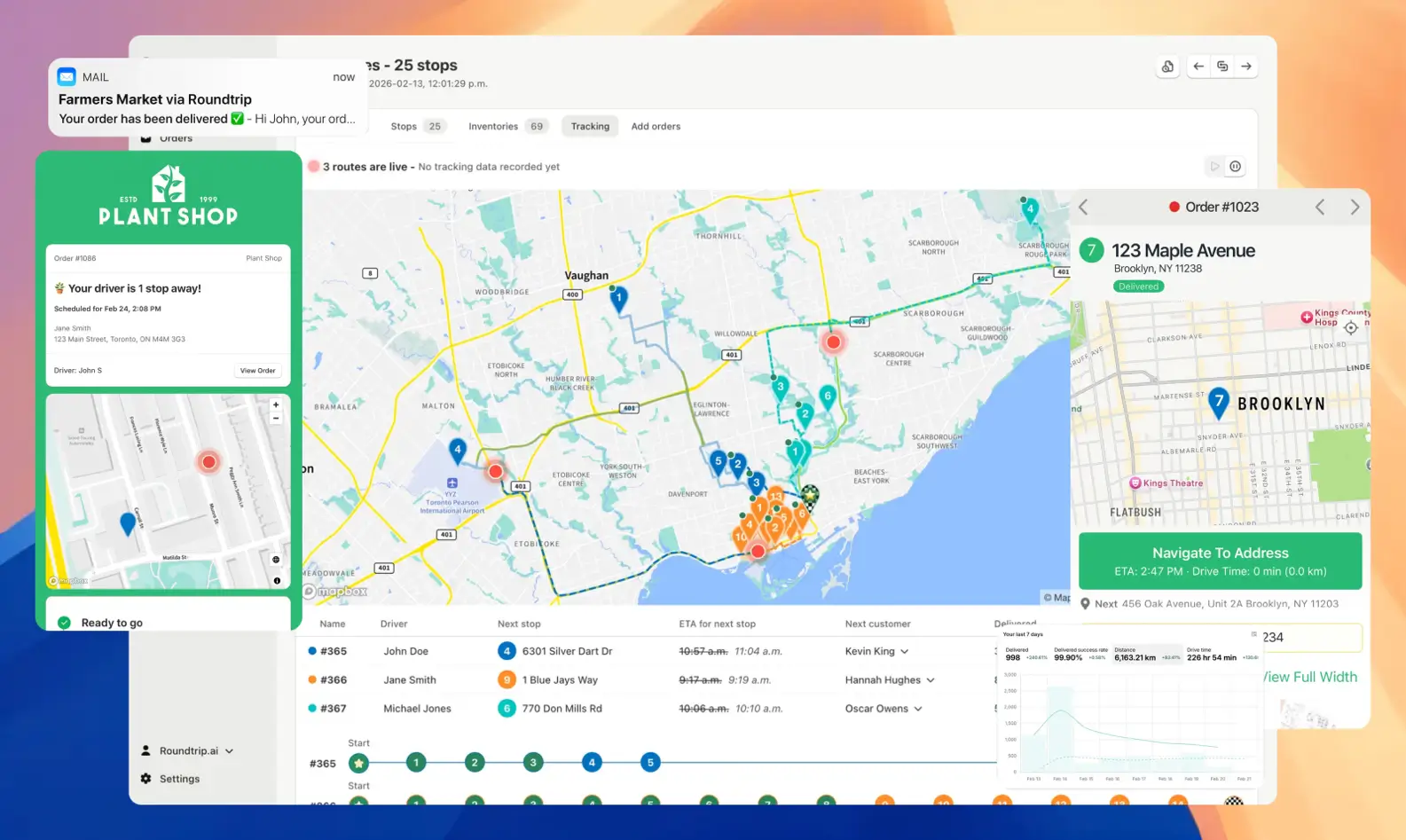
There are several route planners that connect to Shopify, but EasyRoutes is the one built to live inside your Shopify admin from end to end. It helps your team create optimized last-mile routes so drivers finish in the shortest time possible, and its dashboard is clean and intuitive enough to learn in minutes. Shopify itself has described it as “the best routing app for Shopify merchants,” and it holds a 4.8-star rating on the Shopify App Store.
Beyond routing, EasyRoutes keeps customers in the loop with real-time tracking and notifications over email and SMS, plus branded tracking pages that cut down on “where's my order?” messages. Drivers get a dedicated iOS and Android app with turn-by-turn navigation and can capture proof of delivery — photos, e-signatures, and notes — that sync straight back to Shopify. That matters more every year: the global last-mile delivery market reached roughly $184 billion in 2025 and is on track toward $278 billion by 2030, and customer expectations for fast, visible delivery are rising with it.
EasyRoutes offers a free plan plus a 14-day free trial of its paid features, so you can see how it fits before committing. Start a free trial and put it to work on your real orders.
Yes. Automating order fulfillment with a Shopify route planner saves time and money and removes the delays and mix-ups that come with manual order processing — especially as your order volume grows.
Several route planners integrate with Shopify, but if you want one that is fully built into your Shopify admin — no spreadsheets, with orders synced automatically — EasyRoutes is the strongest choice. Compare it against the field in our route planning tools roundup.
Set up an automated route-planning workflow with software that applies real route optimization, factor in time windows and stop priorities, and let the app re-sequence stops for you instead of planning by hand.
As your Shopify store grows, manual delivery management becomes the bottleneck that holds everything else back. The right route planning software removes that ceiling — automating the busywork, tightening your logistics, and giving customers the fast, transparent delivery they now expect. If you sell on Shopify and deliver locally, EasyRoutes is the most direct path there. Try it free and see how much time your next delivery day gets back.
EasyRoutes is the AI-native delivery operations platform trusted by 5,000+ businesses across 75+ countries. Plan routes in seconds, dispatch drivers automatically, and delight your customers — from Shopify or any order source. Experience delivery operations that run themselves. Rated 4.8 stars and certified Built for Shopify.
⭐⭐⭐⭐⭐ 4.8 stars • Trusted by 5,000+ Businesses