Sustainable Delivery Best Practices to Cut Emissions
By Joe SnyderSustainable delivery best practices for 2026 — optimize routes, cut idling, electrify your fleet, slash packaging waste, and lower your carbon footprint.

Sustainable delivery best practices for 2026 — optimize routes, cut idling, electrify your fleet, slash packaging waste, and lower your carbon footprint.
Delivery is one of the most visible places a business touches the environment — and one of the most fixable. Transportation is the single largest source of greenhouse gas emissions in the United States, responsible for about 28% of the national total in the EPA’s most recent inventory. Last-mile delivery sits squarely inside that number, and as e-commerce volume climbs, the number of vans and trucks on the road keeps climbing with it.
The encouraging part is that sustainability and profitability pull in the same direction. Almost every move that shrinks your delivery carbon footprint — fewer miles driven, less time spent idling, fuller vehicles, fewer failed attempts — also trims fuel and labor costs. Customers are watching, too: in Shorr’s 2025 Sustainable Packaging Consumer Report, 90% of shoppers said they are more likely to buy from a brand that uses eco-friendly packaging, and 39% reported switching brands over it. Building a greener delivery operation is, increasingly, just good business.
This guide brings together the practices that matter most for sustainable delivery in 2026 — and the data behind each one. For a broader primer on the topic, see our overview of green transportation and sustainable delivery.

The most effective sustainability lever in delivery is also the most basic: drive fewer miles. Every mile you remove from a route is fuel you don’t burn and CO₂ you don’t emit. Manual planning — sketching stops on a map, dropping pins in a consumer navigation app, or ordering a spreadsheet by hand — almost always produces longer routes than necessary, because a person can’t weigh dozens of stops, time windows, and traffic patterns at once.
Modern route optimization software solves that problem. It sequences stops in the shortest, fastest practical order while accounting for traffic, delivery windows, vehicle load, and driver shifts — turning a tangle of addresses into a tight, low-mileage loop. For operations running dozens or hundreds of stops a day, the savings compound quickly. If you want to go deeper on the mechanics, our guide to multi-stop route planning walks through how it works and how to evaluate a planner.
Fewer miles also means fewer hours behind the wheel, which lets each driver complete more stops per shift and keeps the total number of vehicles you need on the road as low as possible — a second, quieter emissions win.
Idling is pure waste: fuel burned and emissions released while the vehicle goes nowhere. The scale is startling. The U.S. Department of Energy and Argonne National Laboratory estimate that American vehicles waste more than 6 billion gallons of fuel a year to idling — worth over $11 billion even at modest fuel prices. According to the DOE’s fuel economy data, an idling engine burns roughly a quarter to a half gallon of fuel per hour, while restarting a warm engine uses only about ten seconds’ worth of fuel — so the old myth that restarting costs more than idling simply doesn’t hold.
The fixes are inexpensive. Coach drivers to switch off whenever they expect to be stopped for more than about ten seconds outside of traffic, and back that up with telematics. GPS and driver tracking tools surface where and when idling happens, so you can target the worst offenders rather than guessing. Idle reduction is also one of the fastest ways to cut spending; our guide to cutting fuel costs in a delivery business covers it alongside the other big fuel levers.
Swapping combustion vehicles for electric ones removes tailpipe emissions entirely, and the economics keep improving. The electric last-mile delivery vehicle market is growing fast — from roughly $22.9 billion in 2025 toward an estimated $103.5 billion by 2034, a compound annual growth rate above 18% — as purpose-built electric vans, cargo bikes, and three-wheelers come to market and city low-emission zones expand. Up-front costs are higher, but fuel and maintenance savings plus government incentives narrow the gap, and most daily delivery routes fall comfortably within modern EV range.
Electrification isn’t the only fleet move that matters. Right-sizing — matching each vehicle to its actual load rather than running half-empty trucks — cuts fuel use immediately, and in dense urban zones a cargo bike or e-scooter can beat a van on both emissions and delivery time. You don’t need to electrify all at once; replacing vehicles as they reach end of life is a practical path that spreads the investment over years.
Driver behavior is the cheapest emissions lever you have, because it costs nothing but attention. The DOE reports that aggressive driving — speeding, hard acceleration, and hard braking — can lower fuel economy by 15% to 30% at highway speeds and 10% to 40% in stop-and-go traffic. Smoothing out those habits delivers an outsized payoff.
Practical eco-driving training covers gentle acceleration and anticipatory braking, observing speed limits, minimizing idling, and keeping tires properly inflated. Driver-feedback devices and telematics coaching reinforce the lessons in real time; studies cited by the DOE suggest they improve the average driver’s fuel economy by about 3%, and as much as 10% for those actively using them to save fuel. Pair the training with simple incentives — recognition or small rewards for the most efficient drivers — and the gains tend to stick.
A well-maintained vehicle burns less fuel, so a maintenance schedule is quietly an emissions program. According to the DOE’s Fuel Economy Guide, fixing a vehicle that is noticeably out of tune or has failed an emissions test can improve gas mileage by about 4%, and keeping tires inflated to the recommended pressure improves mileage by an average of 0.6% — up to 3% in some cases. Using the manufacturer’s recommended grade of motor oil adds another 1% to 2%.
None of this is glamorous, but across a fleet it adds up to real fuel and carbon savings — and it extends vehicle life, which avoids the embodied emissions of building replacements. Tracking service intervals, fault codes, and odometer readings inside a single system makes the routine easy to keep; fleet management software centralizes maintenance alongside GPS and telematics so nothing slips.
Packaging is the part of delivery customers actually hold in their hands, which makes it the most visible sustainability signal you send. Switching to recyclable, compostable, or recycled-content materials and right-sizing boxes to cut void fill reduces both waste and shipping weight. Reusable and returnable packaging systems, where customers send containers back for another cycle, push further toward a genuinely circular model.
The demand is real but worth reading carefully. In Shorr’s 2025 survey, 54% of consumers said they deliberately chose products with sustainable packaging in the past six months, and minimal packaging was the single most valued feature, prized by 61% of shoppers. That said, McKinsey’s 2025 global packaging research is a useful reality check: only about 13% of U.S. consumers say they will pay a lot more for sustainable packaging, and shoppers still rank price, food safety, and shelf life above environmental impact at the moment of purchase. The takeaway is to pursue sustainable packaging that doesn’t compromise protection or cost — affordable green packaging, not green packaging at any price. Our guide to reducing packaging costs shows how right-sizing does both at once.
Two operational habits waste enormous amounts of fuel without anyone noticing: scattered, under-full routes and failed first deliveries. Consolidating orders — batching deliveries headed to the same area, or coordinating with partners in dense neighborhoods — puts more parcels on every trip and takes redundant vehicles off the road, easing congestion and emissions at the same time.
Failed deliveries are even more wasteful, because a missed stop doubles the mileage for that order: the truck drives the route twice. Most misses trace back to bad addresses, no delivery window, or a customer who wasn’t expecting the driver. Accurate address handling, scheduled windows, and real-time ETA notifications lift first-attempt success and erase those wasted return trips. Because re-delivery is also one of the biggest hidden expenses in the industry, the sustainability case overlaps almost perfectly with the cost case — see our breakdown of last-mile delivery costs.

You can’t improve what you don’t measure. Sustainable delivery works best as a continuous loop: set baselines for mileage, fuel use, idle time, and failed-delivery rate, then review them on a regular cadence and adjust. Telematics and delivery analytics make the data collection automatic, turning gut feel into evidence about where the next gain is hiding.
Regular audits of routes, packaging, and vehicle performance keep the program honest and reveal drift before it becomes expensive. Tracking a focused set of delivery metrics — route efficiency and mileage, first-attempt success, cost per delivery, and driver behavior — gives you both the environmental and the financial picture in one dashboard.
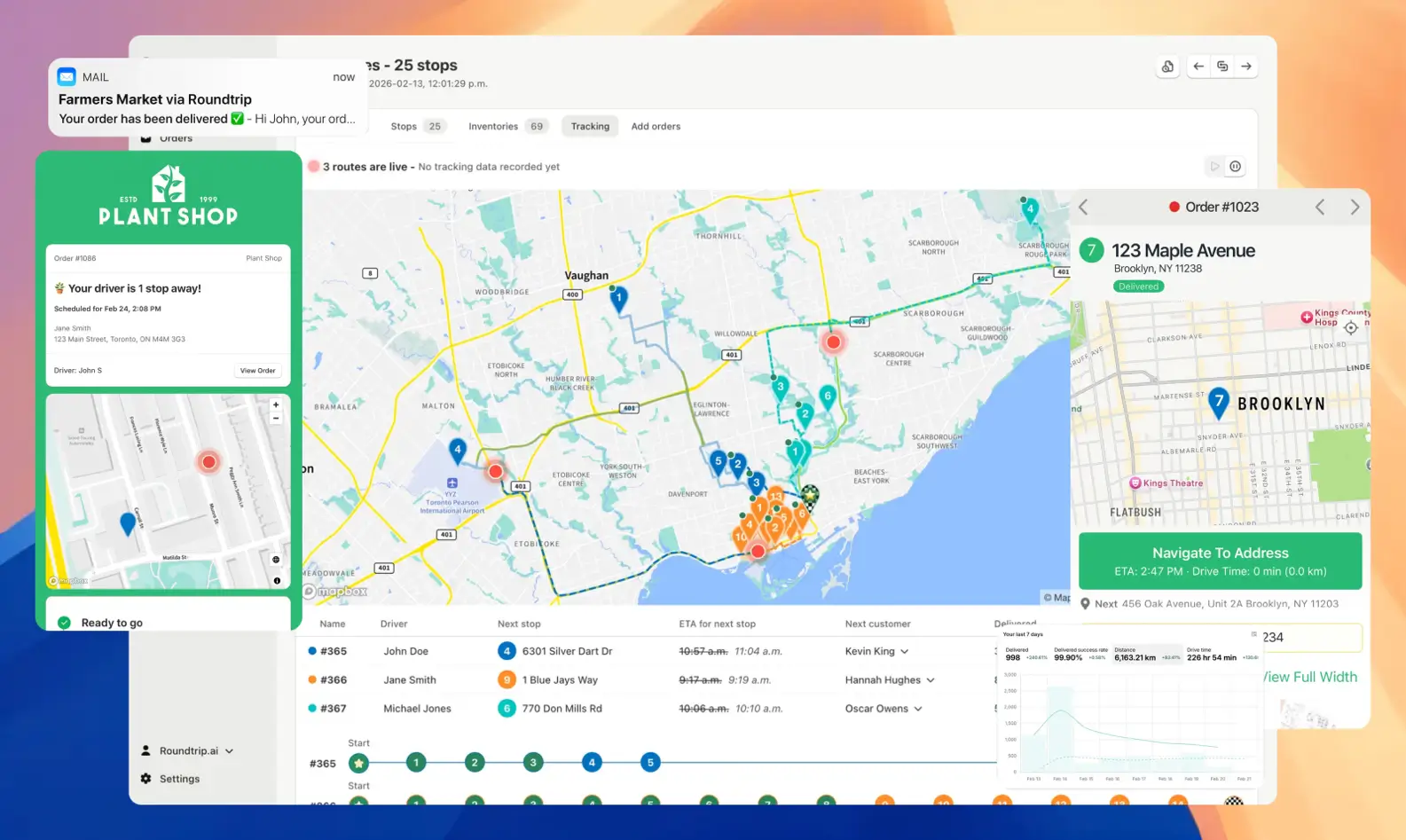
Most of the practices above run through the route itself, and that is exactly what EasyRoutes is built to optimize. EasyRoutes turns your Shopify and multi-channel orders into the shortest, most efficient delivery routes automatically — accounting for vehicle type and capacity, time windows, and balanced workloads across drivers, so you cover more stops with fewer miles and fewer vehicles. It surfaces route distance and duration up front, supports multi-day planning, and lets drivers re-optimize on the fly, all of which trim the fuel and emissions baked into every shift.
On the customer side, automatic ETA notifications and live tracking lift first-attempt success and cut the wasteful return trips that come with missed deliveries. Together with idle and driver-behavior visibility, these features make EasyRoutes a practical backbone for a greener operation — which is why route optimization sits at the centre of nearly every last-mile delivery best practice.
Sustainable delivery isn’t a single initiative — it’s a stack of compounding habits: optimized routes, less idling, cleaner and right-sized vehicles, smarter driving, diligent maintenance, leaner packaging, fuller trucks, fewer failed attempts, and steady measurement. The encouraging truth is that nearly every one of them lowers cost while it lowers emissions, so progress rarely requires a trade-off between the planet and the bottom line.
Start with the levers that touch the route, because that’s where the biggest, fastest wins live. Ready to cut miles, fuel, and emissions in one move? Transform your orders into optimized, lower-impact delivery routes with EasyRoutes, and take the first step toward a more sustainable operation today.
EasyRoutes optimizes deliveries using your selected orders, start & end locations, stop time intervals, time windows, and route limits. You can balance routes, respect capacities, and re‑optimize as plans change.
See: Route Options · EasyRoutes 101
Yes. EasyRoutes supports Vehicle Profiles you can configure and assign to routes. EasyRoutes also supports capacity planning via item or weight limits per route. Use these with other options (like time windows, or custom start/end locations) to keep plans realistic and drivers on schedule.
See: Vehicle Profiles · Max items/weight per route · Commercial/GPX Export
Absolutely. Plan with item and weight limits to reflect the capacities of your fleet. Configure and assign Vehicle Profiles for an additional indicator for routes that have specific restrictions by vehicle.
Yes. Routes display estimated distance and drive time after optimization, and update automatically when you add/remove stops and re‑optimize.
See: Route Mileage
Yes. Schedule routes across multiple days with configured start times/locations and add an overnight driver break to maintain accurate ETAs.
See: Multi‑Day Scheduling
Yes. Enable Balance routes to distribute stops as evenly as possible across multiple routes/drivers while respecting other route constraints (like time windows, or item/weight limits).
See: Balance routes · How many routes?
Yes. Turn on settings to avoid toll roads and u‑turns from the Route Options panel. Enable these options before planning a route, or edit the route after creation and re‑optimize to see them reflected in your route.
See: Route Options
Yes. Schedule routes for specific dates/times, and ETAs will be calculated for each stop on a route. These ETAs can be shared via customer tracking links and email/SMS delivery notifications.
Yes. You can set delivery time windows per stop or import them from supported third‑party date/time apps. EasyRoutes optimizes routes to meet these windows and calculates ETAs accordingly.
Delivery Analytics shows totals and trends for stops and routes, including completed vs. missed deliveries, average delivery time, per‑driver performance, and route metrics over a chosen period.
See: Delivery Analytics
EasyRoutes is the AI-native delivery operations platform trusted by 5,000+ businesses across 75+ countries. Plan routes in seconds, dispatch drivers automatically, and delight your customers — from Shopify or any order source. Experience delivery operations that run themselves. Rated 4.9 stars and certified Built for Shopify.
⭐⭐⭐⭐⭐ 4.9 stars • Trusted by 5,000+ Businesses